Do you need therapy in order to have a good life? What is the difference between therapy and philosophy? Today I want to discuss the differences and how you need to right tools to build a good life.
“We should not use philosophy like a herbal remedy, to be discarded when we're through. Rather, we must allow philosophy to remain with us, continually guarding our judgements throughout life, forming part of our daily regimen, like eating a nutritious diet or taking physical exercise.” ― Musonius Rufus
A few years ago, a friend of mine called me in crisis. And I mean real crisis — the kind of call where you stop whatever you're doing and you just listen. She was telling me she didn't know if she wanted to keep going. She was exhausted, she was hopeless, she couldn't see a way through.
We got her help. Emergency help. Short-term therapy was the right call and I'd make it again every single time. If you're ever in that place, or someone you love is, that's what you do. You get them safe first.
But here's the thing that has stayed with me for years.
Once she was past the acute crisis, once she was safe, she started to figure out what had brought her to that edge. And you know what it turned out to be? She was working nights. Had been for years. Getting four or five hours of broken sleep during the day. Eating badly. Barely seeing her friends because her schedule didn't line up with anyone else's.
She switched to a day schedule. Started sleeping seven, eight hours a night. And within a few weeks she was a different person. Not a little better. Completely different. Like the fog had lifted and she could see her life again.
Now, I want to be careful here. I'm not saying everyone in a mental health crisis just needs sleep. I'm not minimizing what she went through or what anyone goes through. What happened to her was real, and getting her into emergency care was essential.
But I also can't ignore what actually changed her life. It wasn't a breakthrough in therapy. It wasn't a new medication. It was sleep. A basic human need she hadn't been meeting for months.
And that story has sat with me for years because it points at something I think our culture has gotten really confused about.
We have started treating therapy as the default answer to almost everything. Feeling anxious? Find a therapist. Feeling sad? Find a therapist. Feeling lost, unmotivated, disconnected, purposeless? Find a therapist. It has become almost a moral obligation. If you're not in therapy, there's a quiet suggestion that maybe you should be. That you're avoiding the work.
I read an article recently by Scott Galloway on this, and I want to be clear — he's not the villain of this episode. He's actually pointing at a lot of the same things I'm going to point at today. He talks about the structural issues. Economic instability. Disconnection. The fact that therapy isn't even accessible to huge numbers of people. He's pushing back on the same cultural drift I'm going to push back on.
But that drift is real. And I think it's costing us.
Here's my own story with this. I've been in therapy at different points in my life. Some of it was helpful. Some of it wasn't. And when I look honestly at what actually moved the needle for me, it wasn't usually the therapy sessions. I found myself talking around my problems a lot. Getting close, backing away, getting close again. The real work I did — the work that actually changed me — came from deep journaling. Sitting alone and being brutally honest with myself. Looking at all the things I didn't like about myself and learning to accept them.
That wasn't therapy. That was philosophy.
And that's the thing I want to talk about today. Because I think a lot of us are reaching for therapy when what we actually need is philosophy. We're reaching for a specific tool when what we need is a framework for living. And we're reaching for a clinical solution when what we're really facing is a life-structure problem.
Most of what we're calling mental health problems today are life-structure problems. And most of what we're calling self-care is a substitute for the self-building we're avoiding.
That's what I want to unpack in this episode.
The Philosophy
Let me start with something that I find genuinely remarkable.
Every serious ancient tradition — the Stoics, Aristotle, the Epicureans, the Buddhists, the Confucians — they all converged on roughly the same answer to the question what makes a human life go well? Different vocabularies. Different metaphysics. Different gods or no gods. But the core list is almost identical.
A functioning body. Real friendship. Meaningful work. A sense of being part of something larger than yourself. Enough material security that survival isn't consuming all your attention. And some kind of disciplined self-understanding — a way of examining your own life honestly.
That's it. That's the list. And it has been the list for about 2,500 years.
Marcus Aurelius wrote:
"At dawn, when you have trouble getting out of bed, tell yourself: 'I have to go to work — as a human being. What do I have to complain of, if I'm going to do what I was born for — the things I was brought into the world to do?'"
Not the work of an emperor. Not the work of a great man. The work of a human being. Meaning participation in the whole. Contribution. Showing up for your role in something bigger than yourself.
Aristotle spends two entire books of the Nicomachean Ethics on friendship. Two out of ten. Because he understood that real friendship — philia, the kind of friendship where someone knows you and still loves you, where you shape each other over years — is not a nice-to-have. It's nearly constitutive of a good life. You can't flourish alone.
Seneca's letters are almost entirely about this. He writes to his friend Lucilius for years about how to live. About the shaping power of good company and the corrosive power of bad company. About how much of who you become is just the people you spend time with.
Musonius Rufus, one of the Roman Stoics, wrote entire lectures on food and exercise. Because he understood — a point that seems obvious and yet we keep forgetting it — that you cannot philosophize well while malnourished and sedentary.
He wrote:
“For obviously the philosopher's body should be well prepared for physical activity, because often the virtues make use of this as a necessary instrument for the affairs of life.” ― Musonius Rufus
The body is the instrument of the good life. Not optimized. Not biohacked. Just present and functional.
Now here's where it gets interesting. Modern psychology, modern neuroscience, modern public health research — they keep rediscovering this list. And they keep dressing it up in new vocabulary.
"Social connection reduces cortisol." Yes. That's what Aristotle said.
"Exercise is as effective as many medications for mild to moderate depression." Yes. Musonius Rufus could have told you that.
"Purpose predicts longevity." Yes. Marcus knew that.
"Financial stress is the single biggest predictor of psychological distress in working adults." Yes. Epictetus and Seneca both said that material sufficiency matters enormously — not wealth, but enough that you're not drowning.
We are not discovering anything new. We are forgetting, and then rediscovering, what every serious tradition has always known.
So here's the distinction I want to draw today. And I think this is the distinction that can really change how you think about your own life:
Therapy is a tool. Philosophy is a framework for living.
A tool is designed to do a specific job. You use a hammer for nails. You use a wrench for bolts. A hammer is a wonderful thing — as long as what you have is a nail. If what you have is a leaky faucet, the hammer is going to make things worse.
Therapy is a tool. It's a genuinely good tool, and it's the right tool for certain specific jobs.
It's the right tool for trauma. Real, capital-T trauma where the nervous system itself is dysregulated. You cannot exercise your way out of PTSD. You need skilled help.
It's the right tool for clinical depression and anxiety. The kind that persists even when your life is in order. That's real. That's biological. It needs clinical care.
And it's the right tool for patterns you genuinely can't see from inside your own head. Sometimes you need another mind to show you what you're doing. That's legitimate, and it's useful.
But therapy was never designed to answer the question how should I live? That's not what it's for. That's a philosophical question. It's the oldest question humans have. And we have 2,500 years of serious thinking about it that we're largely ignoring in favor of a tool that was designed for something else.
Therapy can't make an isolated life feel connected. The therapist isn't your friend. That's not a failure of therapy, it's a category mistake about what therapy is.
Therapy can't make meaningless work feel meaningful. It can't replace sleep and sunlight and movement.
Therapy can't fix financial instability or generate a purpose larger than yourself.
You can talk about loneliness in therapy for ten years and still be lonely at the end of it. Because the work of building a connected life happens outside the therapy room.
The Struggle is Real
Now, I have to say something honest here, because if I don't, this whole episode becomes a hot take, and I'm not interested in hot takes.
The foundations I'm talking about — they have gotten structurally harder to build. This is not imaginary. Housing eats half of a lot of people's income. Work has gotten more precarious and more stripped of meaning. The dating apps have broken the on-ramp to partnership for a lot of people. Communities have dissolved. The third places — the cafes, the clubs, the civic organizations, the churches for those who want them, the extended family networks — a lot of that has thinned out in our modern society.
So when someone in 2026 is struggling to build a life with real friends and meaningful work and economic stability, they are not failing at something easy. They are trying to do something that the surrounding society has made genuinely harder. Scott Galloway is right about this, and we have to take it seriously.
But here's the Stoic flex. And this is where we earn our keep as people who take this philosophy seriously.
The response to structural difficulty is not to wait for structures to change. The response is to focus on what is yours to do and build the foundations anyway. That's Marcus Aurelius and Epictetus and Seneca taught. You don't get to choose the world you were born into. You get to choose what you do with it.
The Practice
Alright. So how does this actually play out in your life? How do you build the foundation to a better life?
I think there are three categories that get confused, and once you can see them clearly, a lot of this becomes easier to navigate.
Actual Foundations
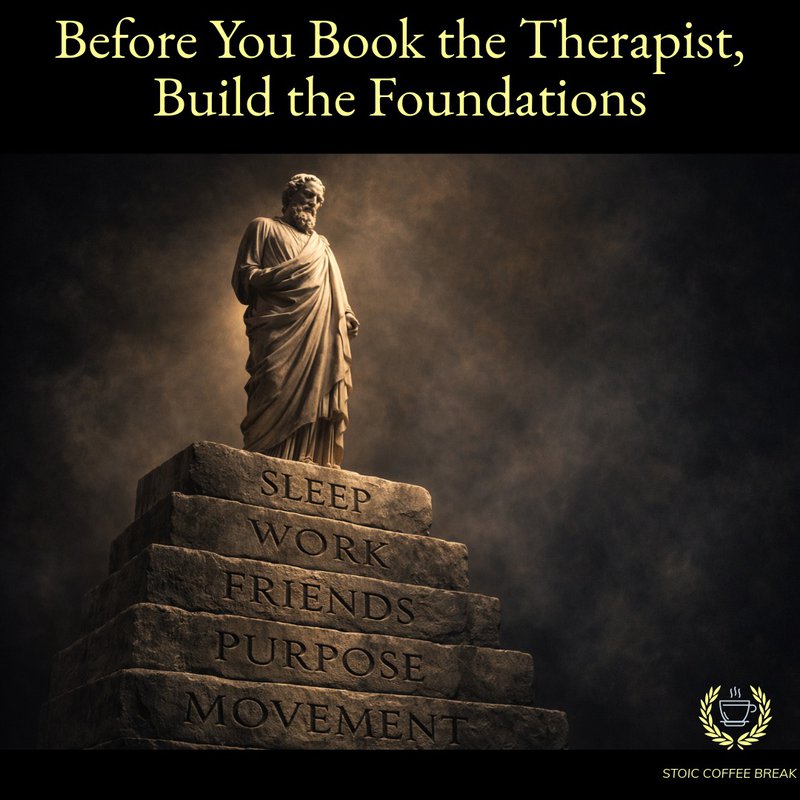
The first category is actual foundations. Sleep. Movement and exercise. Food that's real and healthy. Sunlight. Real friendships — not followers, not networks, real friends who know you. Work that matters to you in some way, even if it's small. A sense of purpose larger than your own pleasure. Enough economic security that survival isn't eating your attention.
A simple example of this appeared in my own life just yesterday. I was feeling really moody and annoyed with everything. I tried journalling to figure out what was at the root of it but nothing surfaced. Finally, later in the day I took a nap. When I woke up it was like the world had changed. I felt happier and that pessimistic mood had disappeared. It wasn’t magic. It was just a foundational need that needed to be addressed.
That's the first category. That's the core list.
Foundation Theater
The second category is what I'll call foundation theater. This is the stuff that looks like taking care of yourself, feels like effort, and doesn't actually touch the real problem.
The 4 AM routines. The ice baths. The elaborate supplement stacks and biohacking. Productivity systems that exist to make you feel like you're building something.
And look, I'm not saying any of these things are bad in themselves. Cold water is fine. Getting up early is fine if it actually serves your life. Supplements can be useful. None of this is the enemy.
The problem is when these become a substitute for the foundations. When the ice bath is easier than the hard conversation you've been avoiding with your partner. When the 4 AM routine is easier than admitting you're in the wrong job. When the supplement stack is easier than going to bed at a reasonable hour. When the productivity system is easier than doing one thing that actually matters.
Foundation theater is seductive because it feels like work. It feels like you're doing something hard. But if you notice, the hard things you're doing are always the things that don't require the actual courage. They don't require you to face the thing you're avoiding.
Therapy as Substitute
The third category is therapy-as-substitute. This is using therapy — or any form of ongoing self-analysis — to process a life instead of building one.
And I want to be really careful here, because I am not saying therapy is bad. I said that clearly earlier. Therapy for trauma, for clinical conditions, for specific stuck patterns — that's the right tool for the right job.
But there's a version of it where someone spends years talking about their loneliness instead of calling someone. Talking about their job dissatisfaction instead of looking for a new one. Years understanding their patterns instead of doing anything different. That's the tool being used for the wrong job. That's philosophy's work being asked of a clinical intervention.
Emotional Courage
I'll tell you what worked for me, personally. I mentioned earlier that I found myself talking around my problems in therapy. And what actually changed me was deep journaling. Sitting with a pen and paper and being willing to write down what I actually thought. What I actually feared. What I actually didn't like about myself.
I want to point out this practice is not something I invented. That is the Stoic practice. Seneca ended every day by reviewing his own conduct, writing:
"When the light has been removed and my wife has fallen silent, aware of this habit that's now mine, I examine my entire day and go back over what I've done and said, hiding nothing from myself, passing nothing by." — Seneca
Epictetus echoed this sentiment:
"Admit not sleep into your tender eyelids till you have reckoned up each deed of the day — how have I erred, what done or left undone?" — Epictetus
Marcus Aurelius wrote the Meditations to himself, for himself, as a practice of honest self-examination. This is one of the oldest practices in philosophy.
It's not therapy. It doesn't require a professional. It requires one thing, and it's a thing that's hard but simple: the willingness to be truly honest with yourself.
And that willingness — that's what emotional courage actually is. Not the willingness to optimize or to look disciplined. The willingness to sit with yourself and see yourself clearly.
Here's what I want you to notice about real emotional courage, as opposed to its performance.
Real courage is embarrassingly simple and almost always uncomfortable.
- It is easier to book a therapy session than to call the friend you've been avoiding.
- It is easier to buy a supplement stack than to quit the job that is hollowing you out.
- It is easier to meditate on your loneliness than to invite someone to lunch.
- It is easier to scroll a forum about self-improvement than to go to bed at 10 PM.
None of the courageous things require insight. They don't require understanding. They require doing the thing. Epictetus said it plainly — “if you want to be a writer, write”. If you want a connected life, connect. If you want a healthy body, take care of it. There isn't a trick. There isn't a hack. There's just doing.
Put it Into Practice
So let me give you two ways to work with this. I know my listeners are different. Some of you are more reflective, some of you are more action-oriented, and I want to serve both.
If you're the reflective type, here's what I'd suggest. Sit down this week with a notebook. Not a phone, not a computer. Paper. And do an honest audit.
Write down what's actually troubling you right now. And then ask: how much of this is a specific psychological problem that would benefit from skilled professional help? And how much of it is a foundation problem — a sleep problem, a connection problem, a purpose problem, a movement problem, a money problem?
Be honest. That's the only rule. Don't protect yourself. Don't flatter yourself. Ask, “what am I actually avoiding by focusing on this problem?”
If you're the action-oriented type, here's a different path. Pick one foundation this week. One, not all of them. Just the one you've been avoiding most.
Maybe it's sleep. You know you should be in bed by 11 and you've been in bed by 1 for six months. Fix that. One thing.
Maybe it's connection. Call a friend — an actual phone call, not a text — and make a plan to see them. One call.
Maybe it's movement, so take a 30-minute walk outside every day. One walk.
Maybe it's the hard conversation. The one you already know you need to have. Have that conversation.
Pick one. Do it for two weeks. Notice what shifts. And I promise you — promise — it will shift more than you think.
And let me say one more time, because this matters. If after you've built the foundations — after you're sleeping, moving, connected, doing work that matters to you — after all of that you're still struggling, then yes, absolutely find a therapist. Go get the right tool for the specific job. That's what therapy is for. And please, if you're in crisis right now, get help today. The foundations argument is not for an emergency. An emergency needs emergency care.
But for the rest of us, in our ordinary lives, with our ordinary discontent — most of what's troubling us is not a clinical problem. It's a life problem. And it has an answer, and the answer is old, and the answer works.
Conclusion
Here's what I want to leave you with.
The easier path is always available. The easier path is the one that lets you keep doing what you're already doing. Take a pill to tolerate a life you shouldn't be tolerating. Book a session to process a friendship you should just repair. Buy a course on discipline instead of going to bed on time. Meditate on your isolation instead of inviting someone to dinner.
The easier path has an answer for every problem, and the answer never requires you to actually change anything.
Emotional courage is different. Emotional courage is the willingness to look at your discomfort and ask the harder question. Not what's wrong with my brain? But what's missing from my life? The second question is harder because the answers demand action. They demand that you build the foundations for a good life.
My friend, the one I told you about at the beginning — she didn't need a decade of therapy to understand why she was in crisis. Once she was safe, what she needed was sleep. And she had the courage to make a big change — different job, different schedule, different life — to get it. That's the move. That's what it looks like.
Therapy is a tool. A good one, for the right job. Philosophy is a framework for living. They are not in competition. They are not the same thing. Don't ask either of them to do what the other one does.
You don't need to be optimized. You need to be built.
And the building — the actual, real, unglamorous building — is waiting for you. It looks like sleep. It looks like a walk. It looks like the phone call you've been putting off. It looks like the honest page of journaling where you finally tell yourself the truth. It looks like showing up, today, for the life you actually want to be living.
That's the work. That's always been the work. And no one can do it for you.
The foundations are older than we are, they've been waiting for us the whole time, so start building that foundation.
My book Stoicism 101 is available! Order here!
Find out more at https://stoic.coffee
Watch episodes on YouTube!
Find me on linkedIn, instagram, or threads.
Thanks again for listening!