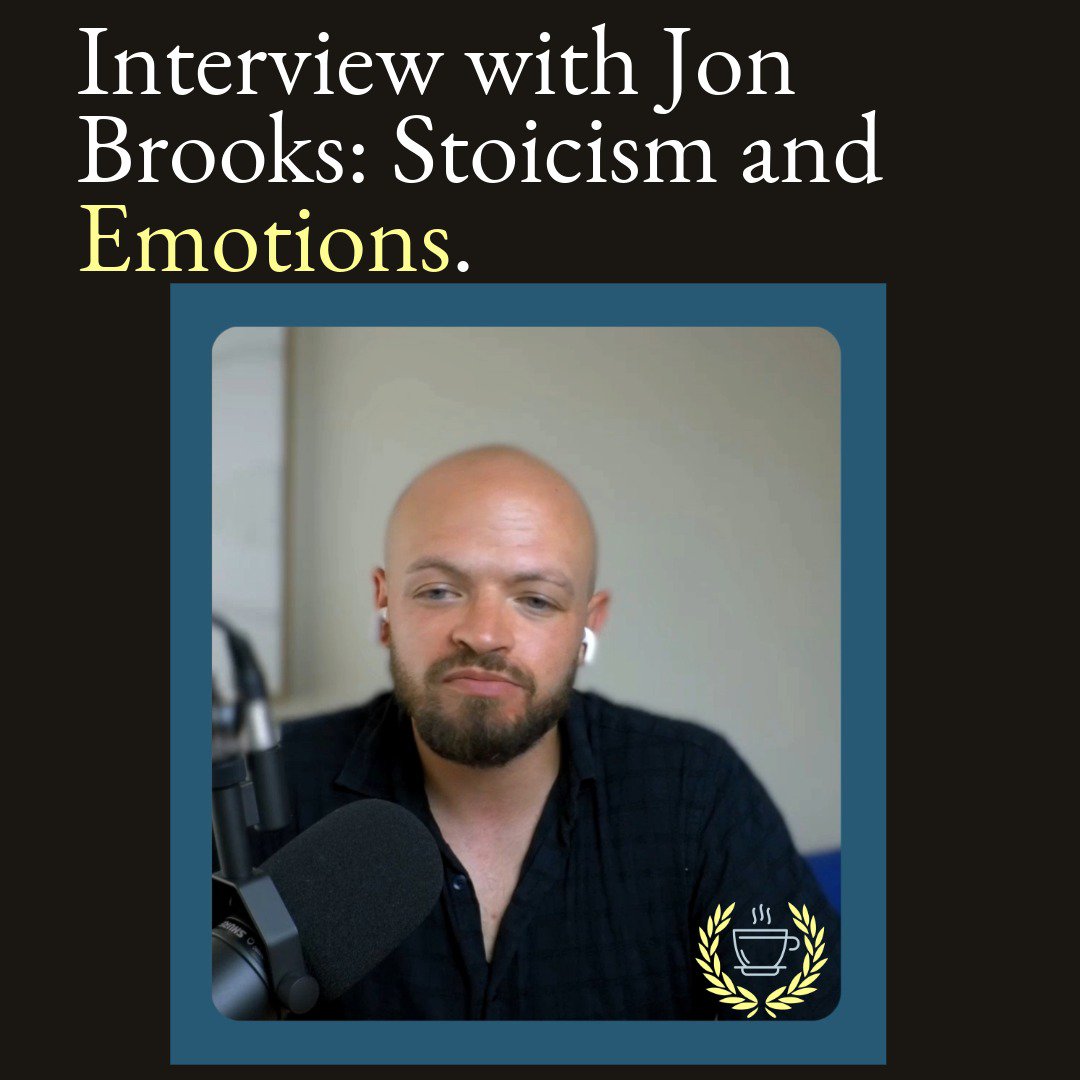
This week’s episode is an interview with Jon Brooks. Jon Brooks is the host of the Stoic Handbook podcast and Substack page. In this episode we talk about the dangers of over-managing your emotions and finding ways to be a good Stoic while not shutting yourself off emotionally.
You can find out more about Jon and his work here:
Transcript:
Erick: Hello, friends. My name is Erick Cloward, and welcome to the Stoic Coffee Break. Stoic Coffee Break is a weekly podcast where I take aspects of stoicism and do my best to break them down to their most important points. This week's episode is an interview with John Brooks. John Brooks is the podcast host of the Stoic Handbook and also writes a lot on Substack.
And a couple of weeks ago, I… maybe a couple of months ago now that I'm thinking about it, time tends to fly during the summer, uh, John posted a note on his podcast, uh, Substack, and it really resonated with me, where he kind of discussed that he was noticing a trend in himself to kind of push things off.
It's something that we stoics often run into, in that things that are emotionally tough because we, we have the ability to manage our emotions, oftentimes we over-manage them, if you could– I guess would be a good term for it. And that he was kind of taking stock of that and seeing how that, you know, how that was showing up in his life and the kind of the good and the bad on it.
And so because of that, I reached out because I also have kind of been struggling with this lately and noticing where maybe I'm, uh, being a little bit too falling into that trap of that traditional stoic or not traditional stoic, I guess the, uh, the traditional image of stoicism. So I invited John to come on our show and, uh, give us, give us some time and, and kind of talk about these issues and see where we end up on that and what we can do about that.
So welcome, John.
Jon Brooks: It's great to be here. I'm really happy you reached out
Erick: Yeah. So John is over, I– where are you located now?
Jon Brooks: Wales
Erick: Wales. Oh, that's right. I kept hearing your accent. I'm like, "It sounds British, but it's not quite British."
Jon Brooks: Not quite British. Yeah, that's right. hard to pin down for people
Erick: Yeah. Yeah, it's the Anthony Hopkins where it's British sounding, but it's softer
Jon Brooks: That's it,
Erick: That's it
Jon Brooks: Love Anthony Hopkins.
Erick: Yeah.
Jon Brooks: yeah, so maybe we can go back to that post. Um, I'd, I'd like to know more about how the sort of stoic bypassing, Jules Evans called it, um, has been showing up for you, and then we can kind of riff off the top of that, and I can share with you how it's coming up for me
Erick: Yeah, I think, um I think it was one of those things that I wasn't sure that I was really noticing until I read this blog post. I read yours, which, which definitely kind of, you know, popped that up. But, uh, just a couple of weeks before that, I was reading this blog post, uh, I wish I could remember her name now.
I-I think she was, like, The Standing Philosopher or something like that on Substack. And she mentioned how in her 20s she had everything that she wanted in life, or so she thought. You know, had– was living with her boyfriend, and he was really sweet and, you know, bring her coffee every morning while she was in the shower.
I was like, "In the shower?" She's like, "Yes, it's a thing." I'm like, "Okay." Um, uh, what else? Uh, had this job that was fairly high status and felt really important with that, but she felt miserable. And so she went to see a therapist and, you know, it's like, "And he kept asking me about my feelings, the bastard," um, and, you know, kept really pressing her on how she felt about things.
And one of the things that he pointed out to her was that whenever she started a sentence, most of the time it was, "I think…" So he would say, "How do you feel?" And she would say, "Well, I think…" And he said, "No, how do you feel?" "Well, I think I feel…" And so, you know, finally s- he– the doctor told her the psychiatrist told her, "Every time that you say, 'I think,' over the next week, replace it with 'I feel,' and see what happens."
And she said it was one of the hardest things she'd ever done, trying to do that exercise of switching from being a thinker to being a feeler and– or at least just being aware of that feeling. And she said throughout that next week, just a lot of things really opened up for her, and one of them was that she wasn't really happy in her relationship.
It's like he was a nice guy, but it wasn't, wasn't– didn't have that spark that she was looking for. And, you know, over the next few months, she really started getting more in touch with her feelings and realized that her job was really soul-crushing, and she was very miserable with that, which was, you know, where a lot of her unhappiness came from.
And it really made me think about how often I, I am just constantly in my head all the time working on the podcast, uh, working on my book, all of– You know, I, I live by myself. I don't have any roommates or anything, and so I kind of get stuck in my head that way and Everything is rationalized. And because of that, uh, because of that kind of epiphany a few months ago, I mean, I did make some changes with some things, and I've been working through some of those.
Um, ended a relationship where, where I, I really liked the person, but it just wasn't sparking me in the right way. And, you know, I kept having to try to justify to myself why I should be in it. Not, not because of anything that she was doing, 'cause she was great, but there was just something missing there.
And if you have to continually justify something to yourself to convince yourself, then it's probably not the right thing. And I felt, I felt awful breaking things off, but, you know, it's what I had to do. Um, but just throughout lots of other things, you know, feeling anxiety, feeling stress, other stuff, finding that I was kind of tamping that down more than just trying to explore it and turn it into something differently.
And so I've been working a lot over the last few weeks and months to just l- try to be genuinely positive, not, not cessation of emotions, but how do I steer my emotions in a different way?
and And, it, it's been tough in a, in a lot of ways. You know, there's been a lot of anxiety because of work and other things like that, or lack of work.
And so I've been looking for jobs and applying to a lot of places without much luck. Um, yeah. And then working on my book, and so just being in my head for, you know, six to eight hours a day for a while is…
Jon Brooks: Yeah Yeah I I feel you on that I've been there Um and I it's something that is quite alive for me at the moment is just coming back into into mindfulness and presence can feel it a lot when I'm with my kids my kids are always a good measurement for my internal state Like how mindful I am my kids will show me really quickly It's easy to distract yourself when it's just you and a computer everything's good Even if you're sleep deprived you you're good You can distract yourself you can work you can entertain yourself When you have to be with a group of children who are wild in the best sense you suddenly realize you're sleep deprived very quickly You suddenly realize that you're not very present You suddenly feel the hand slipping for the phone when you want to avoid a situation one of the things I notice in myself The minute there's like difficulty difficult emotions arise my hand starts creeping towards my phone You know that's
Erick: Hmm
Jon Brooks: of saying I wanna escape into this like digital world instead of be present with the uncomfortable feelings Um so yeah I I I feel you on that When I was doing research into stoic bypassing came across a term called alex alexithymia it's this idea of not knowing what we feel And uh I kind of knew about this concept but I I I started digging into it And the scary thing is with this concept is that you can you can develop it over time by suppressing your feelings So if you grow up in a household where certain feelings are not permitted maybe you've got like a dominant parent or something like that um or you don't feel safe to open up one of the things you will do and it's not a bad thing you will kind of suppress feelings because those feelings are not welcome and they protect it's more protective to kind of push those feelings down because some feelings are unpleasant to feel and they make life difficult then over time as people start to say How are you How do you feel you switch into the thinking mode which you're you're describing because those feelings have now become And I think this links and maps onto stoicism quite a lot because in stoicism w you know we learn this basic theory of emotions You have like an impression In that impression there's a claim about reality and you're told to test that claim Is it true Is it not true Is it within my control or not within my control So you're in your head trying to figure that out and then you assent to it or don't assent to it and then you have passion or emotion And it's very easy uh to just get in your head about this and you start thinking If I'm feeling anxious I made a mistake somewhere I'm a bad stoic You know If I'm feeling stressed I th um there's something wrong with my thinking so I need to think more be able to figure that out And it's like you're not seeing that you've just started another chain of of processing about the stoicism about the processing Um so yeah I'm curious to hear what you think about this but the distinction that I discovered was that you have suppression and reappraisal Suppression is when you stuff down the emotion or passion when it's already arrived and reappraisal is right at the beginning You're sort of redirecting the emotion as you're saying So you're sort of You're noticing the stirring of frustration or the stirring of anxiety come up and then you're working with that and reframing it and redirecting it before it's completely taken over and that I think is a lot more healthy and there's some research to back that up
Erick: Yeah, absolutely. Um, like you, like you described, I can 100% relate to that. So my, my home growing up was, uh, fairly chaotic at times. So my dad was, uh Oh, how to put it in a nice way. Um, he just would have random outbursts of, of violence as well as, you know, just yelling and screaming and shouting. Um, so there was– So it, unfortunately it was, like I said, it was very random, so it wasn't like you were– it was predictable in the way that, you know, if he had been an asshole all the time, then, you know, it would have just known to avoid him as much as possible.
But he would be fine for a while, and then suddenly, poof, something would blow up. And so everything in our home centered around keeping dad's emotions, you know, within check or trying to, which, which was kind of silly because obviously you can't do that, but you can't control whether or not dad's going to get mad.
But it was– everything was always, uh, you know, there became this hypervigilance around what is dad feeling today? What's his mood today? You know, right now, you know, is he going to blow up? You know, and there was just this dancing around like that all the time. And so, yeah, there wasn't really a lot of freedom in many ways to be able to express things like that.
And when my parents finally got divorced, it was suddenly like we, you know, we could all finally start expressing things and talking through, and, and it was just like opening the floodgates. So yeah. So I'm pretty well-versed in that kind of emotional suppression like that because, because of how I grew up.
And so, yeah, a lot of my adult life has been working to understand what I'm feeling, 'cause there are plenty of times when I honestly didn't. Um, with– when I was married, you know, um, oftentimes, you know, me and my ex would be in a, in an argument about something, and I could, I could even be crying, and she would say, you know, "What are you feeling?"
And I'd be like, "I don't know." You know, it's like the body was acting one way, but my brain was completely disconnected from what was going on because that, that emotion was so painful, it just went, "I'm just gonna disconnect from this." And, you know, obviously I'm feeling something because I'm, you know, tears are streaming down my face, but I just felt kind of numb in a way.
And so it's taken years of kind of working through that to, to change that. But it's an easy place to slip into when, when that's a habit that you've learned how to develop well.
Jon Brooks: Yeah the right word there is habit Um you were practicing the habit for on a daily basis for years and the stakes were high so you were motivated to learn this habit Uh I'm sure it gave you great gifts of perception when it comes to other people You know when someone is a bit potentially volatile and you have to watch for the signals You become very good at reading body language which is That is a gift I think that like um that you always get something good from whatever situation you're in um I would imagine you've you're very good at reading the room reading energies sensing when people start to get a little bit angry or tense you know more so than people that never had to learn that stuff Um I don't know if it's true but I did hear that um generally people are really bad at detecting liars and lies but the one category of people that are off the charts good are pe are victims of dem abuse like domestic abuse victims because they've had to master like the perception of reading other people so well Um so I we need to fact check that I did hear it but I thought I thought that it kinda makes sense intuitively why that would be the case
Erick: Well, I mean, it does and it doesn't. So yes, I notice that, but because it's, in a way it's miscalibrated. So oftentimes mild aggression, mild annoyance, mild frustration comes across and is read as anger. So that, you know, so for me, that was something that with my last long-term partnership, that was a real problem.
You know, she'd be annoyed about something, and my brain treated it like, "Oh my God, she's raging mad." And it's like, you know, so there's a miscalibration of, of what it really meant rather than going, "Oh, she's just annoyed, and that's okay." It was like, "She's annoyed. Oh my gosh," you know, "She– Why are you so mad at me?"
And she'd be like, "I'm not. I'm just annoyed." And it's like, "Don't hate me." And it's like, "I don't, I'm just annoyed." And, you know,
Jon Brooks: Yeah
Erick: so unfortunately it becomes miscalibrated in some ways. So yes, you can notice it, but your judgment of it is, is m- you know, makes a mountain out of a molehill, so.
Jon Brooks: Totally Yeah yeah Miscalibrated oversensitized to these um stimuli in the environment Um yeah Well I appreciate you sharing that story uh about how you grew up and it it kinda makes sense why you would have learned the skill of suppressing emotion I think a lot of uh spiritual bypassing goes on you know in the world of meditation Uh I used to work with High Existence and one of our most viral articles was 10 Things Spiritual People Do That Are Total Bullshit and it was just a post highlighting the bypassing that people that are into spirituality tend to do Um it's it's kind of hilarious the contradictions and now there's like a lot of parody in the spiritual worlds on social media kind of like making fun of the people that are overly spiritual because yeah there's there's just contradictions in what they say and and how they act And an example of spiritual bypassing would be something like uh let's just say you're in financial difficulty but you say to yourself The only thing that matters is the present moment You know It's sort of like it's clinging on to some kind of really deep spiritual insight as a way to just not deal with life and I don't think the Buddha would have kind of got behind that You know the Buddha would have been like Hang on a second We're training our mind to be more aware and now you've taken my teaching and flipped it to become less aware
Erick: Mm-hmm.
Jon Brooks: Um and stoicism is a really dangerous one because there's so much thinking involved right There's so much like like but is this within your control You know No it's not so don't worry about it then You know that's a that's a big one People can get into thought loops about that
Erick: Yeah. Yeah, and then, then it comes down to splitting hairs and things like that. You know, it's like, so is this in our control? Is this not? I don't know. And then, yeah. But I think as a, I think as a general rule, you know, it's, it's obviously that's a good thing to understand, and that's part of what drew me to stoicism in the first place, was that I realized that a lot of my frustration was trying to control what other people thought of me.
And, you know, it never, it never really clicked. That's why, you know, I struggled in certain areas and why I felt insecure about things was because of that. And so over time, learning stoicism, working on trying applying that, you know, I'd, I'd had that insight early on and went, "Oh, okay," and then used it as a tool to help me become less worried about that.
Still not perfect at it, but significantly better and find that my life is generally a lot happier because, you know, I'm, I'm not worried if this person likes me or not. If they do, great. If they don't, you know, bummer. Um, but just more of– but also just Just feeling comfortable in my own skin with who I am and that it doesn't matter if other people like me or not.
What matters is if I like me and I'm trying to be a good person. That matters far more than if somebody else likes me or not. And getting to that point of confidence and being comfortable in my own skin like that took a lot of work
Jon Brooks: Yeah Oh it's in The dichotomy of control is so foundational What you said there though is trying to become a good person and that makes that the practice of the dichotomy work Uh I read The Let Them Theory Are you familiar with this book by Mel Robbins recently
Erick: Yeah. I found it a bit repetitive, to be honest
Jon Brooks: So yeah So I was thinking um that The Let Them Theory which is uh a modern take on the dichotomy of control could be used by narcissists and sociopaths right Because you act in a way that's not good that's like not prosocial and then someone gives you negative feedback like Oh hey I didn't appreciate the way you said that and you're just like Let them say that Let them have that negative reaction to me it's missing the foundation of virtue that you know the Stoics had these techniques but it all served virtue The dichotomy of control is a cool technique but you could also use it to become a better assassin thing for mindfulness right You could become a really mindful serial killer you know and just you know focus on the breath before you go out and and murder people why you have precepts you know And the
Erick: Yeah
Jon Brooks: that's why you have virtues Gotta be grounded in that
Erick: Yeah
absolutely. Yeah, I, I thought about it one time. I thought it would be interesting to, to write a, a sci-fi novel where the, the lead character is a stoic who's struggling with his, with his internal moral compass because he's, he's an assassin. And you know, and it's like, "How do I, how do I square these two things?"
You know? And, uh, and thought it would be an interesting moral conundrum
Jon Brooks: I would read that Yeah please please write that That sounds interesting
Erick: But yeah, I, yeah, with the let them theory, like I said, I found that, um, it was very, very thin for me, at least the explanation of it. You know, it was kind of the same idea repeated over and over and over and over. Um, but again, also that lack of accountability that came along with that, and that's where virtue gets into it.
And yeah, so I, I do find that the– I'm glad I'm not the only one who kind of saw that. My mom was, had given it to me for Christmas. She's like, "Oh, I love this book. I think you'll like it too." And I'm like, "Okay." And started reading it, and I'm like, "Oh, this is just dichotomy of control." Uh,
Jon Brooks: Very much
Erick: And, and kind of a repeated, you know, thinner explanation of it than the Stoics.
But I mean, if it, if it gets it out there and people are able to actually get to the heart of the message and keep it aligned with virtue, then I think it would probably be all right. But, um
Jon Brooks: Yeah I so I made a video on the Latham theory and uh I w I bought the book I listened to the audiobook and I and not a single time was the dichotomy of control used as a term in the entire book And the only quote from Stoicism from Epictetus was about it's not events that disturb us but our judgments about them There was no mention of the actual opening of the handbook where he mentions you know So I thought that was a little bit a little bit shady You know there's not much credit being given to uh the the ancients there when it's so clearly inspired You know the fact that you know the Stoics and you mention the Stoics and you quote the Stoics but you don't mention anything about the dichotomy
Erick: Yeah
Jon Brooks: left a little bit of a bad taste in my mouth But quick question why do you think that it was the bestselling book of 2025 when you found it thin What what's going on there Uh you know um why do people love that book so much
Erick: Yeah, I don't know. I mean, honestly, I I think that what we see in our society is that people like easily digestible ideas, and, and she presented it in a way that it didn't take a lot of work. It actually took a lot less work. It was just, "Oh, just let them." And everybody was like, "Oh, it's so easy. Yes, I, it, it changed my life."
And, you know, it's just, uh, th- because it was very low effort, and the real, you know, the real work is actually a lot more effort because you don't want to let other people think what they think, you know, about you. You, you wanna control this, you wanna control that. So it's actually not as simple as it sounds when you really get down to it.
You know, and I'm not overcomplicating it, but I'm just saying that, you know, there comes accountability and responsibility, so you can't just wave your hands and go, "Oh, let them. I can't control it, so pfft." It's like, well, but you also have to hold– call people to the carpet to hold them accountable for things that they do, and when people aren't being responsible, you don't just throw up your hands and go, "Well, they're not being responsible.
Okay." You know? You– So it takes more courage than that, and that's part of that is that when people aren't taking responsibility for what they are supposed to or being accountable, you do have to call them out on it. And, you know, they still can refuse for sure because that's, that's their choice. But, you know, I think a lot of people f- felt like it was just an easy way to abdicate anything and not have to worry about it.
"Oh, I'm just letting them because that's what you have to do." No. Well, b- but like you said, you know, you can't let a serial killer go out and be a serial killer
Jon Brooks: Exactly Yeah I've I've been doing quite a lot of research in recent months into the dichotomy of control cause it's it's one of those concepts I'm sure you know that is kind of easy to grasp on a surface level But many of us can say we've truly embodied the dichotomy of control to the point that we perceive reality through that lens you know And filter all of our uh e emotions and decisions and impressions through that I would say not many Um and a big theme that came up was the difference between like caring and staking your happiness on something So when people first learn about the dichotomy of control they think Oh well I shouldn't care about things outside of my control That's like the big myth like my health is not directly within my control so I shouldn't just care about my health And then they're like But I don't like that I should care about my health so I don't like stoicism It's like not quite We can absolutely care about many things that are not within our control Like we don't control the lives and the happiness of people in a different continent Does that mean we shouldn't care about them Of course we care about them Of course we want them to be okay and we don't wanna see people suffer and we'll do what's appropriate to try and lessen that within our means it's sort of like are you gonna then become depressed and anxious and lose sleep and then deteriorate because of those things Well that's not wise So you can aspire to have good health but if the doctor says Hey you're not very well you go Okay I guess I'm not very well you know I'm gonna try and fix that but you know I'm not gonna crumble because of that news you know And that's that was quite a big insight for me about the dichotomy that people don't quite don't quite get
Erick: Yeah. Yeah, for me, what, what happened when I found stoicism was that I had studied Buddhism years before and found it a little bit too woo-woo-y for my taste, but also just some of the ideas were a little bit hard to grasp, you know, like attachment. You know, for them, that's, that's basically their version of the dichotomy of control, is that suffering comes through attachments to things.
And I was like, "Okay, I kind of get that." But then when I understood stoicism, it finally clarified what that meant, and that was that trying to control things you don't have control over and being attached to them and making your happiness dependent on those things. And that's, that's when it was like, "Oh, here's, you know, here's a much fuller definition or concept of it," and that made a lot more sense to me.
And yeah, so I think that that's, that, that definitely is a big mental leap that needs to come in there like that. And some people, I think s- some people get it, some people don't. Um, you know, they still try and control things, and it's, it's funny for me when I watch TV now because oftentimes when I see people trying to manipulate other people on TV shows, you know, my brain just goes, "Why would you put up with that?"
It's like, they're totally, they're totally manipulating you. All you have to do is step back and go, "Sorry, not, not my monkey, not my circus." But they're so emotionally wrapped up in it, they can't see that they're trying to control this other person when that's something that they can't do.
Jon Brooks: Yeah
Yeah Controlling other people is a big one Um it's kind of uh uh like a lot of us we we wanna believe deep down that we do control other people You know I think there's like a need to to believe that we can influence people like we can influence the world to get validation A lot of social media now is an attempt to control others to get likes You know There's Nobody's on social media like Well I just don't really I can't control any of these people I'm just gonna do me You know And it's like well if you were gonna do you why are you posting 50 pictures you know into like into this space Or why would you not just have your own friends and family and share it with them So that's something that I I But again this is one of the shadows of stoicism that it can make you feel a little bit isolated from others because you feel like not everyone thinks the same way as you Have you ever felt that Like a sort of a distance like a wedge between the way you're thinking and the way other people
Erick: Oh, yeah. Yeah. Um, oftentimes when I see people acting a certain way, and like I said, you know, it's like I can see underneath what it is that's driving them. Is there, you know, when they're arguing with somebody and they're trying to control them like that, and it's like it does create a bit of a distance because I can see the– I can see why they're doing their behavior.
I understand that. And, you know, there's a part of me which is just like, "Why are you doing this?" You know? Can't you see that you're trying to control this other person or you're, where, you know, you're thinking wrong this way? And it, it does kind of separate you out from that because y-you just have a, a different perspective on that.
And, you know, and it's interesting because you can often see their motivations, and you can see the, the kind of the, the thinking and the behaviors underneath. And, you know, it's kind of like you've evolved a little bit, and so you see things a little bit differently. And that's not saying that, you know, I'm putting myself up on this pedestal of, "Oh, I've done this," but I see that I used to be that way, so I understand.
And so it's not that, that I'm so much better. It's just I don't behave that way anymore because that doesn't help me. But I, but I used to, and I understand where you're coming from, and I can see why you're doing this. It just doesn't work for me anymore
Jon Brooks: Yeah Yeah yeah You've you've done it you understand it you experience it there's no judgment Like the Marcus Aurelius idea of seeing yourself in others You know you have compassion for people because that was you once upon a time but you found a different approach of the things that I've I've noticed in myself is that I have a quite a sensitive like virtue radar if I if I can see individuals that are overtly untrustworthy or who don't really who don't value y don't value the idea of becoming a good person You know just like there's something about the way that this person is acting maybe they're gossiping or maybe they you think they're friends with someone and then they start saying bad things about the person that that you thought they were friends with Like little things like that I notice that a lot more now whereas before I would've just been like People are people Um and I think because I'm more aware of that in myself and this idea of you know one of the most important things in life is your character and who you are and your values I tend to notice that more in other people And I do question sometimes if I'm being a bit judgy You know am I being a bit judgy or am I being discerning It's a tricky you know it's a tricky balancing act
Erick: Yeah. Yeah, that, that's always a… Yeah, that's always the balance of things, you know? And, um
Yeah, I don't know if there's any real great way to solve that because oftentimes that's going to be your perspective on it and, you know, where– who's the one who sets the bar for what is, what is discerning and what is judgy. You know, that's, I think that every person kinda has to decide that for themselves.
And this is where philosophy, I think, gets squishy for a lot of people, and that's why they don't like it, is because, you know, in a way, things are relative. We're all w- making up our own scale of w- of, of what things are, you know, what we think is good and what is bad. And, you know, humans don't like that.
They, they like absolutes. They like, "It's either this or that, and w- and we're good." And so when we get in that gray area, that messy area, yeah, that gets tough, and that's where it's a constant work in progress of what is the best way to handle these things. And, you know, what, what worked today, you may change your mind and go, "You know what?
I can do better than that," or, or, "I don't feel good about that thing, so I'm gonna try and do this another way." So… And I think that I, I think that's, that's the ongoing challenge of it, and I think that's why some people, some people, in a way, just give up, and they're just like, "Eh, I just don't care anymore, and I'm just gonna do what I want."
And I think in our current politics, we see, we see that with a lot of people, is that they just, they don't wanna have to take the time and the energy to worry about what it means to be a good person. They just want to act the way that they wanna act and feel okay that the way that they're acting is, is, is fine.
And, you know, we can see, unfortunately, in our president that he do- You know, he's kind of the worst example of that, that, that he just does whatever he wants and doesn't care how it hurts or impacts or anybody else, that as long as it benefits him, it's okay. And that, that completely self-centered approach to life, and other people have latched onto that because they like that too, because they don't like feeling bad that they're racist, or they don't like feeling bad that, you know, that they would rather, you know, act this way.
You know, basically they w- they don't like their conscience, and they wanna get rid of that. And so they use, they use that as an excuse to be able to say, "Well, if he does it, I can do it."
Jon Brooks: Yeah Yeah So you're referencing the president one of the most powerful people in the world Any you know president of the USA is is potentially one of the top you know top most powerful people in the world at least that's how I understand it When we spoke last when you came on my podcast we talked a little bit about the Netflix show Adolescence the manosphere We kinda dipped into that and then
Erick: Yeah.
Jon Brooks: the Louis Theroux documentary came out about the manosphere And I was just like all I could see was stoicism and how antistoic the the manosphere is even though they sometimes quote stoics it's the the vibe I got was they almost turn material worth into a religion Like if I've got a big bank account if I've got a nice car if I've got a harem of women that are models won I've won And you tell me that I haven't cause that's the proof How can you argue with my Lamborghini outside You have a worse car than me so I must be right You know And that's the logic there I must be right because my car's better than yours And it's a it's a really childish way to argue but you can see the the pull of it because nothing you say will change our cars Nothing you say will change our bank accounts and they will always come back to these like static objects a really kind of warped form of logic And um I think you know someone like Trump may in that kind of head space where he might have been rewarded for that way of being you know by acting brash and confident and having no regret and believing he's always right Maybe he got the business deal Maybe he got you know something through the line Maybe he got the the model or whatever and then he's like Oh this is what winning looks like I'm just gonna keep doing it
Erick: Yeah.
Jon Brooks: it And so you know there it
Erick: Yeah. Yeah. I, I read part of, uh, his aunt's document or book that she wrote about him, and, uh, Mary Trump, and yeah, the way that he grew up, his dad was, was a real bastard, to put it mildly, and his grandfather was also. And, but having grown up in that environment, I kind of understand why he is the way he is, and it's, it's unfortunate, but yeah.
Um, but yeah, there's definitely that reinforcement of, well, this worked. The problem is, is that, that he could have been, you know, somebody pointed out he could have been so much more successful if he hadn't acted the way that he had. I mean, he just, you know, constantly screwing people over, constantly not paying his vendors, and making them take him to court before he'd actually pay them.
Um, you know, and just over and over and over, just this really just, you know, not very ethical behavior, to put it mildly. And, you know, but somebody pointed out, it's like if he had acted ethically, you know, the payoffs would've been so much higher. But, you know, my grandpa was kind of that way as well, and he, you know, he had no problem screwing other people over if he thought it'd make him a buck.
And so unfortunately, then he'd burn bridges and then, you know, yeah
Jon Brooks: There's uh like some old conditioning behavior behaviorism where they got like pigeons to tap their beaks a button and then they released pallets of food they they messed with the pigeons where they dropped food randomly You know they had nothing to do with the button pushing But the pigeons started to feel like they knew a pattern would try all double packing you know having spaces between the button pushing though it was completely random they thought they figured out how to get food Yeah and I think that that that maps on well to people as well We feel like Oh because I have some level of success what I'm doing is the only way Like This I've ha I've cracked the code Not There's another way that's ethical and uh if I just did that then I'd be more successful Right You're just like I've figured it out And uh yeah it just uh you made me think of that You know wewe're always like trying to decode patterns just like those pigeons and finding meaning in in the noise and thinking that we've figured it out And it's hard to step back and go Oh mmaybe there's a completely different way of doing things that I haven't thought about
Erick: Yeah. Yeah. And I think that that's one of the things, one of the things that I do appreciate about stoicism for me is that it definitely has helped me with my own critical thinking, because I've become much more aware of my own thoughts and, and pay attention to those things, that I am better at just critical thinking overall than I used to be.
And so I– that's one thing that I definitely appreciate about stoicism is that, you know, I notice, I notice the way that I think, and so I'm able to change it much, in a much easier way because of that. So I wanted to kind of circle back, uh, to what we had talked about, you know, earlier about, you know, because we tend to, as stoics, kind of suppress emotions at times or, you know, that, find that trap easy to fall into.
Um, I know that you, you noticed that you were grabbing your phone, you know, that was kind of your, your main escape path for that. What are, are there any other things you're doing to, to kind of be more cognizant of that and to find more ways to connect em- with your own emotions and connect emotionally to other people?
Jon Brooks: Um Yeah So so the One of the things that I I I've been playing around with is large language models you know and as I'm sure a lot of us have who have a computer you know it's like fun to play Oh look this is magic This is magic technology But I actually can find my mind degrading as I interact with with these I'm learning to skim rather than read deeply Like nobody reads the reply of an AI bot like it's a novel right You're kind of just like Oh skim Uh can I pull that Right supplement should I take Oh skim Oh that one Got it Um you know What how should I think about this situation Okay got it Um so you're training yourself to not be a good listener So then when you're out in public or with loved ones they're talking to you and you're kind of just switching off and just pulling like the most important bit out of it Um you're getting these AI models to think for you which is deskilling us with critical thinking Um so there's a lot of uh potential problems I've been uh cognizant of these things recently So being highly aware and I encourage everyone who is gonna use AI and everyone will as time goes on to just notice what this is taking away from you It's definitely gonna give us great things you know in the realm of health and training and nutrition and science It's gonna be amazing Um you know you you have a a qualified lawyer in your pocket right At any time if you get into some sort of legal dispute boom you get an answer I used AI to help me with a uh like a family legal situation Um solicitors are 250 per hour you know Like that that is not cheap Just for an hour of like Can I talk to you for an hour It's like 250 please You know Um let alone anything else and writing emails and drafting court fees And now you can get knowledge and insight at that level instantly maybe it's not as good but it's definitely 90 95 as good Um and so I'm just becoming more aware um of how I'm using AI more aware of how I'm using technology Um and I'm just noticing what is in the environment that's numbing me and is distracting me and I think I think it's a big problem And because I have kids I need to model the behavior that I want them to have So I did uh some really interesting research as I I was having some intrusive thoughts about my son I was just picturing like him like accidents or hurthurting himself and these like impressions would come and then they'd go thought if I'm gonna worry about anything you know the idea of stoicism is that it's not so so much that you don't have feelings but you just feel things about the right things know Like you have the right priorities So if I'm gonna be concerned and cautious about something I want it to be the right thing So I started doing research into um accidents and issues with children And the first thing that the research said was that the likelihood of a kidnap is 750000 to one you'd have to leave your child unattended for 750000 years for it to be likely So I was like All right we'll cross that off the list And then the big uh the big issues were um uh road traffic accidents and drowning I'm like Right my son does swimming lessons He wears a helmet when he rides his bike Okay we're we're pretty much covered We're checked Um so sort of like learning to uh pay attention and use research to care about the things that matter I have uh a pretty uh epic family I have uh my son who's seven and a half partner she has two daughters that are 9 and 10 and then I we have a baby together who's eight months old Um in the research that I did it said that one of the biggest dangers for children is social media use and technology Now we none of us think that do we We don't think like you know using a phone is a major danger more dangerous than kidnapping You know is it something to be more concerned about than kidnapping But you know everyone's worried about their child getting kidnapped Nobody's saying Keep that phone away from my child You know That like that's a danger That's a danger I know Jonathan Haidt is talking about this stuff
Erick: Yeah
Jon Brooks: and then I'm thinking I've got my phone around my kids I'm con kind of conditioning them to think that that it's acceptable So okay that's something I need to deal with What are the house rules around technology and phones How can I moderate that How can I limit it Um and yeah iin terms of stoicism one of the things that I feel that comes up a lot is the feeling of needing to be perfect with my actions and emotions as a parent as well And with parenting uh you've got some children that have grown up now right You've got some
Erick: Yeah. Yeah, 22
Jon Brooks: Yeah
Erick: and 24
Jon Brooks: Twenty Yeah you talked about your children when we spoke last Um and you you will see that there is just is no book or blueprint that could ever cover every situation when it comes to parenting It's impossible Um you know y I'm got I've got five hours of sleep I've got a baby that's standing up and I need to rush in because she might fall over at any given moment I've got one child that's in a bad mood and is asking for ice cream another child that is complaining that they want ice cream first no clear you you just do this right It's it's chaos It's a mess and you know one of the skills that I learned as a parent is so underwhelming sometimes the best thing you can do nothing You know And just sort of like be there and just contain know and not jump in and be like I'm gonna fix all this but just like Ah okay Yeah I know Yeah I gotta get the baby and I know it it sucks when you don't get ice cream first And yeah yeah you can have ice cream And just just be calm and not do anything instead of trying to be a super dad So there's a bit of a a bit of a spiral there for um your question but feel free to doubleclick on anything
Erick: Yeah. I think, uh, I think a lot of it is just be- getting back to that mindfulness, like you were saying. I think that that's, that's a big key to it because I think it's really easy to, once you kind of learn, like, like you said, the theory of emotions, it's easy to, to quash certain ones because they're uncomfortable.
Um But I think sitting in with them and like I do a journaling exercise every morning and, you know, just write, write for about 30 minutes or so, and just whatever comes out comes out. And I think that that's, that's been helpful. Um, so for me, that's, that's kind of my sitting with it, just letting this emotion be rather than actually trying to govern what that emotion should be.
And
One of the things that I have noticed over the years is that when I find, excuse me, when I find that catastrophizing, that anxiety, you know, starting to kick in because, you know, I'm worried about something and I start to feel that, and there's a part of me that's like, "Oh, I don't wanna feel this," but it is what I'm feeling.
So it's like, how do you, how do you feel the emotion but not get stuck sitting in it? Um, one of the things that I tend to do is I, I call it kind of nudging, and it's this idea of rather than trying to change y- your mood immediately of like, "Oh no, I'm not upset. I'm…" You know, which is kind of a disqualification of reality.
It's, "Yeah, I'm feeling this way, but I can move it a little bit this way." You know, kind of like you're nudging a canoe, and so you don't have to change it 180 degrees if you wanna go a different direction on a canoe. You just have to change it a few degrees, and over time you're gonna end up in a completely different place.
So like think about if you're on the, the side of a lake and you hop in a canoe, just a few degrees one direction or the other is gonna take you in a comp– you know, a very different place on the other side of the shore, depending on how much time you're, you're out on the, you know, how much time it takes to cross.
So this is that same idea of you, you just nudge it a few degrees and get it moving in the right direction of like, yeah, things are a bit stressful, but it's also, it's a nice day outside. You know? You can appreciate that. Oh yeah, yeah, I can. Okay. You know, yes, it's stressful, but you're still alive. You know, finding that gratitude within those things, um, and just recognizing that you can actually literally change your mood.
But what tends to work better, at least for me, is if I do it gradually, that I'm not, you know, going, "Oh, I'm feeling sad. Oh, don't feel sad. Feel glad," you know? Kind of at a, you know… I'm being a little bit hokey there, but, you know, there's… You know, when I was younger, I would often feel depressed about things, and I would try and– I'd feel bad about feeling depressed about things rather than going, "Hey, this is what I'm feeling," and just accepting it and then, you know, working to move it into something else.
It was just, "Oh, I feel bad. Oh, I shouldn't feel bad. I should feel g- great. I should feel glad." And, you know, and it was like forcing myself to not feel what I was feeling because I didn't want to feel that emotion.
Jon Brooks: Yeah Yeah So this is interesting So like lot of us if if you dig dig into it we're going through life and we are trying to avoid the uncomfortable emotions and trying to feel more of the nice positive emotions That's what a lot of us are doing And just accept that as like the only way to be right Like like of course like I have some anxiety That's bad Don't feel that Try and get yourself to not feel that Uh but maybe we can question that and maybe we can say Well who's to say that that is the most important thing to focus in on Maybe there's a bigger game to play that goes above and beyond emotions and I think this is where the voluntary discomfort component of stoicism comes in one of the things that I've I've done is I booked I don't compete very often in jujitsu but I booked a a competition in three months from now and I've booked it so that I can kind of have something in the future to train for I I wanna work on my cardio My cardio has been a weakness for many years so I I wanna commit to doing lots of cardio lots of walking and running and and and biking And when I'm doing these things it feel good You know would I rather be doing something else than walking uphill on a treadmill for 45 minutes You know feeling like you know every 10 minutes that goes by I could easily step off this Yeah but it's also kind of showing me that you know there's there's like positive things in life that go beyond just the the moment by moment emotions You know like there's things like who you are as a person Are you becoming closer to the person that you wanna be Are you getting closer to achieving a particular goal So yeah I do think there there is something about voluntary hardship that kind of trains you to not worship positive feelings That can also be a trap because if you worship positive feelings you're probably going to judge yourself even more when you have the negative ones you you just believe positive feelings are the goal of life But it's like so then what happens when a negative one comes along You're a failure
Erick: Yeah
Jon Brooks: voluntary hardship can can pull you out of that and go Hang on a second There's a different game you can play It's not all about just these feelings that come and go
Erick: Yeah. Well, and, and the other thing is just that, you know, depression is a signal. It can be a gift. It can be saying, "Hey, things aren't working. You need to change what you're doing because this situation is not making you happy." And it's, it's, it can be kind of a wake-up call in some ways of just like, "Hey, this, this isn't good for you.
You need to change something or, you know, understand what's going on here." So I think that, you know, it's, it's really about just being comfortable with those things, and it doesn't mean you sit in it. You know? It's like, you know, if you're feeling depressed, obviously that's a signal that you should probably change something in it.
But also don't get mad that you're depressed or, because then that's, you know, adding, adding insult to injury or, you know, it's, it's piling on top of yourself because you're depressed, and so then you feel more depressed because you feel depressed. And, you know, it can be kind of a cyclical thing there.
Um, but yeah, I think that Especially for a lot of men, and I think this is why the manosphere has their thing, is just that we're not taught to deal with emotions very well and, you know, through our media, through our parents. I remember after I got divorced in, um, 2006 that I, I had to kind of sit down and figure out, "So what now?"
You know, what does, what does my life look like? What kind of person do I wanna be? And really took a look at, at understanding masculinity in a different way because the models that I'd had were from my dad, who was, you know, angry so much of the time. Um, and so for me, you know, that was kind of what masculinity was tied to, was that violence, and I d- didn't like that.
So I'm like, "Well, maybe I can make up my own definition of masculinity and what that really means and, and kind of work through that." But one of the things that I noticed, uh, this is just my own observations, that most men have kind of four states. They have, you know, happy, you know, not feeling bad, but f- you know, feeling somewhat happy, okay, and, you know, which is kind of a neutral state, um, or they feel anger.
So I guess maybe about three states that they have there, or, or nothing I guess would be the fourth state, and that's really where so many things come down to. And so when they have these negative emotions, it all gets funneled into anger. It's like they, they feel grief, it becomes anger. They feel sadness, it becomes anger.
They feel humiliated, it becomes anger. Everything gets funneled through anger because anger feels powerful. Anger feels, um, like you're taking action on something, and so it's the only acceptable negative emotion that a lot of men have. And so I think that a lot of the people in, you know, kind of the manosphere and other stuff like that are actually probably suffering from grief or sadness or humiliation or embarrassment, all of these other emotions, but the only way they know how to express that and to deal with that is to get angry
Jon Brooks: Yeah totally Yeah like the anger is masking over something something deeper you know whether that's fear or grief Um yeah some form of depression Um I think it's also worth sssaying like it's understandable why men struggle with emotions as well you know That it kind of makes sense as well because if you think of the world of dating you know if you think of like a single man uh who's carefree and no responsibilities and all he does is just hang out with his friends and live for himself he's generally appearing to be in a somewhat joyous mood talkative social And then you contrast that with another man maybe he's deep into a relationship There's some conflict in the relationship Maybe there's some stresses at work and he's struggling emotionally and he sees this carefree single man and he's thinking I'm nothing like that know And if I start breaking down in front of my partner look at the contrast here Why on earth would she wanna be with this this man who's like not having fun can't crack a joke everything's so serious So I'm ju actually just gonna act like everything's fine Which is actually not the right move either right Because then you kind of don't release it you don't bond over it um you don't grow from it Um and so yeah there i it's it's it's one of these things that's like much more simple than it seems but also quite hard as well to just go I'm struggling I'm struggling I gotta b gotta be honest I'm having a bad day It's so easy but yet it feels like impossible for a lot of us in the moment
Erick: Yeah. Yeah, I hadn't, I hadn't seen it from that perspective, but yeah, I can definitely see that, that, and I know I've done that in relationships before where, you know, because I was worried that, you know, me showing that vulnerability, that weakness with my partner or whoever I was dating would be like, "Pfft, I'm out of here."
And, you know, which, which, you know, if you– from the stoic perspective is like, yeah, well, if they choose that, that's probably, that's actually a good thing because it shows you what their character is about. And so if that person is gonna bail on you because you're having a little bit of a rough patch, if things got really bad, they'd totally bail on you.
So better they bail out on something small than something big,
you know you know? it's kinda like when you go out on that first date and it, and it totally crashes and burns, that's actually a blessing because then you don't waste time on, on second, third, getting involved in the relationship and then finding out those things later on.
So yeah. Yeah. Emotions are…
Jon Brooks: of,
Erick: Go ahead
Jon Brooks: that example of crashing and burning on a date, like a lot of stoicism comes back to priorities and asking, "What do I want in this situation?" The answer is often, uh, you know, like things related to virtue for the stoics, and wisdom, and courage. if you, if you go back to this idea of you go on a first date and you crash and burn, and then we feel bad, the question is, what do you want?
Did you wanna be validated, or did you wanna meet the right person for you? 'Cause if it's you wanna reet the… meet the right person for you, perfect. You've
Erick: Yeah.
Jon Brooks: one out of the game.
Erick: Yeah
Jon Brooks: validated, so if you only wanna get validated, you've lost that game. But is that the game you wanna play?
You know, because… And, and it puts us in, it kind of reveals to us what are we actually valuing here.
Erick: Exactly. I've always said,
you
know, I figured years ago when, when I was single again, it was like, whenever I go out on a first date, my only goal is to know if I want a second date. That's it. You know, it's, it– So get r- I got rid of expectations. It was just like, you know, 'cause sometimes I go out on a date and I'd be all excited about it, and it would, you know, completely fizzle out, and then I'd feel really crappy and you're like, "Oh," you know?
But once I realized that, no, I don't, I don't have any other expectations of whether or not, of, of I just wanna know if I want a second date. That's it. And if it went really well, fantastic. Then yes, I want a second date, met that goal. But my only goal through that was to know that, and that, that made it much less apprehensive and took so much stress off of the date because I wasn't trying to be something I wasn't.
I wasn't trying to, you know, impress her or, or do any, you know, manipulate things at all because it was just like, I just w- my goal isn't that, to get a second date. It's to know if I want to have a second date. That's my goal
Jon Brooks: Great goal. Yeah, that's a, that's a really good goal. That's just win-win. Everyone involved comes out
Erick: Exactly.
Jon Brooks: like that
Erick: Yeah, because if my goal was to get a second date, then sometimes I'm gonna fail. But if my goal is just to know if I want one, then I'm never gonna fail, and that, that made things much, much easier. So
Jon Brooks: There's a– Epictetus talks about in the "Enchiridion," like don't play games that you are setting yourself up to fail at, you know? In, in other words, you can choose what determines success. That's an example right there. I'm deciding that this is a marker for success. I'm gonna set my own rules, and I'm gonna live according to those.
I'm not gonna inherit society's rules. I'm gonna make my own. So I'm never gonna lose at dating because I've decided either way if I want a second date. I've– I will always win. And this isn't like… I think people might misunderstand that as like only doing things that make you feel good or make you feel like a winner. It's, it's more actually just like the right things, you know? Like, why would you, why would you set yourself up to fail? You're, you're giving too much, um, you're giving too much weight to externals, to fortune, to things that can shift and change, and you're just doomed, you know? C- because one day you will lose. So why not, you know, focus in on what you can control? It's a little kind of nudge to, like, to use your term, focus on the things that you can control. By asking the question, how can I define the rules to this game, to this endeavor, so that I will always win? When you do that, you will naturally be following the dichotomy of control. Yeah, so it's like a, a good way to bring it back
Erick: Yeah. Yeah. And that's, that's definitely a reframe that I try to do all the time. It's not always perfect at it, but it definitely seems to help on things. So I guess we're, we're coming up on time here, so I don't wanna, wanna take too much time out of your day, but I really appreciate you coming on here.
Um, is there anything that you wanna leave with my audience, uh, about what you, what you think, what you discover? Obviously, you've shared plenty of opinions here. I guess probably good parting words or a lesson that's most important to you, especially when it comes to dealing with, you know, getting in touch with those emotions again
Jon Brooks: So first of all, I, I love talking to you, Erick, and I feel like we could just keep going for hours. So I think we, we need– you can come back on my podcast, and we can pick something up again. Um, so I appreciate the invite here and, and the time. Um, so coming back to the idea of being connected with other people and practicing stoicism in a healthy way, one of the things that I've done is I've created a community, and I know you have community too. And the focus on my stoicism community is practicing with others. Uh, and you, you can do this with, like, a one friend, you know, it will still be useful. But the purpose of this and why I find it useful is you stop thinking of stoicism as like a, you did it well or didn't do it well, and instead the only question is, am I practicing? Am I practicing? It's like a dojo or something, right? Like, did you show up to the gym? I don't care what weights you did, you know. I don't care what effort you had. Did you show up? What did you learn? Um, so I do find that to be quite grounding as well, you know, just to practice with other people. Um, you know, there's lots of different ways you can do it, whether that's leave comments on a podcast feed, but just share what your stoicism practice is looking like. Engage with others. Don't be someone that's just, kind of like withdrawn into yourself, practicing alone. The Stoics weren't like that when you think about it, the ancients. They weren't these kind of like– they weren't people that lived in a cave and never talked about stoicism. It's a very social philosophy. Seneca's writing letters. Epictetus has students, and they're kind of going back and forth. And you can just imagine that his students would have gone in looking forward to the lecture. You know, maybe I'm gonna get grilled today. Maybe I'm gonna get an epiphany. Maybe I'll, I'll ask Epictetus a question and, uh, you know, maybe I'll give him some food for thought.
Socrates wandering the streets doing philosophy. Make it more social. Talk about it. Like, what are you practicing? What are you struggling with? Uh, so I found that to be really useful. Um, so that's kind of like the parting tip that I would give, give people. Make it social. Make stoicism social
Erick: Yeah, I like that. I hadn't, I hadn't quite thought about that, but yeah, Socrates was definitely a social philosopher
Jon Brooks: For sure. For sure
Erick: All right. Well, John, I really appreciate you coming on here, and I wish you the best of luck in your endeavors as you, well, take the, take on the daily life that we all have to live and making sure that we're getting in touch with those things that are most important to us and bring that kind of enrichment to our lives.
So also… Oh, I guess before we go on, uh, just let people know where they can find you out on the, the socials, even though we, we talk about the ills of social media, yeah, kind of a thing we do
Jon Brooks: Um, yeah, so I think I have a f- like an audio challenge, stoichallenge.co, that is completely free. So people do like a different Stoic audio track each day for seven days. Um, that's like a good place to start if you just wanna do some Stoic techniques straight off the bat. my website is stoichandbook.co. pretty much it.
Erick: Right. All right. Thanks again, John. I really appreciate you coming on here, and, uh, we'll talk again soon
Jon Brooks: Yeah. Looking forward to it. Thanks, Erick
Erick: All right. So that's the end of this week's Stoic Coffee Break. As always, be kind to yourself, be kind to others, and thanks for listening.
The Build an Unbreakable Mind program for building mental discipline is open!
My book Stoicism 101 is available! Order here!
Find out more at https://stoic.coffee
Watch episodes on YouTube!
Find me on linkedIn, instagram, or threads.
Thanks again for listening!