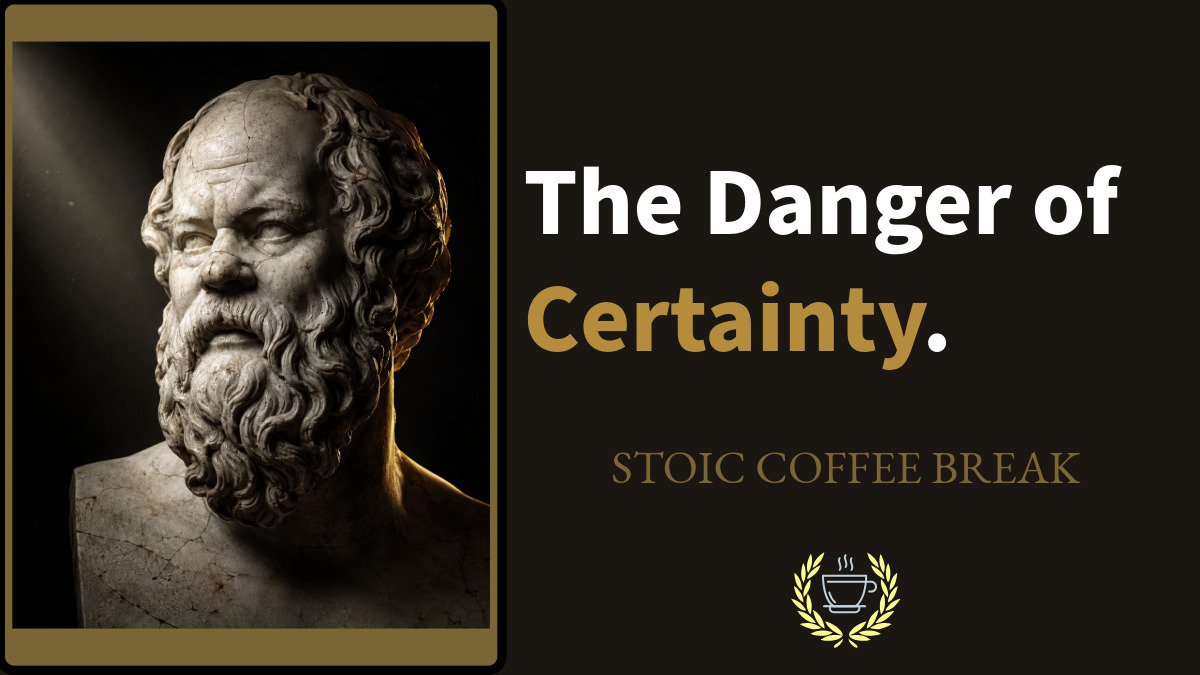

Certainty and hubris have always been part of being human. It feels good to be certain, to believe that your opinion is the right one. We like leaders who sound certain and shun those that don’t. But sounding right isn’t the same thing as having the truth. What if the actual way to truth is not through being certain, but by embracing uncertainty?
“It is impossible for a man to learn what he thinks he already knows.” ― Epictetus
The Problem
We live in an age of certainty.
Open any social media app and within seconds you’ll be hit with confident declarations on politics, relationships, health, ethics, all delivered with the kind of conviction that leaves no room for doubt. Hot takes are presented and settled truth. The more confident the claim, the more it spread.
Certainty is the currency of attention.
But here’s the problem: certainty is a trap. It’s one of the more dangerous traps that we can fall into. Not just personally, but as a society.
When we’re certain, we stop questioning. We stop listening. We lose our ability to sit with complexity and nuance. To consider that we may not be seeing the whole picture. We trade wisdom for the comfort of feeling right.
That comfort is seductive. We like certainty because it feels safe. Ambiguity triggers the same neurological response as physical danger. Your brain would rather have a wrong answer than no answer at all. Uncertainty feels like we’re in the dark. Certainty feels like turning the light on, even if what we see is distorted.
But the cost is enormous. Certainty damages relationships because if you already believe you have the truth, you can’t hear anyone who sees things differently. It damages communities because it turns disagreements into threats. And it damages your own capacity for growth. As Benjamin Franklin reminds us:
“The doorstep to the temple of wisdom is a knowledge of our own ignorance.” — Benjamin Franklin
Being able to sit in uncertainty, to acknowledge your ignorance, is where wisdom starts. Wisdom only comes to someone who is willing to be wrong.
We don’t live in a black and white world, but certainty insists that we do. This isn’t a new problem. The ancient world wrestled with it too, and in one of Athens most cautionary tales, certainty brought down one of the world’s greatest civilizations.
The Philosophy
To understand the danger of certainty, we need to got back to 5th century BCE Athens. What happened there maps almost perfectly to what we’re going through right now.
Like us, Athens was a democracy, which meant that political power belonged to whoever could best persuade the crowd. In this environment were a group of professional teachers called the Sophist.
The Sophists were the original political spin doctors. They traveled from city to city teach rhetoric, the art of persuasion. But here’s the critical distinction: the didn’t teach people to discover the truth. They taught how to win arguments. How to make the weaker case appear stronger. How to use language to emotionally manipulate people, regardless if what was being spoken was true.
In one of Plato’s dialogues, Socrates confronts the Sophist Grogias. Gorgias claims rhetoric is the greatest of all arts because it can convince anyone of anything. Socrates’ response is brutal: rhetoric without truth is flattery. It’s the difference between a doctor and pastry chef. One tells you what you need to hear. The other tells you what you want to hear.
One of the more famous Sophist, Protagoras, said, “man is the measure of all things.” In other words, the truth is relative. There is no objective truth. Only what you can convince others to believe. That idea, weaponized by skilled rhetoricians and handed to skilled politicians, was extremely dangerous. And the politicians lined up to learn it.
This was the environment that Socrates lived in, and he found it repugnant. Socrates had an entirely different starting point. When the Oracle at Delphi declared him the wisest man in Athens, he was genuinely baffled. So he went out to test it. He spoke with politicians, poets, craftsmen — anyone with a reputation for wisdom. And what he found was consistent: they all believed they knew things they didn't. They had mistaken confidence for knowledge.
His conclusion was humble: his advantage was knowing that he didn't know. To Socrates, that awareness, that gap between what we think we know and what we actually know, is the beginning of all genuine wisdom.
He even stated:
“I know that I am wise because I know that I know nothing.” — Socrates
This is the practice we now call the Socratic method. Not debate. Not rhetoric. Disciplined questioning, that is designed to expose false certainty, including his own.
The Sophists hated it. Because Socrates wasn't playing the same game. He didn't care about winning. He cared about truth. And in a culture increasingly addicted to persuasion, that made him dangerous.
It eventually got him killed.
The Trial of Socrates
In 399 BCE, Socrates was put on trial for impiety and corrupting the youth of Athens. His accusers used exactly the tools the Sophists taught — emotional appeals, crowd manipulation, confident declarations. And Socrates, true to his philosophy, refused to fight fire with fire. He wouldn't flatter the jury. He wouldn't perform certainty he didn't have. He argued his case with the same disciplined honesty he'd practiced his whole life.
He was convicted and sentenced to death.
Certainty won. Truth lost.
The Sicilian Expedition
But the consequences of Sophist-influenced certainty weren’t limited to one man's execution. They played out at a civilizational scale in what historians consider one of the greatest strategic disasters in ancient history.
In 415 BCE, Athens voted to invade Sicily. The campaign was championed by Alcibiades, a charismatic, brilliant, Sophist-influenced general who was absolutely certain the expedition would succeed. His confidence was intoxicating. The Athenian assembly, swept up in collective certainty, voted yes despite almost no strategic justification. The one voice of caution, the general Nicias, was overruled.
The entire Athenian fleet was destroyed. Tens of thousands of soldiers lost. Athens never fully recovered. It was the beginning of the end of Athenian power.
That is what happens when persuasion beats wisdom at a civic level. When certainty is more valued than careful thought.
The Stoics
The Stoics, who came roughly a century after Socrates, inherited his epistemic humility and built it into the foundation of their philosophy.
The Stoics picked up Socrates' practice of questioning everything and formalized it. Epictetus makes clear that the first discipline is the discipline of assent. You don't just accept impressions, you interrogate them:
“You can process in your intellect and senses a wealth of thoughts and impressions simultaneously. There are impressions that you assent to, others that you reject; sometimes you suspend judgement altogether.” — Epictetus
Marcus Aurelius writes repeatedly about suspending judgment. The Stoic concept of kataleptic impression (a true, reliable perception) was important precisely because they understood how hard it is to actually know something.
Where the Sophists said truth is whatever you can convince people of, the Stoics said the first obligation of a rational person is to interrogate their own impressions before accepting them. You don't just receive an idea and run with it. You examine it. You question it. You ask whether what you're seeing is actually true, or whether you're being moved by emotion, by habit, or by someone else's rhetoric.
Marcus Aurelius, writing in his private journal, returns to this again and again. In Meditations, he writes something remarkable for the most powerful person on earth:
"If someone is able to show me that what I think or do is not right, I will happily change, for I seek the truth, by which no one was ever truly harmed. It is the person who continues in his self-deception and ignorance who is harmed." — Marcus Aurelius
Think about that. The most powerful man in the world, holding his beliefs lightly enough to be corrected. That's philosophical courage.
Seneca makes a parallel point about consuming ideas. In his Letters to Lucillius, he warns against absorbing too many opinions without digesting them or taking the time to develop you own discernment:
“It is not how many books thou hast, but how good; careful reading profiteth, while that which is full of variety delighteth.” — Seneca
It’s the ancient version of doom-scrolling through confident hot takes and mistaking exposure for understanding.
And the politicians who traded in certainty? The Stoics were clear-eyed about them too.
Thucydides, the great Athenian historian, wrote about a demagogue named Cleon with barely concealed contempt. Cleon was loud, certain, and crowd-pleasing. He argued for the extermination of the entire population of Mytilene after a revolt. The Athenians voted yes, whipped into certainty by his rhetoric. They reversed the decision the next day, barely in time to stop a massacre.
The Sophist playbook hasn't changed in 2,400 years. We see it in our own politics today. Confident framing. Simple villains. No room for complexity or nuance. The certainty itself is the product. It makes followers feel safe, chosen, and correct. Questioning it feels like betrayal.
You would think with all the advances we’ve made as humans we would have moved past this. That we would adopt a more logical and rational way of conducting ourselves. But while technology and society have advanced in many ways, human nature hasn’t. In fact, the ability to exploit human nature has gotten worse.
The Sophists were dangerous to Socrates not because they were wrong about everything, but because they didn't care about being right. They cared about being convincing. That distinction matters enormously and maps perfectly to modern media.
Demagogues, politicians, and influencers, use modern media to exploit our desire for certainty. Masses are moved not by what is actually good and virtuous, but by what they can be convince of. Those with power, wealth, and influence use this to advance their own agendas, rather than well-reasoned virtuous choices that contribute to the greater good.
And looking arrund, you don't need me to tell you where you see that today. You already know.
The Practice
So why is certainty so seductive? If it's this destructive to us personally and as a society, why do we keep reaching for it?
Because it does something powerful for us. And we need to understand what that is before we can do anything about it.
The first thing certainty gives us is identity. When a belief becomes not just something you hold but something you are, questioning it feels like self-destruction. I saw this growing up in a high-certainty religious environment. The entire framework was built around having "the truth”, with a capital T.
And that certainty wasn't just theological. It extended into everything. Your community, your family relationships, your sense of purpose and meaning — all of it rested on the foundation of being certain. Doubt wasn't just uncomfortable. It was an existential threat. Because if you were wrong about this, what else were you wrong about? Who were you without it?
That's not unique to any one religion or ideology. It's the structure of all high-certainty systems. The belief and the identity become fused, and once that happens, evidence stops mattering. You're no longer evaluating truth. You're defending yourself.
The second thing certainty gives us is belonging. In any tribe, whether religious, political, or ideological, certainty is the price of admission. Expressing doubt signals that you might not be fully committed. That you might be a threat. Communities enforce certainty not because they're malicious but because shared belief is the glue that holds them together. Questioning it publicly is a social risk most people aren't willing to take.
The third thing certainty gives us is status. Confidence reads as competence. This is well documented. People consistently rate confident speakers as more credible, even when they're wrong. The Sophists knew this 2,400 years ago. Every cable news anchor, every algorithm-optimized headline writer, every podcaster who leads with a hot take knows it. Certainty performs well. Nuance doesn't.
So how do we fight something this deeply wired into us?
The Stoic answer is practice. Deliberate, repeated, uncomfortable practice.
Practice 1
The first practice is to pause. Before you share a confident claim, repost a video, or repeat that hot take, stop. Ask one question: how do I actually know this is true? Not "does it feel true?" Not "do people I respect believe it?" But what is the actual evidence? This is the discipline of assent in daily life. It only takes a moment, but it changes everything.
Practice 2
The second practice is inversion. When you find yourself certain about something, ask: what would have to be true for the opposite position to be right? Not to change your mind necessarily, but to genuinely understand the strongest version of the counterargument. If you can't articulate it, you don't actually know what you believe.
Practice 3
The third practice is deliberate exposure to disagreement. Find one credible voice that sees your most confident belief differently. Not a strawman argument putting forth the worst version of the opposing view. Find the most serious, thoughtful person who disagrees with you. Read them. Deeply.
John Stuart Mill wrote one of my favorite quotes ever that clearly explains why this is important:
“He who knows only his own side of the case, knows little of that. His reasons may be good, and no one may have been able to refute them. But if he is equally unable to refute the reasons on the opposite side; if he does not so much as know what they are, he has no ground for preferring either opinion.” — John Stuart Mill
This is what Socrates did. He went looking for people who might prove him wrong. He believed it was better to lose an argument learning the truth, than win and still be ignorant or wrong. That's not weakness. That's intellectual honesty.
Practice 4
The fourth practice is media literacy as a Stoic discipline. When you encounter a confident headline, treat it the way Epictetus treated impressions. Don't accept it immediately. Ask who benefits from certainty here. Ask what's being left out. Ask whether the confidence in the framing is proportionate to the actual evidence. Certainty in headlines is almost always a sales technique. You're being sold a feeling of knowing. The Stoic practice is to notice that and step back from it.
None of this is comfortable. Sitting with uncertainty, holding your beliefs lightly, genuinely entertaining the possibility that you're wrong, these things feel like weakness in a culture that rewards confident declarations.
But here's what I've learned: the people who've actually done the work, who've examined their beliefs, who've been willing to be wrong, who've rebuilt their understanding on something more honest, have a kind of groundedness that those who certain never do. Because their foundation isn't the belief itself. It's the integrity of how they arrived at it.
That's what Socrates had. That's what Marcus Aurelius was practicing in his journal. That's what the Stoics were pointing at.
Not the comfort of certainty, but the courage of honest inquiry.
Conclusion
Socrates was the wisest man in Athens not because he had the most answers, but because he was the most honest about what he didn't know.
He lived honestly in a culture that punished it. He practiced disciplined uncertainty in a world that rewarded confident performance. And it cost him everything — his reputation, his freedom, and eventually his life.
The Stoics carried that torch forward. Not as martyrs, but as practitioners. They built epistemic humility into a daily discipline. The pause before assent, the interrogation of impressions, and the willingness to be shown they were wrong. Marcus Aurelius did it on a battlefield, running an empire, and under constant pressure to project certainty that was expected of an Emperor. He still wrote, privately, that he was willing to be corrected.
That's the standard. Not perfection. Not permanent doubt about everything. But the ongoing practice of holding your beliefs honestly, lightly enough to examine them, and seriously enough to act on your best current understanding.
We live in a world that is going to keep selling you certainty. The algorithms reward it. The politicians weaponize it. The headlines traffic in it. And some part of your brain is always going to find it appealing, because uncertainty is uncomfortable and certainty feels like solid ground.
But solid ground built on false certainty is just a comfortable trap, keeping you in ignorance.
The Stoic path, the honest path, is harder. It requires you to sit with not knowing, and say "I might be wrong about this." It means that you genuinely listen to people who see it differently, and interrogate the confident claims that confirm what you already believe just as rigorously as the ones that challenge you.
This week, pick one belief you hold with certainty, and ask yourself honestly: have I ever really tested this? Have I sought out the strongest counterargument? Do I know this, or do I just believe it?
You don't have to change your mind. You just have to be honest about the difference between knowing and believing.
That's where wisdom starts.
The Build an Unbreakable Mind program for building mental discipline is now open for enrollment!
My book Stoicism 101 is available! Order here!
Find out more at https://stoic.coffee
Watch episodes on YouTube!
Find me on linkedIn, instagram, or threads.
Thanks again for listening!