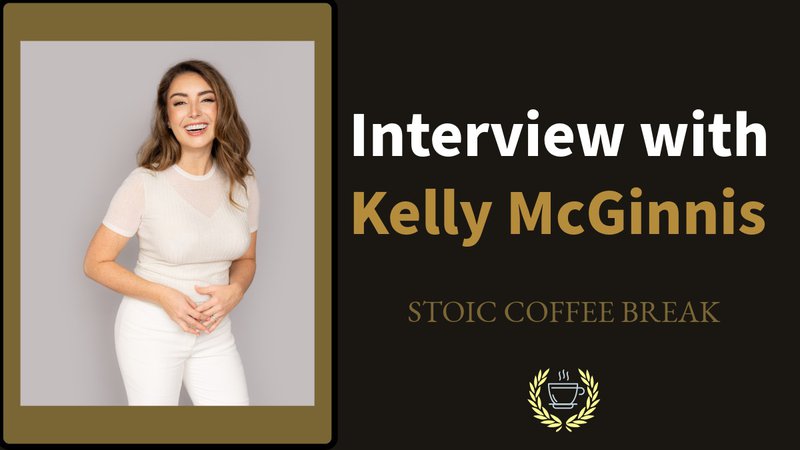
Kelly McGinnis spent two decades navigating the most complex systems in the Fortune 100 arena, from driving digital transformation to unlocking billion-dollar opportunities as a CFO and President. I have worked with teams all over the world. Today, she help leaders stop "getting back to themselves" and start integrating their professional superpowers with their personal reality. She focuses on what truly matters so you can stop sweating the small stuff and start leading from a place of steadiness.
Transcript:
Erick: Hello, friends. My name is Erick Cloward, and welcome to the Stoic Coffee Break. So the Stoic Coffee Break's a weekly podcast where I take aspects of stoicism and break them down to their most important points. This week's episode is an interview with Kelly McGinnis, and even though it sounds like a great name, McGinnis, it's not Guinness like you would want Guinness to be.
But that's okay. We'll still have a good time here even if we're not drinking beer. So, um, rather than me introduce Kelly, I'm gonna go ahead and let her introduce herself so that she gets all the facts right rather than me fumbling over them. So go ahead, Kelly
Kelly McGinnis: Sure. Great, Erick. Thanks for having me. So I'll start with I've been a founder for approximately a month a very long, uh, ascent up the corporate ladder, mostly in the life sciences industry. Pretty much learning everything that I can do right and go- and do wrong for that matter, and mostly learning from the do wrong. And ultimately decided few months ago to start my own path, and I, I think being able to forge the future the way that I want it and the manner in which I want it is, is really my path. So you're, you're finding me in this season of change myself
Erick: All right. So I know that you worked for Thermo Fisher, I think it was? Yeah, went from, uh… Ended up being CFO there, and then eventually moving on to president. So, and I re- I think they have a location here in Portland. So when I was first here, yeah, when I was first moved here back in 20- or 2004, I remember I got a job, um, just outside of Beaverton, and in the same building, there was a Thermo Fisher thing there.
So I do remember that, so
Kelly McGinnis: Oh, yes. It's us and Nike and other semiconductor basically, I remember Portland
Erick: Yeah. Well, there's also Adidas has got a big headquarters here. Uh, Under Armour has a big campus over here as well. So the big shoemakers are, a lot of the big shoemakers are here. Um, so where I live is up in Northwest, and Adidas has a big outlet store about half a mile from my place, so,
Kelly McGinnis: Okay,
Erick: my son was working there for a while, and so he…
I'd go over, over every now and then, and we– he had, get a discount, and we'd, we'd do that, so that was kind of fun.
Kelly McGinnis: Absolutely
Erick: yeah. So a lot of your stuff that you talk about, so I know that you wrote a book a while back, um, Becoming Whole Again. Um, so it's very much about kind of high-achieving mothers and how they lose themselves.
And the Stoics would say that we often suffer when we're attached to an identity that isn't ours. So do you think that the crisis isn't loss of, isn't loss of self, but finally confronting parts of which of your old self were never really you?
Kelly McGinnis: I think it's a little both. And, and I think based on my experience, first of all, I wrote the book I was struggling myself. And oftentimes, if I'm struggling myself, I have to write about it. Writing is therapy t- for me. And so I wrote it I just couldn't figure out why I felt I was failing in my mind in everything.
I was failing as an executive, in my own mind. I was failing as a mother, in my own mind. And wasn't 100% of either way. I was missing things at work, and I wasn't there all the time for my son. And I just hated every moment of feeling like I was failing on both sides. And what I found over time is that the identity I created for myself, which is successful executive rising to the top as fast as I possibly can, because mostly I grew up working in fish markets and had enough to eat, but I, I wasn't, I wasn't thriving by any means. And so I thought I had to strive for this thing, and I created this identity for myself that looking back now is completely meaningless at the end. it was a whole process for me to re-figure out who I was, but it wasn't either/or. And, and that's what my writing was about, and that was my, what my own journey was about at the end
Erick: So do you feel like you had a lot of imposter syndrome based around that because you had set out this identity for yourself and then it was a mask you were putting on?
Kelly McGinnis: Absolutely. Yeah, and I think as everybody does, they're shaped by their upbringing, I think. And I had a wonderful childhood, but I went… I'm from a beach town called Cape Cod. I don't know if you're familiar. It's in Massachusetts.
Erick: Been there.
Kelly McGinnis: You've been there? Okay.
Erick: Yep
Kelly McGinnis: if you've been there in the summertime, you realize there are the locals and there are the summer people.
And the summer people, I would look out, I worked at a fish market, I would look out at the beach, which our fish market was by the beach, and say, "These people have the life. It is a Tuesday at 2:00 PM, and they're chilling on the beach." And that's all I really wanted to do, and we're shaped by that. And so throughout my career, I always had the feeling of why me?
Like I, I don't have anything that these people had, and so why me? But it kept working. I kept working really, really hard, and it kept working, and I kept getting promoted in my mind despite all of those things, not having the credentials. And I think even when I had my son, who's almost three now, I kept thinking, w- what, I, I'm gonna be a terrible mother.
What, in what world would I be a good mother because all I've ever done is work? And, and so you just convince yourself that you're less than throughout the whole process. I think everybody does
Erick: Yeah, very much so. I remember when I had my kids, I was, I was terrified. So because I grew up in a pre- in, in a pretty violent home. It was… I mean, not, not all the time, which was kind of the problem. Like, if, if there… And I, you know, I remember, uh, I think it was Wil Wheaton talked about this, that in a way it was helpful that his dad was kind of an asshole all the time because then he knew exactly what to expect.
He's like, "I knew my dad hated me, and so I never w- never had to worry about what his reaction was gonna be about things because that's just who he was." Whereas my dad was fine a lot of the time, and then would just completely out of the blue blow up over something that, you know, you're like, "Why is… W- what's going on here?"
And so it was th- it was that, that unpredictability that became very challenging
Kelly McGinnis: Oh gosh, that's the worst
Erick: Yeah
Kelly McGinnis: including in leadership. Unpredictable people are the worst. They set everybody on edge
Erick: Yeah, exactly. And that's… I've… So I've been thinking a lot about leadership and, and maybe I'll kind of run this by you, but part of the reason why stoicism works so well is because it's, it's based on virtue. Everything is all about, you know, wisdom, courage, justice, and temperance. You know, you make decisions that are wise.
You know, use your, your critical thinking skills to find out the best solution and, and be okay with not knowing and being okay with being ignorant about things. I mean, that was what Socrates' superpower was, is he's just like, "I don't know anything, and so I'm gonna ask a lot of questions as if I'm an idiot so that I can try to understand this in a bit."
Um, obviously justice, meaning fairness and consistency in how you treat everybody everywhere. And then courage, obviously stepping up and doing the right thing even when it's hard. And then temperance is finding that balance of all of those different things. But what I realized in talking with different people about it is what these things do, especially the consistency portion with temperance and justice, is it creates high trust.
You know, it's like if you have a curmudgeon on your team, but he's always a curmudgeon and you know exactly what to expect, that's, that's fine. You know? As long as they're dependable, they can be a curmudgeon and you're… you still love and care for them because they are predictable and they are consistent with who they are.
It's that unpredictability that I think causes the biggest problems. But in talking about that, I realized that really what makes any organization, whether that's a family, whether that's a team, whether that's a company, a band, you know, it's all about trust. And even if somebody's an asshole but you can trust them, that's better than somebody that you like who you can't trust
Kelly McGinnis: Yeah, and, and I think, I don't know if you've seen it, but Simon Sinek had this great talk and four by four map where he ma- it was a, it was a Team 6 I think was the context. have s- I'll, I'll explain it real quick, but it's, it is astounding in that when you ask the SEAL Team 6 operators who they'd rather, they would rather the average performer. Obviously
Erick: Yep
Kelly McGinnis: super high performance. Obvious, obvious statement of the century. But thing is the low to medium-trust super high performer is worse than the high-trust medium performer. I, it's
Erick: Yeah
Kelly McGinnis: it's so true, and I would take that any day, all day on my teams, and you can see the difference
Erick: Yeah. And the thing is, is, you know, as he pointed out in that, 'cause I- that it, it impressed me as well, and I think I found it after I'd kind of been having this discussion with people, and I was just like, "Really, it comes down to trust." And then I saw Simon's thing and I'm like, "Oh, there it is. Yes, it does come down to trust."
You know, it's… Yeah. And it, it, it was really… Oh, so one of the things that he said on there was, "Skills can be taught. You can't teach somebody to be trustworthy." You know? They have to take on that action. But, you know, somebody can learn to be a programmer, they can learn to be a data scientist, you know, as long as they have an aptitude for it.
But teaching somebody to not be an asshole, that's a much harder task
Kelly McGinnis: It's impossible because if it's inherent in you… I, I've had leaders over the years that were just such assholes, and they would try, right? You can always tell when someone's trying. But if you really are underneath it all, it always comes back, and you seem even inauthentic if you try to not be. Like, it's
Erick: Yeah
Kelly McGinnis: off-putting if someone's an actual asshole, and they're being nice to you.
Uh, it just doesn't reconcile, and people just actively push against it
Erick: Yeah, your spidey sense starts tingling and you're like, "Something's wrong here."
Kelly McGinnis: What's wrong with you? Yeah,
Erick: Yeah.
Kelly McGinnis: Exactly
Erick: and that's the thing. I've had bosses that were… They weren't necessarily the nicest people, but they were consistently who they were. And it was like, "Okay, I can, I can deal with this. As long as they're consistent, we're good." Uh, but my two favorite managers were both very nice people, and they were just…
They were great people, and they were also great leaders. And, you know, and I remember I was writing about this several years ago, and I came up the, with the idea of like, who you are is how you lead. And then a while back, I was listening to a short by, uh, Brene Brown, and she said that exact thing. And I said, "Great minds.
Great minds."
Kelly McGinnis: Exactly. Exactly. Exactly. Yeah
Erick: So, all right. So you talk about leading with clarity or, yeah, leading with clarity without losing yourself, but most corporate environments reward conformity. I mean, so how do you actually hold, hold your ground in an institution that's pulling you in different directions? And yeah, I think that's something that a lot of us deal with.
What do you, what do you think about that?
Kelly McGinnis: I, I think it starts with has to know what they stand for and what their values are. Because I actually think a lot of people haven't quite figured that out yet. And if you haven't figured that out yet, it's really hard to assert yourself or hold your ground in a corporate environment because just inconsistent, getting back to your point of consistency. So I, I've always made it a point around people have to be clear what I stand for, what my important values are, and then what is secondary to me. if I'm clear that when I push back or I say, "Hey, I'd rather not do this," or, "I'm not gonna have my team do that because of this, this, and that," there's a consistency to it.
The leaders that fail at this, get, getting back to your point, are the ones that pick this battle one day and this other random battle some other day, and then some other random thing. And it, it just at a certain point I remember asking, I remember asking one of my peers, "I, it seems like you just like to fight battles.
I can't tell what you care about." And I think that's a huge issue, frankly
Erick: So why do you think, why do you think people are that way? I mean, what is it about, what is it about some people that they do decide what their values are and they're able to hold onto those things? And what would you tell a leader to understand what the difference is between, you know, the values that are important versus why they might pick a fight, but it's not necessarily value-based?
Kelly McGinnis: So I think I have a saying that I tell people sometimes. Some people are committed to being right versus committed to doing what they value or where their virtue lies or whatever. They're just committed to being right, and they will fight and fight and fight, and the value in it is only that they want to be correct or right versus they actually wanna move something forward. we've all probably met the type. They exist. And so from that standpoint, I can pick those people out pretty quickly. And I
Erick: Mm-hmm.
Kelly McGinnis: if I meet a person like that, I actually don't engage much because if someone is committed to being right, they're gonna do or say and continue for as long as it takes to be right.
And frankly, they're committed to being right, they could lead an army or a team, so to speak, in the completely wrong direction, which makes them an absolutely terrible leader. so I think really figuring out every… And even when I fight and even with my husband, fighting because I just wanna be right 'cause I kinda know I am, and I just wanna fight even though it doesn't matter? Or does this actually matter to me? And picking your battles is super, super important. That's why I tend to think leadership and life is kinda one and the same in a lot of these things
Erick: Yeah. Yeah. Yeah, very much so. I think that it comes down to being able to lead yourself in that way. And I remember, um, like there was a conference that I gave or that I went to in Amsterdam. I was asked to lead a workshop there, and they had kind of three statements, and they were just kind of switching the words around, but I thought it was interesting.
You know, it's like, first, are we doing the right things? Meaning are we… Are the, are the activities that we're doing the correct activities to reach the goal that we want? Then the next one was, are we doing those things right? You know, meaning is the quality of our work where it should be? And then lastly, is this the right thing to do?
You know, that's kind of the overarching thing, and I always thought that was really interesting. And I think that, that fits along with there because, um, oftentimes I've been on teams, and I know that I've done this myself when I was younger and I was, you know, a little bit headstrong about things, that I would fight for my idea rather than fight for the right idea.
You know, when we were, when we were working on a problem, we're like, "Okay, how are we gonna solve this?" Because I was a soft- I'm a software developer as well, and, you know, working through an engineering problem, we'd be like… You know, sometimes I'd be like, "No, no, this is the right solution," and it was… I had to fight to get that solution, and then later on it was like, "Oh, that one wasn't really the best one.
Maybe we should've gone this way with it." And, you know, I like to… One of the things I like to stress is that even if you win, if your team loses, you've lost. It's really that simple
Kelly McGinnis: Absolutely. Do you think you were doing that for competition, or is it just must be right all the time?
Erick: Um, a lot of it was because of insecurity. Because I felt like if people disagreed with my ideas and my opinions, then they were… They weren't just rejecting the idea or opinion, they were rejecting me.
Kelly McGinnis: Oh. Yeah. Yeah
Erick: And so for a long time, uh, and this was something that I act- I actively had to work on that, was to recognize that, you know, if somebody doesn't like my opinion or agree with me on something, that's okay.
Kelly McGinnis: Mm-hmm.
Erick: my opinion, and what they're have, what they think about something is their opinion, and I probably don't agree with that, but it doesn't mean I don't like them. So why would I, you know, if, why would I think it's the other way around, that if they don't like my opinion, they don't like me?
Because I can hear somebody's opinion and be like, "That's dumb, but still love you anyway," you know? And, but it, but when you're insecure like that, you need other people's validation, and part of that validation comes from when they say, "Yeah, that's a good idea. I agree with you on that." And so learning that it's okay if people don't agree with you, and being able to just let that go, and that was, that was a hard lesson to learn.
Kelly McGinnis: Yeah. Yeah, that's so true. I've been there too. I totally get that. It's hard to grow out of it. You just have to grow out with experience. I don't know. I've never met a sub 30-year-old that does that properly. I definitely didn't.
Erick: Yeah
Kelly McGinnis: know. I don't know. Maybe I was, maybe I was late 30s before I figured out fully how to do that
Erick: Yeah, I was probably early 40s, so I dated a gal and, and, uh, one of the things that I noticed was that in conversations oftentimes I would overrun the conversation, and then people kind of check out and I'm… And I noticed it and I mentioned to her one time and then we're, we're out to dinner with some friends and on the way home she goes, "Remember how you said, mentioned that thing?"
And I was like, "Yeah." She's like, "You did it again." I'm like, "I did?" And I thought through and I was just like, "Oh, I did." And she's like, "Hope you're not mad at me telling you that." I'm like, "No, no, I know I'm trying to change that, so thank you for pointing that out." And so I wrote the number three on my wrist for a while, and what that meant was when I was having a conversation with somebody, I had to ask at least three questions
Kelly McGinnis: That's a good idea
Erick: Yeah.
And I didn't always get to the three questions, but I at least got one or two, and it made me much more cognizant of that. And then I worked on… And that was just the, kind of the surface issue, and then I worked on the core issue, which was I just felt insecure and wanted people to like me. And then once I realized that the reason I didn't think other people liked me was because I didn't like me, then I was able to go, "Okay, I need to work on liking me, and then it doesn't matter if other people like me or not.
Kelly McGinnis: Yes
Erick: I don't need that validation, but the reason I need it is because I'm not getting it from myself."
Kelly McGinnis: Oh, yeah. Yeah, it's all connected. Totally. Yeah
Erick: was your biggest insecurity? I mean, you talked about feeling like an imposter when you were in these different positions. I mean, you had the credentials, you were obviously hired for those positions. What was it that, that kept holding you back? Or what w- what was the thinking behind that?
Kelly McGinnis: So I think it came in two waves. The first wave was when I first started out, like my first 10 years in the corporate world, I would… I mean, this is probably the first time I'm admitting it out loud other than to my friends and husband, but I would n- not tell the whole truth about where I was from.
Like I, I felt embarrassed saying I was from Cape Cod. And when they heard Cape Cod and they'd say, "Yeah, summer people," I- it's not like I was lying, but I didn't correct them and say, "No, no, no, no, no, not the summer people. Like, the people that served the summer people." And I worked two jobs through college.
I, I just, like selective just telling everything I thought these kids went to the Ivys and they did this and they summered in Europe and I, I just felt, it's back to the imposter syndrome, but I made it wor- like there, there was no real reason to do that. I don't even think the kids that I was growing up with early in, in corporate would have judged me any differently.
I, I, it was just something I just did. Like no one made me feel like I had to. I just did it bec- because I was uncomfortable. And then it got better for a while, to your point, because when you start getting titles you're like, "All right, I'll start letting people in a little bit more into the real story." then my, I had my son, so now I'm, I had my son at 41, so it happened again. And I remember when I went back to work, so I took the company's maternity leave, which was eight weeks, and then went right back, which is not enough. Another story. But would feel just such a failure because I would show up on Saturdays to take my kid to little Gymboree classes, Mommy Me in here, a playground, this and that, and, and the wom- women would say, "I, I only ever see your husband here," or, "I only ever see the nanny here."
And it was just, I let myself feel the judgment, I took it as judgment, and I translated it and I got angry and I said something probably back that I shouldn't have. It was, "Well, it's nice not to work," or some- I, I said something snarky I'm sure. And you just feel I just felt like, why, why am I doing that and what am I trying to prove?
And so I think imposter syndrome sort of cycles through all the different arcs of your life because i- if, if I just got over it, I would have been fine when I became a mom and wouldn't have let myself feel the judgment, but I didn't. And so probably happen again. I just don't know for what exactly, but it will
Erick: Yeah, and that's one of the things the stoics are really big on is, you know, they talk about the things you can and you can't control. And one of the most important things in there is your reputation, meaning what other people think of you. And when, you know, when somebody comes up to me, they're like, you know, we get to know each other, and they're like, "Oh, I don't know anything about stoicism.
Tell me about it." And like, you know, and I mentioned that, you know, and there are things you can control, like basically the way that you think about things, the choices you make, the actions you take. That's about it. You don't even control your body. You don't control your possessions. You don't control other people.
You don't control your reputation. They're like, "No, no, I can control my reputation." I'm like, "Really? You can control what other people think of you?" And they're like, "Well, w- well, I can do good things." I said, "You can do the right thing. You can be a perfect person, and people will still hate you."
Kelly McGinnis: They will. Yeah?
Erick: And they're like, "Oh, I didn't think of it that way."
I said, "So no, you can't control your reputation. You can control the things that you do, which would hopefully make you a reputable person. But even then, there are reputable people that get slandered, and people dislike them, and there's not much you can do about that. You can only control the things that you have control over, which are the actions you take and the choices you make."
Kelly McGinnis: Absolutely. I, I don't know if you felt something similar, but the more I started posting and just being more out there, the more inevitably you're gonna have someone that's like, "Oh, what you said is stupid," or, "I can't believe you're so out there. You're so full of yourself," or whatever. Fill in the blank. And I let it get to me again, and then I would realize, like, okay, I could say anything. I could say literally anything and it, it doesn't matter, and someone is gonna say it's stupid, and why am I self-promoting, or why am I this, or why am I… people are born to have opinions about something. So I don't know if you felt that way too as you started doing your podcast and otherwise.
Erick: Yeah, when I first started the podcast, I was, wow, I was so insecure. Like, I was so worried about, you know, what are people gonna think of me? Can I say this? Can I act that way? And, and, and, you know, are they gonna think I'm an idiot? Because, you know, it … I started the podcast really as just a practice podcast.
I was like, "Okay, I wanna practice making a podcast. When I start my real podcast, I will have skills to be able to do so."
Kelly McGinnis: Hmm
Erick: And so I, I chose stoicism just because it was what I was studying at the time. I, I had bought a couple of books on it, and it was just something that had really caught my attention and really changed the way that I viewed things.
So, but I always felt like, who am I to talk about this on here and to teach people these things?
Kelly McGinnis: Mm-hmm.
Erick: And my ex-partner was really good, and she was just like, "Hey, you're just, you're the seeker sharing your message or sharing your journey. As you're, as you're learning these things, you're saying, 'Hey, this is what I found,'
Kelly McGinnis: Yeah.
Erick: that's what you're…"
And so I was like, "Oh, okay. I c- I think I can do it that way." And so most of my episodes are, "Hey, this is the shit I'm dealing with this week. Here you go, and this is how I'm learning, how I'm working on trying to deal with it." Um, but yeah, when I get comments from people who are, you know, that are kinda rude or whatever, as much as I try not to, it used to bother me a lot more.
Now I don't really care as much. But if I do anything that anybody perceives as being political, that's usually where I get the hate mail. Like, you
know, talked about, like I talked about having moral courage and watching what was going on in Minnesota when ICE was raids in there, and I just said, "You know, this is just wrong, just plain and simple.
The, the, it's very, very simple, and these people are stepping up, and they're, they're taking moral courage." And I had a few people pile on like, "Oh, who do you think you are? They were breaking the laws," and all this stuff. I'm like, "Even if they were breaking a law, and getting shot in the face does, is not, not appropriate."
And they were like, "Oh, how dare you? You know, you bunch of lefties." And it was just like, like, okay, you know? And it's just… But really it comes down to they have an opinion, and they, for… What I found is that when you get any type of fame like that, people start to project onto you the things that you don't say about things and assume they, because they agree with you on these things, they're, you would agree with them on these other things.
And so when I disappoint that,
Kelly McGinnis: Mm-hmm.
Erick: you know, like Ryan Holiday spoke up about some of the things that Trump was doing, saying, "Hey, look, this guy is not really fit for leadership. You know, these, there, here's these, these documented things." And man, watching, looking the comments on Instagram, and they were piling on like, "Can't believe he's this hardcore left to right left-winger.
He's sto- he can't be stoic and a left-winger." And I'm like Are you… I'm like, okay, stoicism is all about virtue. It's about are you acting wise? Are you being just? Are you being courageous? Are you, you know, practicing temperance and those things? It doesn't have a political affiliation, but if it did, I would tend to think it would be more on the compassionate kindness side, not the white-knuckle your way through, you
know. And so I'm just like, you m- what books are you reading on stoicism that, that you're getting that point of view on it, you know? And so I, I actually did an episode called Stoicism versus Bro-icism, and just talking about some of those things. Because they're just like, you know, it's, stoicism is not about shutting down your emotions.
It's not about being a tough guy. It's, in fact, I think that somebody who can sit with their emotions, can sit in grief, can sit in sadness, and not let it ruin them, that's real strength
Kelly McGinnis: Completely. Completely agree. a lot of people just wanna be angry about something. I've tr- I've, I've actually thought about it a lot, like why do people feel like the feeling of angry makes them feel better somehow? But it is, there's just so much anger right now
Erick: Anger is a very potent, uh, aphrodisiac, if you will. So it feels powerful, but it isn't.
Kelly McGinnis: Mm-hmm.
Erick: And there was an episode I did a while back. Um, so when I first got divorced, I remember I was like, "Okay, I gotta figure out this masculinity thing," because, you know, I had bad examples growing up. I wanna be better. Um, but as I talked with other men who are in similar situations to me, one of the things I found was that men oftentimes have, like, three, maybe four emotional states for the most part, just your average dude.
And that's, um, okay,
Kelly McGinnis: Mm-hmm.
Erick: happy, happy or laughing, you know, about something that was funny, um, angry,
Kelly McGinnis: Mm-hmm.
Erick: sometimes sadness, but generally that gets turned into anger. So what happens is any negative emotion gets swept down into the funnel of anger because anger, you know, grief, sadness, humiliation, all of those things, those feel like weakness.
And so, and people point them out as weakness. So it, those get all funneled into anger because anger feels powerful. Anger is for action. And so, you know, girlfriend dumped you, don't feel sad about it. Get angry about it, you know? It's like, no, feel that sadness. Feel that grief. You know, your, your mom dies.
Oh, you should be mad about that. You know, don't, don't allow yourself to feel sad and cry about that, you know? And so I think that a lot of people, it's not necessarily that they're angry, it's that they feel other emotions and they don't know how to actually process those emotions. So it just comes out as anger because that's the only real negative emotion that's acceptable for men.
Kelly McGinnis: Oh, interesting. A- and it, it's hard not to compare it to what I do with my three-year-old. I, I ask my three-year-old, "How are you feeling?" And if he can't ex- like, he goes through the iterations of, "I feel this, I feel…" He usually just says, "I'm angry." I'm like, "Okay." Even at three. I'm like, "Okay, but about what?" And it's, he, it's like, "Well, I'm sad because Auntie Sylvia did whatever."
Like, that's, that's a different emotion. And so I feel like even as, like, little guys, they're accustomed to just, "I feel angry every time."
Erick: Yeah. Anger becomes the default emotion for anything negative. Um, there was a, a guy I knew who is about 10 years older than me, and his best friend killed himself, and he didn't know how to process that anger or process that grief. And so rather than dealing with the grief and sitting in that sadness, because that was just too overwhelming, it was too much, he just got angry at everything all the time, and little things just set him off all the time.
It was just like, "Dude." But it was because for him and the way that he was raised and, you know, this kind of masculinity, it was that grief and sadness weren't something that, that he w- he was comfortable with or knew how to actually sit with. And so expanding that m- emotional vocabulary is incredibly powerful
Kelly McGinnis: Super powerful. Yeah, super powerful
Erick: All right. Uh, let's see. A couple more questions here that we can go down. Um, oh, okay, here's a good one. So a lot of leadership content is about tactics, how to be seen, how to get promoted. You explicitly are anti-fluff, and what's the internal work that nobody talks about that just actually determines whether somebody becomes a great leader?
Kelly McGinnis: Yeah. So I have observ- have observed over the last 20 years that lots of what people think they get promoted is if I do more activity, like I show up at 6:30 AM and I'm there until 7:00 and I really push my teams and I have all the answers. Those are actually all the things that are the opposite of what gets you promoted. Now, I'm not saying some don't slip through the cracks. Some do. But after, after sitting through dozens and dozens and dozens of promotion reviews to people who get VPs and higher, the ones who are able to say, "Here's all this noise, and I'm not going to do 80% of it. Like really not going to do it, and I'm not going to have my team spin 80% and do it." But there's so few people that do that. There's so many people that show up at work and are just performative about it. And forget, as leaders, even managers who manage, you know, three people, four people, five people, whatever, if you are performative as a manager, your team is also performative. You're training them to be performative. You're not training them to be productive. You're not training them to work on the things that matter most. You're training them to perform, that's exhausting. And those teams nearly always fail. And so I go — I've spent my whole career going out of my way to figure out what I cannot do, meetings I can't be in or meetings I don't want to be in because they're not important for me, um, things that my team should just do.
And you teach them, you teach people that you are not needed for everything. If you're needed for everything, you will never, ever get promoted. I've said that 10,000 times. Nobody really believes me. But if you're needed for everything, you will never get promoted. And so I've really just tried to say that over and over.
It's ha- I mean, it, uh, are examples everywhere. Like in order to actually do this the right, the right way, you need to be in front of me or the CEO and as a leader and not know the answer to something because your teammate is sitting right there and they know the answer. And you have to be comfortable to say, I'm not sure.
You know, hey, Sue, can you let, you know, Mr. CEO know the answer?" It's — nearly nobody does it. I think it's that lack of self-confidence that you were talking about earlier
Erick: Yeah. Yeah, I think a lot of people do try… I, I love that idea of the, the performative productivity. You know, it's like, "Hey, we're looking busy. We're getting…" You know? And, uh, yeah, I think that that… I think that happens a lot. I think that rather than… And part of it is that, you know, it's because we, because we live in an attention economy, and so it's all about are you getting the right attention,
Kelly McGinnis: Yeah.
Erick: you know?
And I think that… I don't know. I think that that's, that's actually a downside to all of this performative nature of things. It's just that it doesn't matter if you have good points or if you're actually qualified, it's like how much attention can you get?
Kelly McGinnis: Yes. Yeah, and do you think there's, across generations, do you think there are difference of how much performance people are trained to do versus others? Or do you think it's just across everybody?
Erick: I think that unfortunately the generations after us, you know, probably have it a lot worse. Because, like, when I was in high school, the stupid things that I did or said or, you know, all these things, they were never recorded. Like, I barely have, like, you know, maybe 10 pictures of me from high school, and then my yearbooks, and that's about it.
So it's like, you know, like we just didn't, we didn't do that. We were so busy just doing the thing that we didn't think about, "Ooh, hey guys, we better take a picture of this." It didn't even occur to us because we were just in the thing. We were just living our lives. And so there wasn't, I mean, you know, I mean, I was definitely performative in that I was in theater and music, so there was, you know, that was part of it.
But I, I mean, I think that people is, naturally have, you know, a performative streak with people. But I think that it's gotten so much worse because it is so much about attention, and I know that there are a lot of kids who talk about they're worried about trying to do things because they're worried about looking stupid, because it's gonna go up on the internet, and it's gonna be there forever.
And so I think that It's, it damages people in one regard, then they don't take risks. Um, and two, it damages them because, you know, again, if it's, you know, if it's not cool, it's not this, not that, even if they do succeed at it, if it's not cool, then, you know, there's a reputational risk with that. Whereas for us, it didn't, it didn't matter.
Like I said, if you, if you said something dumb at school, it'd be forgotten in a week or two. You know? Whereas now, "Oh, so-and-so said this," boom, now it's on Twitter, and everybody's like, "Oh, remember that time you said this?" And they can go search all the dumb things that you said. And I'm so glad that I didn't have that when I was in high school.
Kelly McGinnis: Me too. I have no photos too. Like very little. Yearbook photos. I don't even have any photos of the 2000s really. Like, especially the early part of the 2000s, which is magical because were the times I was out in the clubs and things. So I'm very thankful for that, I think. You know, I think it shows up at work too.
I mean, and the reason I ask the question, so there's… I've noticed a trend, the younger millennials and the Gen Z, send me something, and I, I have thousands of people working for me at any time, and if someone, if I ask someone for something in that age range and they sent it to me and it looked kinda like what I wanted, I said, "Great, thanks."
And I just, that, that was it. And that was me saying, "Cool, I'm, I'm, I'm good. You sent me what I needed. Thank you." Hence, great, thanks. I- I find out like weeks later, "You didn't give me feedback." I'm like, "Well, what do… But what do you mean though? I said great, thanks, which means I'm good. Thanks." But they're, what they're looking for is, like, this validation of this was great, and this was great, and this was great, and this thing was great, and… You know, I grew up in an era where I don't even know that my manager would've said, "Great, thanks." They would've just ignored it. But I say, "Great, thanks," just so they know I'm good, I'm satisfied. No more follow-ups. You did it. Thank you. And, and I think that this consistent validation or i- is just, it's eating people up
Erick: Yeah. I think unfortunately that has to do with some of the parenting with that. You know, there's the constant like, "You're special. You're great. You can be anything." And, and, you know, and, you know, and I know that people harped on this forever, participation trophies. You know, I always thought those were silly.
Even when I was a k- kid and, you know, that wasn't really a thing, and then when they started having those I was just like, "Well, why?" I mean, the fact that you're participating is, is enough. Like, if I went to a wrestling match and I, you know, I didn't place, okay. You know, it's okay. Doesn't… I didn't, I didn't win the trophy.
I mean, fortunately when I was wrestling, you know, at least at the tournaments that I was at my first year, I did place every time, so I didn't have to worry about that. But I would've felt silly if they said, "Hey, you wrestled." And I'm like, "Yeah, I did." Um, I don't know. But, um,
Kelly McGinnis: Yeah, yeah
Erick: but yeah, I think that, I mean, I think there needs to be encouragement, but I don't think…
But unfortunately when people get hooked on that validation, that, I think that can be a detrimental thing. And, you know, that's why the stoics talk about, you know, if you, you know, the only pleasure you really need to derive is just basically being able to be in your own company, and that your strength and your support should really come from you first and foremost, not being dependent upon others in that regards.
I mean, yes, you need to depend on other people because that's, that's part of being human. They w- That's why they came up with the idea of cosmopolitanism, meaning we're all part of the same family, so we all need to help and support each other. But first, depend on yourself for those type of things. And then, you know, that way if you don't get them from other people, you're good
Kelly McGinnis: That's su- validation's distracting. I, I, I had to explain to someone who didn't get promoted that the primary reason I could pin it down to was that they were constantly distracted by validation, that they lost sight of the big picture and the why, and as a result didn't guide their team in the right direction.
Like, um, imagine having to explain that. It sounds logical when I say it, but completely confused by the statement
Erick: So they were looking to get validation from their team rather than actually direct their team?
Kelly McGinnis: They were looking to get validation from their … This, this person worked two layers down from me, from their leader and their team that they're a nice person, and their peers that they are great to work with. Just constantly asking for feedback. And, and I'm not trying to say feedback is bad. It's great, and it's a gift. But when you're only focused on how everybody is seeing you all the time, I think you lose sight on the mission and where you're going, and the actual direction that you should be leading your troops to
Erick: I see. Yeah. So it's better to… Yeah. It's that whole thing of they wanna be liked more than they wanna actually lead.
Kelly McGinnis: Yes,
Erick: Yeah. So again, they were, they were too worried about the reputation rather than just being, rather than being the, that type of person, they wanted other people to perceive them as that type of person
Kelly McGinnis: Yes, exactly
Erick: Interesting.
Huh. And did, did you event- did they eventually finally get it?
Kelly McGinnis: Yeah. It took two more years, which I think in that time, frankly, they learned that what we meant and we had act- I, I spent a lot of personal time coaching them on the here, here's where it matters, where you kinda need to know where you're headed and how the team is thinking of you. And, and but most of the time, like 80% of the time, you just need to focus on am I doing what's right?
Am I leading my team in the right direction? And are we accomplishing goals as one team that really likes working together and is really clear what their vision is? If those things are true, you'll do great. Like, but I think there's just this lot, and it goes back to even that email where I said, "Great, thanks."
Like, people just need to hear that all the time. Am I doing well? Am I not? And that's just not how the world works in a, in a lot of ways. If you spend all your mental energy on that, I think it's just distracting
Erick: Yeah. I mean, I think in those cases, a good leader would simply say, "If you d- if I don't come and talk to you and tell you there's a problem, you're fine.
Kelly McGinnis: Yes
Erick: just assume everything is good until I come and talk to you." I mean, that, that does make them a little bit nervous then when you come in and go, "We need to talk."
They're like, "Oh, no." But, uh,
Kelly McGinnis: Exactly.
Erick: yeah. But I mean, I always hated that because that was my dad's signal, you know. When, when I was in trouble, it's like, "We need to have a talk." And I'm like, "Oh, crap. What'd I do now?" And I would have no idea, and he'd be upset about something and, you know.
Kelly McGinnis: Oh,
Erick: But, uh, so yeah. So whenever any teacher or boss would say, "Come on in, Erick.
We need to talk," I'd be like, hackles would raise up . I'm like… They're like, "No, no, it's, it's all good." And I'm like, "Okay." And, uh, but yeah, that's, that's interesting. Do, do you find with… So this is another thing I'm kind of curious about, and I don't know if this, if this is something that you saw when you were leading.
Do you find that the things that you measure within a corporation, meaning as far as people's performance and stuff like that, do you find that it's very distracting? Because, so there's this, the idea, I can't remember what it's called. But that when you have particular KPIs or things that people, that you actually measure people by, that becomes the target rather than being a measurement of them a- actually hitting the target.
Does that make sense?
Kelly McGinnis: Yeah.
Erick: so the, and the things, the things that are actually good and that, that make a good employee, that, that people really thrive at, are nearly impossible to measure. So how do you balance those two things?
Kelly McGinnis: Oh, it's really hard. So, so starting with your first point. People– Assuming that you pay people and compensate people and then also give them praise based on what the measured KPIs are, most companies are like that, people will strive to hit defined number KPIs. And so that can go wrong in a couple of ways, and then I'll get into the how do you measure the immeasurable. So I've seen a few companies have, like, 15 to 20 KPIs. Let me tell you, it is impossible to rate people on 15 or 20 KPIs. It is impossible. And so whenever I come into a company, whether it's on a board or I work there, I'm a consultant or whatever, if they've got more than four, say it has to be changed because it is absolutely impossible.
Now, what you will find if you're a company that only pays and measures people on the quantifiable KPIs, I can already tell you it is not gonna be a high-functioning company. Why? Because nobody is incented to do any of the, quote unquote, "soft things," they're not softs, but quote unquote "soft things" that make the company really good well. And so the companies that only have, and again, most companies are like this, you know, the revenue, the order book, the margin, the cash flow, you're gonna fa– 100% going to fail because it is really hard to measure these other things. But the
Erick: Mmhmm
Kelly McGinnis: that do it well, they are talking about what's my customer retention, what's my employee engagement score, what is my manager employee… We call it an EIS score, but it's employee engagement, basically, and that measures you and your effectiveness as a leader. The good companies 50/50 marry those two things up for the actual performance of any individual or any team. If I were to put a number on it, 80% of companies don't do that. It is 80% of the companies are purely measuring on the financial metrics, and as you can imagine, if you're only measured on financial metrics, you get, sorry about that, very odd behavior. you get behavior where people are doing things are gonna change the outcome of the financials, not necessarily the success of the company. They're not always the same thing.
Erick: Yeah. Yeah. It's like they say, when, when you, when, when you come up with a measurement, it oftentimes becomes the target,
Kelly McGinnis: Totally.
Erick: know? And it's just like, no, the target is the goal that we're, we're striving towards. The measurement is to see if we're actually getting there, but then, you know, and people will pad the numbers, they'll do things, you know.
Um, uh, for example, the Wells Fargo years back where they had that big scandal because it was, how many people are you enrolling? So they were enrolling people into f- you know, people into fake accounts, or I mean, they, well, they were legit accounts, but accounts they never asked for. So all this fraud was going on because the target was, how many people did you enroll in accounts?
Not, how good of a customer service did you actually create? Yeah. And then they were like, "Oh, we don't know how that happened," you know? "Just some bad employees." And it's like, no, you incentivized the wrong things
Kelly McGinnis: Oh gosh. You know, it's so funny you said that because I, I'm this It's many years, almost 20 years later, but I am a current student of the '08 financial crisis just for my own interest. And if you think back and you think about what actually caused this disaster, it's not that hard if you think about it.
It is how are people incentivized, and incentives are gonna drive the behavior, and it doesn't require a bunch of criminals, though there were some. It requires really messed up incentives. That drives human behavior. It's not that hard
Erick: Yeah. Yeah, very much so. And it was interesting. So one of my coaching clients, um, we were talking, it was near the beginning of the year, and he was talking… You know, he was giving employee reviews, and so he, he asked for some advice on… You know, he's like, "So we're giving these. My team's really good." You know, it's like, "What can I do on this?"
And I said, "Well…" This came from a friend of mine who ran a software company down in Grants Pass and was teaching a course on leadership, and we were… And it was, it was about compliments, but I said, "This can actually be about feedback as well." And he said, "There's level one compliments," where it's… Which is, "This is what you did, and this is how you did it well."
Kelly McGinnis: Mm-hmm.
Erick: It's like, cool. Then number two, two level compliments was the quality of their work.
Kelly McGinnis: Mm-hmm.
Erick: You know, not just this is the things that you accomplished, but this is how well you did them, especially this thing, and you point out those, those type of things. And level three was, "This is the kind of person you are, and this is why I like you," you know, or, "This is what I really like about you."
And so with the… And you can do that as, as feedback or criticism in there as well. It's like, "This is what you got done. This is the quality of your work, and this is why your work is excellent or not excellent, and this is what you bring to the team that's the intangible thing. You know, this type of quality makes our team better because of these types of things."
You know? And it w- he was just like, "Oh, yeah, that's really good." And, you know, again, it came from just giving compliments. Like, "Hey, you did this. Good job." Then it was like, "Hey, you did this, and w- wow, when you did it like this, it was so… It was really, really great." And then the last one is, "You know what I really like about you is this."
And, you know, as far as giving it as just feedback, you know, kind of flipping it on its head, and he was just like, "That's great." And so, 'cause he was trying to find more stoic principles and ways of talking through some of these things, and he had some ideas, and I said, "Well, add that on top." And I said, "How did that go?"
And he was like, "That was great, 'cause I had never thought of thinking at it in three levels like that," because we so focus on the level one things. Here's all the things you got done. Maybe level two, which is here's the quality of your work. But we never talk about here's what you as a person bring to our organization.
Kelly McGinnis: Love that. I love that. I, if you think, if I think about, back on the, all the leaders I've had, the best ones do maybe not so perfectly in the tiers, but the best leaders do some form of that, and the worst ones stay on level one. Like,
Erick: Mmhmm
Kelly McGinnis: surface level tactical
Erick: Yeah, because it's the measurable thing. I know you did X, Y, and Z.
Kelly McGinnis: Yeah.
Erick: And then maybe level two, which is you did X really well, Z wasn't quite as good, um, but Y turned out great,
you
know But then level three, that you have to be observant, you have to know the person, you have to have more insight into them and see something below the surface rather than just they're a person who performed a task
Kelly McGinnis: So true. I love that. I'm gonna use that l- that layer. That's really good
Erick: Yeah, you're welcome to. Like I said, it was just, I don't even know how it came up. We were just talking and, well, I mean, he asked me about that and it just popped in my head. I'm like, "Well, you could do this." And it was like, oh, hey. And you know, again, taking it from the complimentary side and, and giving it, you know, as critique and feedback, I was like, that's a really…
Yeah. And you know, as we discussed that, he was just like, "Oh, I love that idea." And, and so, you know, my little bit of an ego there, it felt good.
Kelly McGinnis: Love it. Yeah, it's great. That's great
Erick: But, uh, yeah. All right. Um, another question or something we can discuss here. So the Stoics believed that our judgments about events cause more suffering from the events themselves. For high performing women navigating ambition and motherhood, where does that spiral most often start, and what does it act- what does actually interrupting it look like?
Kelly McGinnis: So I, I don't know, I can't speak for all mothers, but I can speak for myself around, I've never felt like more of a failure than I did when I first had my son. It's I- it's, it's uncanny. I don't, I don't know if it… It's, it's probably all parents possibly, but with me, because just really feel like you're doing it all all wrong.
Like I, I could be great at work and do my, I get there at my normal seven-ish time, and I do my whole thing all day, and then I go to a client dinner 'cause I'm trying to sell something or whatever. is being really, really good at the job. But what that would also mean is I see my son never in that day, and that means I'm entirely failing.
And so you end up in this world in the beginning feeling like I'm doing neither well, 'cause I'm in later, and I'm out earlier, and I'm failing at both because these… I, I'm just, I just don't know where I am in this whole world. And I just really judged myself for that. I mentioned even earlier too, it's just even the judgment with the other moms.
I thought the other moms were judging me of how bad a mother I was. They weren't, I'm sure. But you just project that and you feel that. And I think going back to your point around the judgment that you're feeling that you really do to yourself is worse than anything else. And I, I… Looking back with more clear eyes, and I was lucky not really to have any postpartum stuff, but I just, I don't think anyone had enough time or care to judge me.
They were too busy with their own stuff, and no one's really judging me. No one cares. It was 100% and
Erick: Yeah
Kelly McGinnis: I remind myself some days. I don't, I don't know if you do this sometimes. But I remind myself, like, nobody cares. Nobody cares. Everybody's so, like, caught up in their own thing.
Nobody cares, so just get over it." Like, I remind
Erick: Yeah.
Kelly McGinnis: that
Erick: Absolutely. Yeah. I mean, we talk, that's, you know, I've talked about that with people as well. It's just like, what do other people think of you? They don't. For the most part, they really don't. I mean, unless, one, unless they care about you or they hate you, and oftentimes those are the same people. But, um, but, but really, no.
I mean, people are too busy in their own heads thinking about their own, their own thing. I mean, you know? And the thing is, is why does it matter anyway? It's not anything you can control
Kelly McGinnis: No, you can't. You can't control. And those are layers too, 'cause I, I, my first layer is nobody cares, Kelly. Nobody's thinking about you. Fine. But then if I do think, no, they really are spending their time being, you know, this just at me, yeah, okay, who cares? Like, I, I kind of look at it as two different stages of, just cycling through it
Erick: Yeah. Yeah, and that's one of the things that, that, like, the stoics talk about. You can't, you can only be offended if you choose to be offended. And when I tell people that, they're always like, "Well, no, they said that offensive thing." And I'm like, "No, they said some words. They made some sounds, and your brain interpreted them and made them offensive."
I said, "What if they screamed at you in Chinese and you don't speak Chinese? Would, would it be offensive then?" "Well, yeah, it'd still be offensive." I said, "But would you know it was offensive? Could you be offended?"
Well it…"
You know, and, uh, y- then they have that kind of like, "Well, but…" And I said, "You can only be offended if you choose to be offended." Sure, what somebody can say, you can judge it and you can say, "I find what that person says to be offensive." There you go.
Kelly McGinnis: Totally
Erick: You know? And if you don't care about what ha- somebody has to say, then it can't offend you
Like, you know, and that's the… You know, and it's, it takes time to get to that place. And when I tell people that, I'm just like, "You know, if you don't care about what somebody else says about you, then it doesn't, it doesn't really hurt you." Like, um, I had a friend when I was living in Amsterdam who was struggling because his ex was just so manipulative, and they had a kid together, and it would just…
She knew exactly how to push his buttons. He was a really sweet guy, and it would just set him off for a week, and he's like, "Why? How do I deal with this? I don't, I can't control her." And I said, "No, you can't." And so when we were talking about things, I, I kind of turned to him at one point, I said, "I think that you still worry too much about what she thinks of you.
You actually care what she thinks of you." And I said, "And in the relationship that you guys have now, that should not even be a priority. The only thing that matters in your relationship is how she impacts your son. That's it
Kelly McGinnis: That totally,
Erick: He, the only, the things that take priority in a relationship is your son and you.
She does not take a priority. You don't care about what she says and thinks anymore 'cause she's not your partner. You split from her for a reason. So he was like, "Yeah." And, and over time he finally … But at first he was just like, "No, no, that's not it." I said, "Yeah, you really do worry about it, otherwise you wouldn't care if she got mad about something."
And he was like, "Hmm, okay. I gotta think about that." And I was like, "You know, if we actually care what somebody says, then that's when it bothers us. If we don't care, you know, some g- if there's somebody that we don't like and they say some random thing about us, we're just like, 'Yeah, whatever.' But if it's our best friend and they say some r- something, then we're like, 'Ow, that actually hurt because I care about what you think of me.'"
Kelly McGinnis: Totally. Totally. You know what ha- has helped me over the years is separating things into columns of facts verse stories. Like,
Erick: Yes
Kelly McGinnis: Because it's actually, you, your mind like creates all these stories about things, and you're like, p- oh my gosh, when people say, "The fact of the matter is," I'm like, I always tune out 'cause I'm like, "That's probably not a fact."
Facts are things like I'm wearing a blue shirt and you're wearing a gray shirt. Okay, great. But, like, story is, oh, you're, you're wearing an earring 'cause your parents are hippies. I don't know, whatever. But like you create these things about things that you know nothing about, and then your brain tries to convince you it's a fact, and you get angry because you think it's a fact, when in reality, it's like your brain is just creating something that's a story that may or may not have anything to do with what other, some other person is actually thinking
Erick: Yep. And actually I had that exercise in my last podcast episode.
Kelly McGinnis: you did? Oh, I
Erick: Yeah
Kelly McGinnis: listened to a few other ones, but not that one. Okay.
Erick: Yeah. So it was all about premeditatio malorum, which is the idea of the premeditation of evils, in that you sit down, rather than letting anxiety sit and fester or you keep trying to push things away because there's the pink elephant problem, in that, you know, don't think about a pink elephant, you have to think about a pink elephant because the mind, you know, you have to think of something before you can actively get rid of it.
The mind cannot operate in a void. But it's the idea that the more attention you try not to think of something, the worse it gets. And so with premeditatio malorum, it's like, okay, lean into that. Face it head on.
Kelly McGinnis: Mm-hmm.
Erick: thing you're worried about, look at it. Stop ignoring it. Look at that thing, and then write down, write down the story you're telling yourself, then write down the facts of the situation in that, you know, again, anything that can be proven in a court of law.
And then the next thing is write down how you feel about it. Just how is this thing making you feel? Just so that you get it out on paper, and then you come back and you write, you rewrite the story part based upon the facts and having a clearer vision of that
Kelly McGinnis: And it's always different, isn't it? Once you do that
Erick: Mmhmm
Kelly McGinnis: crazy story that I, my stories are usually nuts. The actual, what the facts actually support are
Erick: Yeah
Kelly McGinnis: totally different
Erick: Yeah. Like I stumbled on this exercise actually long before I found stoicism. I was working at a startup and they were running into f- some financial problems, and we found out later it was because the president of the company was embezzling money. But they bounced five of my paychecks in a row. And so I would, you know, I'd pay for things, and then I would get returned checks.
And this was back when we used checks and stuff like that. And so I was running into all these problems, and I was just really, really frustrating. And so at one point I was like, "Well, crap." You know, I, I… There was one week where I had $17 to last me the whole week,
Kelly McGinnis: Gosh
Erick: I had a date, I had a date that week, so I was just like, "Oh, boy."
Um, luckily she was cool. We just went up and had some sushi, and I'm like, "Here's my $17," and she paid for the rest. And I was like, yeah, that was fine. But, uh, but I, I remember during that time I was thinking, I'm like, "Okay, well, what happens if I lose my job?" You know, it was 2006. Um, you know, like, what if I lose my job?
What if, you know, all the what-ifs that were going on. And it was just like, okay, what if I did lose my job? And, you know, I was paying child support at the time, and I also had, was paying alimony 'cause I was just recently divorced, so I had basically no money. And then all these checks are bouncing and I'm just like, "Well, I could live in my car.
I have a gym membership that costs me $49 a year, so I could go shower there. Um, I could move back to Salt Lake if I need to with my family." You know, it was like I just went through all of these things. You know, I sat down and figured out all the facts, and I was like, "Okay, what am I t- what's the story?"
And, and by doing that and thinking about, okay, now what are all the things that I can actually do? And, you know, it was just like, oh, okay. Yeah, it'd be okay. It would suck. It would totally suck. But I would, I'd muddle my way through somehow
Kelly McGinnis: Hey, it survived. totally.
Erick: And so it really took away a lot of that fear of what happens if I run out of money.
It's like, I'll figure out a way to survive
Kelly McGinnis: I completely agree. I've had to do that too. Not the $17 part. Haven't had to do
Erick: Yeah.
Kelly McGinnis: But the what, what is the wor- like, what's the worst that can happen? And it's
Erick: Yeah
Kelly McGinnis: bad as your brain is making you think
Erick: Yep. That's actually the title of the episode.
Kelly McGinnis: Oh, really?
Erick: Yeah, what's the worst that could happen? But, uh, but yeah. So tell us a little bit more about, you said that you had just recently quit your job and you're, you're starting your own venture, so tell us a little bit more about that
Kelly McGinnis: Yeah. So I, I got to a point where I'd be- I'd gotten almost as high as I could go, I had this thought. I woke up one day, actually, just at 3:00 in the morning, I thought, "Is this really all there is? Is this it? Is this really… You know, I'm in my early 40s. Is this really there is?" And I kept thinking to myself, "I'm only in my early 40s.
I'm gonna live, hopefully, hopefully, for many years after this, and is this as good as it gets?" And I had remember thought, like, when I was younger and, you know, working my way up, and I was like, "Okay, I'm gonna reach the top, I'm gonna reach the top, I'm gonna reach the top." And I'm almost there, and I'm like What's the point? what happens now? And then I realized, okay, in order for me to have maximum impact, I actually need to do something different. And I, e- even though I've always worked, I've picked companies I actually wanted to work for, meaning I believed in the mission and all of these things. But I also felt there was something missing around, I can use all of these skills I've learned over the last 20-something years and plow it into something that I actually think is going to make the world a better place.
Like, and a really, a better place. And what I've decided to do, haven't announced yet, but it'll be soon, I'm going … I'm, I'm creating a fintech company that is meant to help pe- people make really, really good decisions everything is stacked against them. And so as we alluded to in earlier parts of the conversation, I'm a big believer that everybody does what they're incented to do.
So for an e- … as an example, if you're going to sign a mortgage, and you actually think your mortgage broker is on your side, they're not. I promise you they're not. They're going to get paid when you close the deal, whether it's good or not. And oftentimes, as there was in the '08 financial crisis, they will get paid to put you in a worse loan, because the bank is gonna give them a kicker incentive to put you in a worse loan. And so fix that, because I think that sucks. And so really building in some more democracy and symmetry of information is really where I'm going next
Erick: Nice. Nice. Yeah, I actually, um, worked for a mortgage servicing company for a while. It was owned by IBM, and then I don't know why, but they bought it and it was terribly run. Um, the whole process of doing all of that is just an absolute disaster. It's a real mess. Um, I was… L- let me put it this way, I was cr- I was translating COBOL files
Kelly McGinnis: Oh gosh
Erick: That's the programming language that my dad started out in So, and actually one of the compa– one of the vendors that they worked with was the company that my d- one of the companies my dad worked for back in Virginia.
So it was called Software AG, and it was… And I was talking to these guys there, and I said, "So, so how long have you guys been working there?" And they'd been there, like, their whole careers, like 30, 35 years at this point. And I, I thought back on the timeline at this point, and I'm like, "That was actually when my dad worked there."
And I was just like, "You guys probably knew my dad." They're like, "I don't know. Name kind of sounds familiar. I didn't, I don't re- remember it." And I said, "Well, we were here in like '85, '86." They were like, "Yeah, yeah, we were." And I said, "Yeah, then you probably worked with my dad."
Kelly McGinnis: So funny
Erick: But yeah, I was translating COBOL files.
I was like, "This is ridiculous." But yeah, it's, it's an archaic, incredibly inefficient system, and at the time I tried to, you know, I was just a contractor doing some work there. I tried to, you know, convince some of, you know, one of the guys who really understood all the processes. I'm like, "You need to get out of this place.
This is a depressing company, and you're a great guy, and you know all this stuff. Why don't we, you know, work on something together?" And he's like, "I got 10 years till I retire. Eh." And I'm like, "Oh, come on, Steve, you can do this." But, uh, but yeah. So it was just kind of funny. But yeah, it's, it's ripe for disruption
Kelly McGinnis: It is, and I'm gonna t- I'm gonna try to do it and really just control what I spend my mental energy on. A- and, and I realized, you know, 'cause I was like very close to the top, there is no top. Like, the, even the CEO of any, of any of these enormous companies are run by either politicians or the market or the econ- like s- there is no top.
And so if I'm looking for the top, there, there is none. And so why don't I create something that I actually do get to dictate the direction fully and, and not have to worry about, you know, earnings per share in a given quarter. Just work on something that I like doing and make the world a better place. I, I sound like a Pollyanna, but fundamentally that's what I was looking to do
Erick: Yeah. Well, I mean, that's kinda what I'm trying to do with my podcast, is make the world a better place, so yeah. I mean, I say every time now, and then I think about it, I'm like, "You know, my podcast is reasonably popular. What could I do to make it more popular?" You know, then I'll see, like, some- somebody who doesn't have a very good podcast, but it's very inflammatory about politics or something like that.
I'm like, "Yeah, I could probably do that." But I'm just like, but then I, I don't think I'd like that very much, just being angry all the time and spouting off at people. It's like, I mean, reading stories about politics already makes me irritable enough, so
Kelly McGinnis: I'm with you. I think keep doing what you're doing. I'm gonna try to stay out of that too.
Erick: Yeah. Well, good. Well, I think that's, that's a good place for us to, to wrap up here. So I really appreciate your time. Um, where can people find you?
Kelly McGinnis: The best place to find me is on my Substack, so leadwithkelly.substack.com. I do a lot more long form writing there on what's on my mind
Erick: All right. So and your website is kellymcguinness.com, correct?
Kelly McGinnis: Correct
Erick: All right. So yeah, things should show up there as well. All right. Well, we're gonna wrap up here. Um, thanks everybody for listening to our podcast. As always, be kind to yourself, be kind to others, and thanks for listening
My book Stoicism 101 is available! Order here!
Find out more at https://stoic.coffee
Watch episodes on YouTube!
Find me on linkedIn, instagram, or threads.
Thanks again for listening!