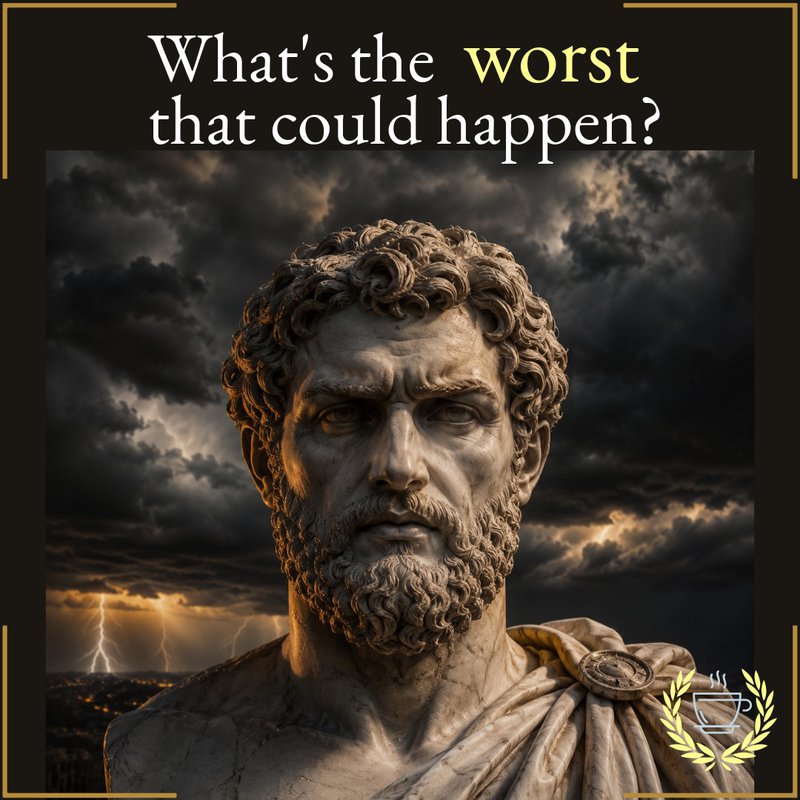
“What’s the worst that could happen?”
We’ve all heard this before. Usually it’s tongue in cheek just before something really bad does happen. But counterintuitively, it’s actually one of the most powerful questions that we can ask ourselves when we’re stuck in anxiety. So let’s talk about how imagining the worst can you you be your best.
“The mind that is anxious about future events is miserable.”
— Seneca
The Problem
In today’s busy world, we all struggle with anxiety. Most people complain about anxiety hampering their daily happiness. And where does this anxiety come from? It’s from worrying about things that we think are going to happen.
This is a natural part of being human. The brain is a prediction machine. Think about when you're walking through a crowd, your brain is constantly reading people's trajectories so you don't collide. It does the same thing with the future — always trying to anticipate what's coming next.
That capacity kept us alive. If we couldn't imagine bad outcomes, we'd never prepare for them. But most of us have taken that survival tool and turned it into a source of constant stress.
What if instead, you could take that same ability and use it to build resilience rather than anxiety? What if considering the worst could help you become your best?
The Philosophy
Paradoxes
In episode 377, I talked about paradoxes — holding competing ideas without rushing to resolve them. It's one of the most powerful skills we can develop, because the moment we choose a side, we close off other possibilities.
Seneca puts it plainly:
“Ignorance is the cause of fear.” — Seneca
The longer we can withhold judgment and hold each idea and try to understand it, the deeper our understanding of it. This is how we gain wisdom, which is not just about knowledge but about being able to see things clearly. Marcus Aurelius captured this idea in his Meditations:
“The first rule is to keep an untroubled spirit. The second is to look things in the face and know them for what they are.” — Marcus Aurelius
The more clearly we can define what troubles us, the easier it is to turn it to our benefit.
Premeditatio Malorum
Stoicism is full of paradoxes, but one of the most useful is premeditatio malorum, the “premeditation of evil”. Rather than ignoring what causes our anxiety, we look it in the face. We stop judging it as good or bad and treat it as something that simply is.
This is why the Stoics teach that events are neutral. We're the ones passing verdict on them.
“It is not events that disturb people, it is their judgements concerning them.” — Epictetus,
When we see things as neutral, some of that anxiety loses its grip.
The Present Moment Problem
Here's the paradox: the Stoics also teach us to be present. To stop worrying about what might happen, and focus on now.
In his Letters to Lucilius, Seneca writes:
“There are more things, Lucilius, likely to frighten us than there are to crush us; we suffer more often in imagination than in reality.” — Seneca
The anxiety we feel is a direct result of the story we're telling ourselves about the future. We catastrophize. We treat the worst possible outcome as the only one. And what makes it worse — we're doing it to ourselves.
The mind has a hard time distinguishing imagination from reality, so the body responds as if the threat is real. Think about a time you were convinced someone was upset with you. You felt the tension. Maybe in your stomach or shoulders. Then you found out you were wrong, and the relief was immediate. Your body was responding to a story, not a fact.
That physical distress creates a spiral: thoughts create story, story creates sensation, sensation triggers the fight-or-flight response, which narrows your thinking to the very thing you're afraid of. That's why getting someone to breathe slows the spiral. Calm the body first, then the mind follows.
Avoidance Makes It Worse
When we try not to think of something, we give it more power. It’s the pink elephant problem. Try not to think about about a pink elephant and you will think about one. The brain has to imagine a concept before it can dismiss it. It can’t operate in a void, and suppression takes energy.
So the fear stalks you. You scroll your phone. You have a drink. You eat things you shouldn't. Anything to avoid sitting with it.
But Seneca reminds us:
“Everyone faces up more bravely to a thing for which he has long prepared himself, sufferings, even, being withstood if they have been trained for in advance. Those who are unprepared, on the other hand, are panic-stricken by the most insignificant happenings.” — Seneca
The courage to face it head-on is the path through.
Outcomes
One more thing worth naming: when we fixate on outcomes, we lose agency. Outcomes aren't under our control. Actions are. That's why the focus has to shift to what you can actually do — not what might happen.
But here’s another part of the paradox. We do have to consider what might happen, consider other possible outcomes. Even ones that we’re not focused on at the moment. As Seneca writes:
“What is quite unlooked for is more crushing in its effect, and unexpectedness adds to the weight of a disaster. The fact that it was unforeseen has never failed to intensify a person's grief. This is a reason for ensuring that nothing ever takes us by surprise. We should project our thoughts ahead of us at every turn and have in mind every possible eventuality instead of only the usual course of events.” —Seneca
This isn’t about running a catastrophizing session. It’s considering as many possible bad outcomes as you can so that you aren’t caught by surprise. You don’t have to do them all at one time, but by taking on the things that scare you, you’re following Seneca’s advice:
“So I look for the best and am prepared for the opposite.” —Seneca
The Practice
So how do you actually do this — and what makes it different from just ruminating?
Two things. First, you do this in a safe space — not in the heat of the moment, but sitting quietly with time to think. Second, you approach the problem with objectivity. And objectivity isn't cold. Think about the friends you trust most — they're the ones who tell you the truth, not what you want to hear. This practice is you doing that for yourself.
Seneca explains this clearly:
“This is why we need to envisage every possibility and to strengthen the spirit to deal with the things which may conceivably come about. Rehearse them in your mind: exile, torture, war, shipwreck. Misfortune may snatch you away from your country… If we do not want to be overwhelmed and struck numb by rare events as if they were unprecedented ones; fortune needs envisaging in a thoroughly comprehensive way.” — Seneca
Now, it’s important that you write it down. Don't do this in your head. Getting it on paper creates distance. You see it more clearly. You have to actually articulate the thing.
This practice that I’m going to share with you is one from my course, Build an Unbreakable Mind. If you find this useful and want to learn more useful practices, make sure to check it out on my website at stoic.coffee/unbreakable
Step 1: Write down the the story you're telling yourself. It can be freeform, or you can ask yourself:
- What outcome am I afraid of?
- What do I think happens if that outcome occurs?
- What doubts do I have about myself?
- What assumptions am I making?
Step 2: The facts.
These are things that could be proven in a court of law:
- What are the actual roadblocks?
- What's outside my control?
- What skills do I have? What am I lacking?
No opinions. Only what could be proven.
Step 3: The emotions:
Write down everything you're feeling. Angry, sad, scared, nervous. All of it. Get it out.
Then take a break. Step away. Come back later with fresh eyes.
Step 4: What you can actually do:
- How will you handle the roadblocks?
- What could you learn to close the gaps?
- If the worst actually happened — what would you do?
- What's under your control right now?
- Where can you take action today?
This is how you rewrite the story. You use your rationality to see more clearly, and shift your perspective toward something useful.
Conclusion
Anxiety about the future is part of being human. You're not going to think your way out of having it. But you can stop fighting it and start using it.
Premeditatio malorum is leaning into the fear. It's having the courage to ask: what am I actually afraid of? It's sitting with the hard thing — clearly, not catastrophically — and dismantling the doom loop before it dismantles you.
So the next time you catch yourself trying not to worry about something — stop resisting. Welcome it in. Look it in the face.
And ask: “What's the worst that could happen?”
My book Stoicism 101 is available! Order here!
Find out more at https://stoic.coffee
Watch episodes on YouTube!
Find me on linkedIn, instagram, or threads.
Thanks again for listening!