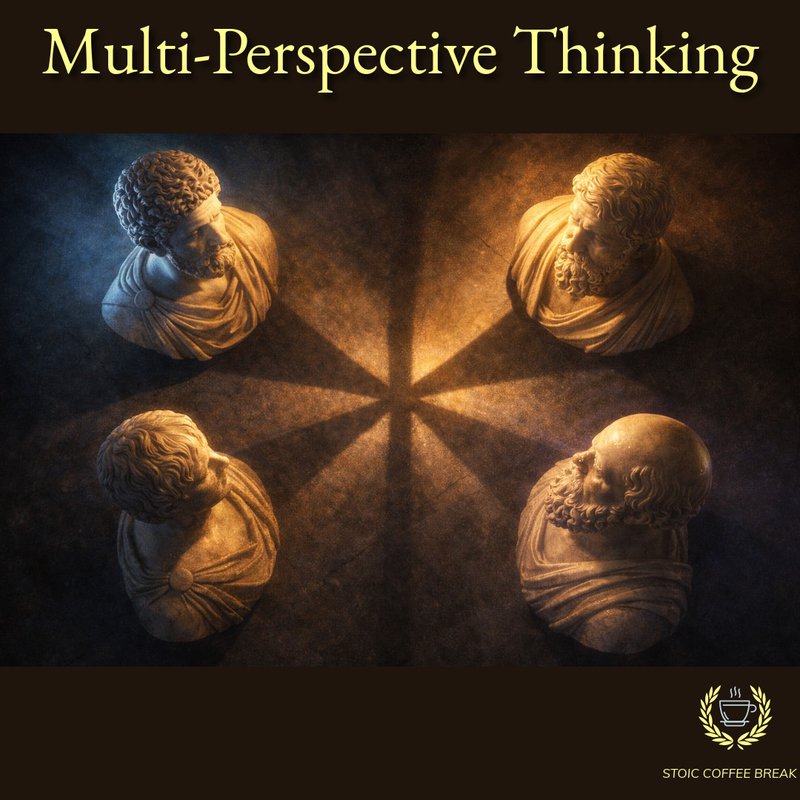
Do you approach a problem from only one perspective? Are there ways that you could expand your understanding and incorporate different perspectives? Today I want to talk about the power of multi-perspective thinking and how it can help you dig deeper into challenges in your life.
“Everything we hear is an opinion, not a fact. Everything we see is a perspective, not the truth.” —Marcus Aurelius
Socrates
Socrates and several of his friends went to see the Oracle at Delphi and one of their group, Chaerephon, asked the Oracle, “Is any man wiser than Socrates?” The Oracle responded, “Of all men, Socrates is the wisest.”
Now Socrates on hearing this was shocked. He didn’t consider himself wise. He was so full of questions about everything. He felt like the Oracle must be wrong, so he set out to prove them wrong. He made it his quest that he would speak to every wise man he could find in order to find one wiser than him.
He lost that quest.
Now why was Socrates considered so wise?
It wasn’t because he all the answers. It was because he had so many questions. He wanted to understand, and he felt the only way he could truly understand something was to interrogate it as deeply as possible. He even said, “Wonder is the beginning of wisdom.“
And wisdom was what he was after.
We Want Answers
So why do we like answers?
We love to have answers. Answers are safe. They feel solid. They offer security and comfort.
We feel good when we have an answer.
Questions disrupt. They’re ambiguous and unsecure. They rock the boat, tilt the world.
Questions examine, probe, and uncover.
We feel uncomfortable when faced with a powerful question. We often grab onto the first answer we find because we don’t like the discomfort.
But questions are where the power lies.
Answers are brittle.
Questions are resilient.
We’ve all experienced the power of questions with children. How many times has your answer been destroyed with a simple question from your child?
People in power don’t like questions because questions expose ignorance and weaknesses. Ever have a know-it-all boss who shot down hard questions because it threatened their ego?
When you approach life with questions, you approach things with wonder, curiosity and flexibility.
When you “have all the answers” you’re static, unyielding, and stuck.
This is why Socrates said:
“I know that I am intelligent because I know that I know nothing.” — Socrates
It wasn’t because he was stupid. It was because he knew that any answer he came up with could and should be challenged. Everything he knew could be wrong.
Truth vs. Being Right
One of the biggest things that keeps us from trying to discover the truth in conversations and debates is that we want to be right. We come in with a preconceived notion, and our only goal is to win.
Socrates wanted the truth, even if it meant that his first ideas about something were later proved wrong.
In his quest to find the wisest man, he often spoke with sophists. Now, the sophists of Socrates times were rhetoricians who were skilled speakers and very persuasive. But for the sophists it was more important to be right and to win the argument than it was to find the truth. They would even debate on topics that they knew little about, but could speak so persuasively, they would often win.
The problem is they would use all kinds of logical fallacies such as appeals to emotions, straw man arguments, and ad hominem attacks. The rhetorical tricks made them sound as though they were knowledgeable and credible.
We see this same approach in online debates all the time. The goal is to defend a point of view rather than actually discuss, critique, and maybe change minds. The problem with this type of debating is that rarely does anyone go away any wiser. They usually are even more entrenched in their point of view.
When Socrates spoke with someone who considered themselves wise, he exposed their ignorance by asking questions. He didn’t set out to “beat” them or win. He was earnestly seeking wisdom and he found the only way to get there wasn’t by simply asking for answers, but to methodically ask good questions.
Ego Gets in the Way
So why do we prefer being right over or finding the truth?
It feeds our ego. It feels good to think we’re right. We feel superior.
And the thing is, our education system reinforces this way of thinking. We get used to being rewarded for having the “right answer” , rather than for working through how to come to a good answer.
I had a coaching client who had this show up in an interesting way. His company is in an emerging industry, and often they’re discovering the path forward. The arguments they’d have over the right solution often became heated because each person on the team wanted their solution to win. As the manager he found it challenging to get them to collaborate on trying to find the best solution.
Because they’re developing a whole new product, they sometimes have to change direction, and look at other options that were put forward earlier. This often led to the person with the newly selected idea to get upset because they felt that their idea should have been chosen in the first place. Basically saying, “I told you so!” They would also use this as leverage later on, saying, “Remember you didn’t listen to be before when I was right.”
When we’re focused on being right rather than finding the truth then we remain in ignorance and error. We’re more focused on feeding our ego than growing and learning.
We should be willing to be proven wrong.
Socrates pointed out that the winner of an argument actually loses because they still hold the same opinion as they had before. On the other hand, the person who loses has been able to discover where they were wrong and learned something.
Multiple Perspectives
One of the most powerful tools that Socrates employed was his ability to discuss things from multiple perspectives. Because he wasn’t trying to prove his point of view, but rather find the truth, he wasn’t attached to a particular outcome. He would take a point of view and follow it down a path of reasoning, only to contradict it later as they uncovered better conclusions.
John Stuart Mill summed it up nicely:
“He who knows only his own side of the case, knows little of that. His reasons may be good, and no one may have been able to refute them. But if he is equally unable to refute the reasons on the opposite side; if he does not so much as know what they are, he has no ground for preferring either opinion.” — John Stuart Mill
This is why it’s important to have different perspectives. We need to be able to see challenges more holistically. If we only know one perspective, we aren’t seeing the whole picture.
Why do we struggle with looking at things from multiple perspectives?
I like how Anaïs Nin put it:
"We don't see things as they are, we see them as we are." — Anaïs Nin
We like to be right. It feels good to be right. We try to protect our identity and our worldview. We like to think that we’re smart and can come up with the best solution. We have an idea, and rather than trying to disprove it, we do our best to prove it’s the right one.
Other perspectives show us where we might be wrong and that can bruise our ego.
As Brené Brown explains:
“We can choose courage or we can choose comfort, but we can't have both. Not at the same time." — Brené Brown
It takes courage to sit in that discomfort. But the discomfort of being wrong is a price worth paying to reach a better conclusion.
Multi-Perspective Thinking
How can we get better at interrogating a problem and seeing it from multiple perspectives?
Obviously, talking with others about their perspectives on something is very useful. But we need to be sure that we seek out those that have different perspectives and not just find those who agree with us. We also need to actually listen to opposing perspectives and not get defensive if they poke holes in our perspective.
As F. Scott Fitzgerald put it:
“The test of a first-rate intelligence is the ability to hold two opposed ideas in mind at the same time and still retain the ability to function.” — F. Scott Fitzgerald
Another way we can do this is to practice it on ourselves. We can play our own critic—be our own devils advocate.
I put together a simple exercise that you can do which can help you see things from multiple perspectives.
The Practice
First, write out your point of view. List all the facts as best you can. Then list out your opinions about the situation, and what logic you used to come to your conclusion.
Then, critique your analysis from the opposing viewpoint. Try to poke as many holes in it as possible.
Next, synthesize both perspectives by taking the best from each and integrating them.
Finally, critique it one more time from a contrarian perspective. Look for things that might be missing:
- Could the whole idea be wrong?
- Is this solving the real problem?
- Did I even ask the right question in the first place?
So what does this look like? Let’s use this exercise in a practical example.
"I Need to Be More Disciplined"
Now, let's say that I decided that I wasn't disciplined enough and I needed to be more disciplined.
My Point of View:
- Facts: I skip workouts, procrastinate on projects, can't stick to routines
- Opinion: I lack discipline and willpower
- Logic: Successful people have discipline, I don't, therefore I need more of it
Opposing Viewpoint Critique:
- I've successfully maintained lots of things (friendships, job, hobbies I care about)
- Maybe it's not discipline I lack, but genuine interest in these specific things
- I have a lot of expectations about how I should be acting. Who am I comparing myself to?
- Discipline is a process—how I do something. Not an actual goal. So what am I actually trying to achieve?
Synthesis:
- I DO struggle with consistency in certain areas
- But it's specifically in areas where I'm forcing myself based on external expectations
- The things I naturally maintain, are things align with my actual values
Contrarian Critique:
- Wrong question entirely. Not "how do I get more discipline?"
- Real question: "What do I actually value, and am I pursuing THAT, or someone else's version of success?"
- Maybe my lack of discipline is data – telling me I'm climbing the wrong mountain
The reason that I like this exercise is that it’s far more powerful than just a pro and con list. It’s about questioning judgments from an impartial way. It helps to uncover the real issue which can lead to a better solution.
Conclusion
It’s challenging to think outside of our point of view. It’s not something that comes easy to most of us. This is why Socrates was such an exceptional thinker, and why he often made others uncomfortable. He wasn’t afraid to ask the hard questions, take contrarian positions to uncover deeper truths, and more importantly, he wasn’t afraid to be wrong.
When you take various perspectives then you are allowing yourself to explore the issue from multiple sides. It gives you a deeper understanding, and helps you get to the root of the actual issue. It’s okay to be wrong and sometimes you get further by trying to disprove your initial conclusions.
So the next time you’re facing a challenge or having a debate, ask yourself, “Do I want to win? Or do I want to find the truth?”
Join the Build an Unbreakable Mind program. Enrollment is now open.
My book Stoicism 101 is available! Order here!
Find out more at https://stoic.coffee
Watch episodes on YouTube!
Find me on linkedIn, instagram, or threads.
Thanks again for listening!