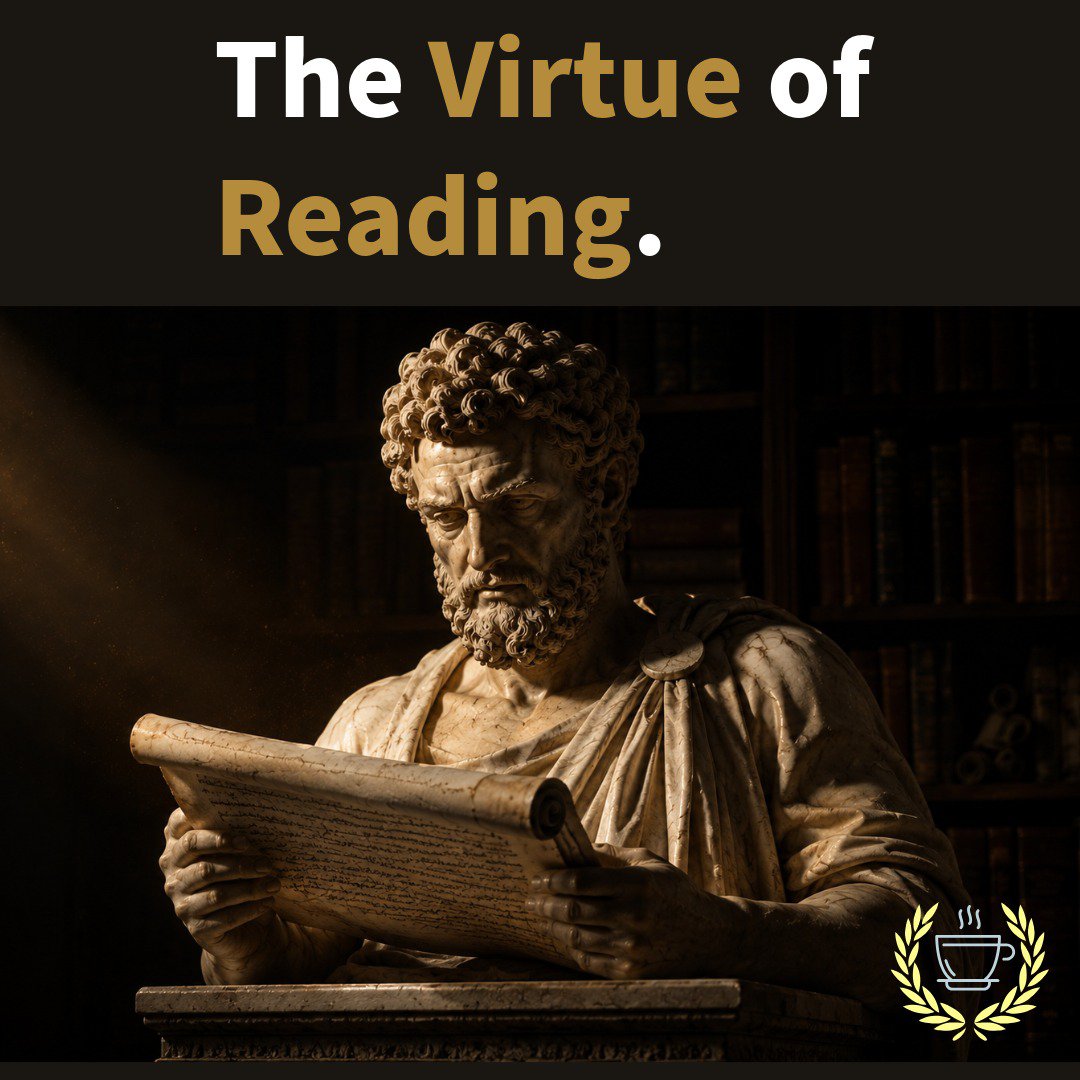

When was the last time that you read a book. A serious book. Something stretched your mind? Something that you had to stop and go back and reread a sentence or paragraph to make sure you understood it? Maybe even learned some new words? New ideas? In this episode, let’s talk about why you should read deeper — not just so you can check another book off your list, but as a tool to help you deal with the complexities of life.
“Friends, the school of a philosopher is a hospital. When you leave, you should have suffered, not enjoyed yourself.” — Epictetus
The Problem
Last year, only 60% of Americans read at least one book. Almost 57% of Americans placed a bet. That's not a statistic I'm making up to be dramatic. It's from a piece in The Atlantic by Rose Horowitch called "The End of Reading Is Here." She's not calling us illiterate. She's calling us something worse, in a way — post-literate. Still surrounded by words. Words everywhere. Just losing the capacity, and the appetite, to sit with the hard ones.
The top selling books today are simpler and less complex, with young adult novels taking the lead, even among adults. Libraries are following this trend getting easier to read books for patrons. In 1958 the English translation of Doctor Zhivago was the best selling book. Boris Pastenak wrote in long complex sentences, demanding your attention. Last years top novel? Sunrise on the Reaping, the latest in the Hunger Games series. Nothing wrong with that book, but nobody's calling it a wrestling match.
I want to be clear about something before I go further: this isn't me being a snob about it. This isn't "kids these days" or "nobody reads anymore, sad." This is me pointing out something specific — we are choosing, at scale, to stop training the one muscle that everything else in a thinking life depends on. And I don't think that's a coincidence that it's happening at the exact moment we need that muscle most.
Difficult reading, as Maryanne Wolf, a cognitive neuroscientist at UCLA points out, strengthens the cognitive abilities of comprehension and synthesis—the ability to read something and integrate it into real life situations.
And here's why it matters. When you stop reading hard things, you don't just read less. You lose practice at friction. At hitting a sentence you don't understand and going back over it instead of scrolling past it. At holding two conflicting ideas in your head at once instead of picking a side in the first four words. You start expecting to be handed the conclusion. Told what to feel. And when real life doesn't hand you the conclusion, when it just hands you the mess and expects you to work it out, you're out of practice for the one skill that job requires.
Why is Reading Hard?
Reading and writing is not something that comes naturally to us as humans. Our brains don’t naturally have a space set aside for processing the written word. This is a skill that we have developed as humans. Writing allowed us to preserve ideas that otherwise would have been handed down orally, and changed in each telling.
But in that development we’ve also developed logic, grammar, rationality, mathematics, emotional complexity. In order to put something down on paper, the author has to think through their arguments and clearly articulate what they are actually trying to say, so they can best communicate their ideas to the reader.
On the reader’s side, it means that the arguments and ideas don’t disappear as they do when a conversation or video ends. It’s still there on the page, allowing you to go back and dive deeper, consider other possibilities, find rebuttals, and poke holes the flaws you might find.
Reading doesn’t just give you information. The act of reading literally changes the way that you think. Reading helps you construct mental models in a way that no other medium can.
Reading also places you in the mind of other people. It’s like you experience the world as another person. You read their thoughts and observations. You understand a completely different perspective on that world that you otherwise couldn’t. If you only stick to books that are easy, or ones that speak to your worldview, then you never understand how others experience the world.
As we become a more oral and visual world, thanks to social media, we lose something. Social media, while at times can be instructional, is meant to be entertaining and hook your attention, not to deeply educate you. It’s too short for the reader (or watcher) to really engage in the material, to challenge their own thinking. It’s simplified down to soundbites and that’s not a way to educate yourself. If it doesn’t catch your attention, you skim past it looking for something to amuse rather than inform.
Videos are a more passive form of engagement, requiring less imagination and reasoning. In a study by University of California San Francisco, they found that reading actually increases the size of the cortex in the brain. Those that spent more time reading performed better on cognitive tests. Those that spent more time watching videos actually had regions of the brain decrease and performed worse on the same cognitive tests.
This weakens our ability to handle the complexities of the world, other people, and even ourselves. We reduce things down to simple narratives and assumptions. Things become more black and white, eliminating the shades of gray and nuance that are part of the complex world we live in.
The Thinking Class
A few months ago, I listened to an interview with Brené Brown where she noticed an interesting disconnect. She talked about how in her work that she meets with leaders from all kinds of companies, including some of the top tech firms. Every leader she talks to tells the people under them to learn to code, learn data science, get the technical skill that'll survive the future. Yet, when pressed on the books that they read that actually shaped them the most, they all mentioned books on philosophy, critical thinking, literature, psychology, history, even art. None of them pointed to a technical book.
That's not hypocrisy. That's a class system, and it's an honest one, whether anyone means it that way or not. One class gets trained to execute, the other gets to keep the skill of deciding what's worth executing in the first place.
And the interesting things is that a YouGov study on reading in America backs this up. They found that that just 19% of Americans read 82% of the books.
So the question is, which class do you want to be in?
If you’re not expanding your mind, if you’re not challenging yourself to consider alternate viewpoints and new ideas, then you’re making that choice.
When we meet challenges in our lives we can either lower the bar, or increase our capacity. Lowering the bar is easier. Increasing your capacity is harder. But which one has a higher likelihood of being successful?
Attention
What this comes down to is not only are we losing our ability to think about complex things, we’re losing our ability to pay attention. SAT and ACT scores have been falling each year as students struggle with long reading passages, even as the test creators have been shortening the passages for reading comprehension.
College students, even in Ivy League schools, regularly complain about having to read long books for their classes. Not just because they are difficult, but because they struggle with the capacity to finish reading them. Teachers are being instructed to use shorter passages from the books, basically dumbing down the curriculum.
Margaret Rennix, Harvard’s assistant director for humanities and social-sciences support, even talked about how some students see reading as a burdensome way to acquire knowledge.
Think about that. Isn’t that what higher education is about? Increasing your capacity and skills? Challenging yourself so that you’re better, smarter, more creative than when you started?
If we as a society aren’t even just keeping up, but are actively lowering the bar, how do we expect to continue advancing, not just technologically, or as a society, but as human beings?
As Neil Postman wrote in his book, Amusing Ourselves to Death:
"When a population becomes distracted by trivia, when cultural life is redefined as a perpetual round of entertainments… a nation finds itself at risk; a culture-death is a clear possibility." — Neil Postman
The Philosophy
Here's the thing the Stoics understood about the mind two thousand years before anyone ran an fMRI study on it: attention isn't a background feature. It's the kernel of the operating system.
They had a word for it, prosoche, which is usually translated as attention, but it’s really closer to vigilance — a trained, sustained watchfulness over your own mind. They treated it as the foundational discipline. Not a nice-to-have next to the "real" Stoic work. It’s the foundation everything else stands on. Because before you can sort what's in your control from what isn't, before you can choose a response instead of reacting, you have to actually be there long enough to see the choice in front of you. No attention, no discipline. No discipline, no Stoicism.
Epictetus points this out directly:
"When you relax your attention for a while, do not fancy you will recover it whenever you please; but remember this, that because of your fault of today your affairs must necessarily be in a worse condition in future occasions." — Epictetus
So when I say we're losing the ability to sit with a hard sentence, I'm not being precious about literature. I'm saying we're losing the raw material the whole practice runs on. You cannot examine an impression you scrolled past.
Seneca saw his own century's version of this. Not video, not doomscrolling. For him it was people bouncing from scroll to scroll, author to author, never landing anywhere long enough to actually digest it. He wrote to his friend Lucilius:
"You must linger among a limited number of master-thinkers, and digest their works, if you would derive ideas which shall win firm hold in your mind." — Seneca
Linger. Digest. Firm hold. He's not telling Lucilius to read more. He's telling him to read deeper, on fewer things, or end up, in his word, "unsteady." Swap "authors and books of every sort" for "tabs and feeds and fifteen-second clips" and he's describing your Tuesday.
Here's where people get it backwards: they hear "read hard books" and assume it's about sounding smart. It's not. It's about training the exact muscle Stoic practice needs to function at all — staying with something uncomfortable long enough to actually think, instead of reaching for the next hit of easy resolution. Lose that muscle, and you haven't just gotten less well-read, you've lost the capacity for the thing you're actually here trying to practice.
The Practice
So what do you actually do with this. Three things, and none of them require a syllabus.
First: pick one book, and finish it before you start another. This is Seneca's actual prescription, not a metaphor. Most of us have four books going at once and finish none of them, which means we never get past the first, easy layer of any of them. Pick one hard book. No new book starts until that one's done. That's the whole rule.
Second: give it twenty minutes before you're allowed to quit. I noticed when doing theater that Shakespeare was always a challenge for me at first. But about fifteen, twenty minutes in, something shifts. The rhythm starts to land. The jokes start landing where they're supposed to. It's the same thing that happens learning a language. Most people quit a hard book a few pages in, right before the part where it would've started working on them.
Third: build your capacity for attention, your prosoche: take a difficult paragraph from a book you’re reading and really read it. Then read it again. Then, out loud or on paper, explain what it's actually arguing, not what it's about. "This is about grief" is a summary. "He's arguing that grief is the tax we pay for having loved something specific, not something in general" is the argument. That gap between noticing the topic and naming the claim is where the attention actually gets built. Do that once a day and in a month you'll notice you're doing it automatically with things that aren't books. Conversations. Arguments online. Your own thoughts.
None of this is about becoming a more impressive person at dinner parties. It's building the capacity that lets you tell the difference between what's really happening and what you're being told is happening.
Conclusion
When I was a child my mother read to me and my siblings every night. Not just when it was convenient. Not when she felt like it. Every night. Even if it was late, we’d read a short book. We had weekly trips to the library which were just as exciting as going to the playground. We even had a Christmas tradition of reading a chapter a night of The Best Christmas Pageant Ever each December.
I passed along that reading habit to my own kids, reading such treasures as Goodnight Opus, The Stinky Cheeseman, and Cowboy and Octopus before tucking them into bed each night. Taking them to the library or Powell’s books each weekend. If they wanted a book, I’d get it for them.
Reading has always been a constant in my life. I always had an extra book in my backpack throughout school, and regularly hit up the used book store when I was in college. When I moved to Amsterdam, I sold and gave away hundreds of books, which I now kind of regret, as I’m slowly rebuilding my library after moving back to Portland.
So I would implore you read some hard books. Not just about philosophy, but other ideas. For me some hard books that changed my worldview include James Carse’s Finite and Infinite Games, Carlo Rovelli’s the Arrow of Time, and Douglas Hofstader’s Gödel, Escher, Bach. The first two aren’t that long but are can shift your perspective in a chapter. The latter, I’ll admit is thick and takes work to get through, but the mental payoff is worth it.
And the thing is, we don’t just have to spend all our time reading books on philosophy, history, or science. Reading can be educational and entertaining. There are plenty of other books that are complex and challenging that are also entertaining. Personally, I love reading complex science fiction. Works from Asimov, Neil Stephenson, Ursula Le Guin, and Andy Weir have have complex plots, and novel ideas that have changed the way I think. Each one created a world that I conjured in my own imagination, with the help of the author, experiencing things that I never would have considered on my own.
Lastly, reading is fun. You don’t have to read only complex books. You can read something just because it delights you. I remember reading The Hitchhiker’s Guide the Galaxy and laughing my ass off. Every now and then I pick up a Christopher Moore book because I find them ridiculously entertaining. But try to have some veggies with your dessert.
The point is, reading is a muscle that will weaken over time, so make sure you get your reps in. But read those hard books to so that you can be part of the thinking class, not the part that follows them. Prosoche, vigilance of mind, is how you buy your way into the first group. Not money. Not credentials. Just the willingness to sit with something difficult long enough to actually see it.
As Epictetus put it:
“We should discipline ourselves in small things, and from there progress to things of greater value.” —Epictetus
So, which one are you training for? I know which camp I’m in. See you at the library.
The Build an Unbreakable Mind program for building mental discipline is now open for enrollment!
My book Stoicism 101 is available! Order here!
Find out more at https://stoic.coffee
Watch episodes on YouTube!
Find me on linkedIn, instagram, or threads.
Thanks again for listening!