Why does virtue matter in leadership? What happens to a community, a city, a country when there is lack of virtue in leadership? In this episode we’re going to discuss power, leadership, and why virtue matters.
"Nearly all men can stand adversity, but if you want to test a man's character, give him power." — Abraham Lincoln
Lincoln understood something the Stoics knew 2,000 years earlier: Power doesn't build character. Power reveals it. Power amplifies it. Power takes whoever you already are and turns up the volume.
Think about it this way: Money doesn't make someone generous or greedy—it just gives them more resources to express what's already there. Alcohol doesn't create who you are when you're drunk—it just lowers the inhibitions hiding who you've always been.
Power works the same way. It's an amplifier. And when you hand that amplifier to someone without virtue, you don't just get a leader making bad decisions. You get someone actively damaging the community, the organization, the country—what the ancients called the polis.
Today we're exploring why virtue in leadership isn't some nice bonus feature—it's the essential foundation. We'll look at what happened in ancient Rome when leaders had power without character, we'll see what happened when George Washington understood this principle, and we'll talk about what this means for you—whether you're leading a company, a team, a family, or just yourself.
Because here's the truth: We're all leaders in some area of our lives. And we all face the test of power.
The Amplification Effect – What Power Actually Does
Let me tell you about two men who were given almost identical amounts of power. The difference in what they did with it tells you everything you need to know about virtue in leadership.
Cincinnatus (519-430 BCE)
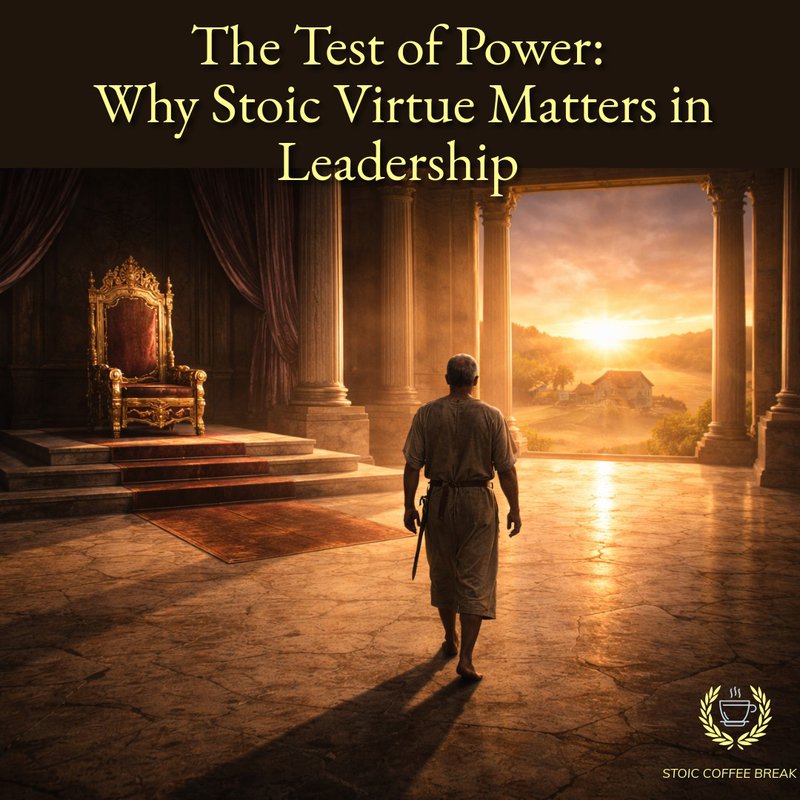
Cincinnatus was a Roman farmer. In 458 BCE, Rome faced an existential crisis—enemies were literally at the gates. The Senate gave Cincinnatus complete power as dictator. Not the modern meaning of the word—in Rome, a dictator was someone given absolute authority during emergencies.
So here's a guy who had been just working his farm. Now he has unlimited power. He could've done anything. Seized land. Enriched himself. Held onto power forever.
He saved Rome in 16 days, then went back to his farm.
He did it again 20 years later at age 80. Given absolute power. Solved the crisis. Handed power back. Returned to his plow.
Nero (37-68 CE)
Start with a teenage boy who becomes emperor of Rome at age 16. Absolute power. The whole Mediterranean world at his feet.
At first, guided by the Stoic philosopher Seneca, Nero seemed reasonable. His first five years were well regarded under Seneca’s guidance. But here's what power amplified in him:
- He had his own mother murdered
- He kicked his pregnant wife to death
- He executed anyone he perceived as a threat
- He blamed Christians for the Great Fire of Rome and used them as human torches to light his garden parties
- When he needed money, he'd just accuse wealthy citizens of treason, execute them, and take their property
Power didn't create Nero's cruelty. It just removed every constraint that had been hiding it.
Cincinnatus had virtue before power. Power amplified his sense of duty and service. Nero lacked virtue before power. Power amplified his vanity and cruelty.
The Lincoln Principle: Adversity? Both men could probably have handled it. But power? That's the real test. That's where you see what someone's actually made of.
The Modern Parallel
This isn't ancient history. This is happening right now, in every organization, every government, every sphere where humans have authority over other humans.
Research backs this up. A 2024 study found that power doesn't change people—it reveals them. People with narcissistic tendencies become more narcissistic with power. People with empathetic tendencies become more generous with power. The core character was always there. Power just gave it room to breathe.
Another study on ethical leadership (2025) found that leaders who lack the cardinal virtues—wisdom, courage, temperance, justice—don't just fail to inspire their organizations. They actively damage them. Lower trust, higher turnover, increased cynicism, and a culture where everyone learns to operate without ethics because that's what the top models.
The Stoics knew is that if you give a virtuous person power, they'll use it to serve the community. Give a person without virtue that same power, and they'll use the community to serve themselves.
Why This Matters to You
You might be thinking: "I'm not an emperor. I'm not running a country. Why does this matter to me?"
Because you have power. Maybe not political power, but you have influence somewhere:
- Parents have power over their children
- Managers have power over their teams
- Teachers have power over students
- Anyone with a platform has power over their audience
- Anyone with more resources has power in relationships
The question isn't whether you have power. The question is: What is that power amplifying in you?
What the Ancients Taught About Power
Marcus Aurelius: The Philosopher-Emperor
Let's talk about the most powerful man in the ancient world learning to handle that power from Stoic philosophy.
Marcus Aurelius became emperor in 161 CE. He ruled the Roman Empire for 19 years. And every night, he wrote in his journal—what we now call the Meditations. These weren't meant for publication. He didn’t write about his triumphs or victories. He wrote reminders to himself about how to stay virtuous when you have ultimate power.
Here's what he wrote to himself:
"Waste no more time arguing what a good man should be. Be one." — Marcus Aurelius, Meditations 10.16
Not "appear to be one." Not "convince others you are one." BE one. When you have power, it's easy to substitute appearance for reality. Marcus kept reminding himself: the internal work matters more than the external show.
"The object of life is not to be on the side of the majority, but to escape finding oneself in the ranks of the insane." — Marcus Aurelius, Meditations 6.6
Power gives you the ability to ignore everyone else. You're the emperor—who's going to stop you? But Marcus understood that just because you CAN do something doesn't mean you SHOULD. Virtue requires checking yourself against a standard higher than popular opinion or personal desire.
His Daily Practice:
Marcus would ask himself each morning: "What am I going to face today?" He'd prepare himself for:
- Arrogant people
- Ungrateful people
- People who would try to manipulate him
- His own temptation to abuse his power
He didn't pretend these challenges wouldn't exist. He prepared his character to meet them with virtue.
The Four Cardinal Virtues for Leaders
The Stoics identified four essential virtues, and when you look at them through the lens of leadership, they become incredibly practical:
1. Wisdom (Prudence) – The ability to see clearly
- Knowing what actually matters vs. what just seems urgent
- Understanding consequences beyond the immediate
- Seeking truth even when it's uncomfortable
- Distinguishing flattery from honest feedback
Power without wisdom: Reactive decisions, shortsighted policies, falling for yes-men, confusing activity with progress
2. Courage (Fortitude) – The strength to act on what's right
- Making unpopular but necessary decisions
- Standing firm against pressure
- Admitting mistakes
- Saying no to corruption even when it's costly
Power without courage: Cowardice dressed up as pragmatism, going along to get along, or moral compromise rationalized as necessity
3. Temperance (Self-Control) – Restraint and moderation
- Not using all the power you have just because you can
- Resisting corruption and flattery
- Maintaining perspective about your own importance
- Limiting yourself even when no one can stop you
Power without temperance: Excess, indulgence, narcissism, using resources meant for the community for personal gain
4. Justice – Giving each person their due
- Fair treatment regardless of status or usefulness
- Protecting the vulnerable
- Maintaining impartial standards
- Remembering you serve the community, not yourself
Power without justice: Favoritism, exploitation, targeting enemies, protecting allies regardless of their actions
A leader with all four virtues will use power wisely. A leader lacking even one will cause harm. A leader lacking all four? That's how empires fall.
Seneca on Power's Corruption
Seneca was Nero's tutor. He watched in real-time as power corrupted someone he'd tried to train in virtue. Here's what he wrote about the abuse of power:
“There is nothing dangerous in a man's having as much power as he likes if he takes the view that he has power to do only what it is his duty to do.” — Seneca
Seneca understood that those with power needed to practice restraint—something that Nero was unable to do:
“Those who abuse their power never stay powerful long. Moderate governments survive.” — Seneca
He also wrote about power and anger—how powerful people are often the most volatile because no one stops them. When you're powerful, your anger doesn't get checked. Your ego doesn't get challenged. Your worst impulses don't get corrected.
Seneca's warning: Power will reveal and amplify your lack of self-control if you haven't developed it beforehand.
Cato: The Incorruptible
Cato the Younger was famous for one thing: you couldn't buy him, you couldn't intimidate him, you couldn't corrupt him.
Julius Caesar—one of the most charismatic and powerful men in history—tried to win Cato over. Offered him positions, honors, alliances. Cato said no to all of it. Not because Caesar was his enemy, but because Caesar was accumulating power in ways that damaged the Republic.
When Caesar finally won and offered Cato mercy, Cato chose death instead.
Why?
Because for a Stoic, living without virtue isn't living. And cooperating with the corruption of power—even to survive—was a betrayal of everything that mattered.
Cato had developed his character long before he faced the test of opposing Caesar. You don't build virtue in the crisis. You reveal it.
What Virtue Looks Like in Leadership
George Washington: The Cincinnatus of America
Let me tell you about George Washington, because he's the perfect example of someone who understood virtue in leadership despite not being the most intellectually sophisticated of the Founders.
Washington wasn't the brilliant writer like Jefferson. He wasn't the political theorist like Madison. He wasn't the renaissance man like Franklin. But he understood something deeper than all of them: power must be handled with virtue, or it destroys everything.
The Revolutionary War:
Washington led the Continental Army for eight brutal years. His soldiers were starving, freezing, unpaid. He could have used his military power to:
- Seize supplies from civilians
- Declare himself military dictator
- Force states to pay the army
- March on Congress
He did none of these things. Even when his officers nearly mutinied and planned to overthrow Congress, Washington stopped them. Not with force, but with a speech where he pulled out his reading glasses and said, "Gentlemen, you will permit me to put on my spectacles, for I have not only grown gray but almost blind in the service of my country."
That moment? That's temperance. That's wisdom. He reminded them of service, not power.
The Resignation
When the war ended, Washington had the most powerful army in North America under his command. He could have become king. People literally suggested it. He said no and resigned his commission to Congress.
King George III heard about this and said: "If he does that, he will be the greatest man in the world."
Why? Because kings don't voluntarily give up power. But Washington did. Twice.
He became President, served two terms, and then—when he could have stayed President for life—he stepped down. He set the precedent that power is temporary, that service has limits, that the office is bigger than the person.
The Cincinnatus Connection
Washington wasn't just inspired by Cincinnatus—he consciously modeled himself after him. He went back to his farm. He chose virtue over power.
The key: Washington understood that his legacy wouldn't be measured by how much power he accumulated, but by how he handled the power he had. And he understood that the moment you start believing you're indispensable, you've already failed the test of character.
Modern Examples: The Test Continues
Nelson Mandela:
27 years in prison. Finally released with the moral authority to lead South Africa. He could have pursued vengeance. The people who imprisoned him, who ran apartheid, who caused immeasurable suffering—they were vulnerable.
Instead, Mandela chose reconciliation. Truth and Reconciliation Commission. Forgiveness. Building a new nation rather than burning down the old one.
And then—like Washington—he served one term and stepped down. Didn't cling to power. Understood that the transition mattered more than his personal authority.
Power amplified his commitment to justice, his vision for the future, his restraint.
Robert Mugabe (Zimbabwe)
Started as a liberation hero. Genuine moral authority after fighting colonial rule. Given power to build a new Zimbabwe.
Power amplified his paranoia, his greed, his willingness to destroy his country rather than share power. By the end, Zimbabwe was ruined and Mugabe was still clinging to office in his 90s.
Same starting point—liberation leader with moral authority. Different character. Completely different outcome.
Corporate Examples
Think about the difference between:
- Yvon Chouinard: Was the founder and CEO of outdoor clothing company Patagonia. His company was considered one of the best places to work, offering benefits such as onsite childcare as far back as 1984. He committed 1% of Patagonias sales to environmental causes. When he finally retired, he put the company into a trust committing all its profits to environmental causes.
- Elizabeth Holmes at Theranos: Started with a vision to help people, but lack of integrity plus unchecked power led to fraud, lies, and endangered patients
Power revealed and amplified what was already there in both leaders.
The Warning Signs: How to Recognize Leaders Without Virtue
From ancient Rome to modern boardrooms, leaders without virtue show patterns:
- They can't admit mistakes
- Blame others, blame circumstances, but never look inward
- Marcus Aurelius struggled with himself to be sure that he lead with virtue
- They surround themselves with yes-men
- Fire or exile anyone who challenges them
- Nero killed anyone who might be a threat; modern leaders just fire them
- They see the position as about them, not service
- "What can this role do for me?" vs. "What can I do for those I serve?"
- Washington vs. basically every tyrant in history
- They use their power to avoid accountability
- Different rules for themselves vs. everyone else
- "Justice for thee but not for me"
- They escalate rather than de-escalate
- Every slight becomes a war
- Every criticism becomes betrayal
- Seneca warned about this—powerful people with no self-control
- They can't let go
- Cling to power long past effectiveness
- Change rules to stay in charge
- See retirement as death rather than completion
The Stoic Litmus Test
Watch how a leader handles:
- Criticism
- Limits on their authority
- People who disagree with them
- Situations where they have to choose between what's right and what benefits them
That's where you see character.
What This Means for Your Leadership
You don't need to be President or CEO for this to matter. You need virtue in leadership wherever you have influence:
As a Parent:
- Do you use your power over your children to serve their growth or your ego?
- Can you admit when you're wrong?
- Do you model the virtues you demand from them?
As a Manager:
- Do you credit your team's successes and take responsibility for failures?
- Do you protect your people or throw them under the bus?
- Do you use your authority to develop others or just get results?
As a Teacher:
- Do you use your power to empower students or control them?
- Are you fair even with students you don't particularly like?
- Do you stay curious or assume you have nothing left to learn?
As Someone with a Platform:
- Do you use your audience for truth or validation?
- Can you say "I was wrong" publicly?
- Do you punch down or punch up?
The Practice: Every evening, Marcus Aurelius would review his day:
- Where did I use my influence well?
- Where did I let my ego drive my decisions?
- Where did I confuse what I wanted with what was right?
- What will I do differently tomorrow?
Power as Responsibility
The Stoic View: Power as Duty
Here's where the Stoics completely flip our modern understanding of power.
We tend to think: More power = more freedom = more ability to do what you want.
The Stoics said: More power = more responsibility = more constraints on what you should do.
Marcus Aurelius reminds us:
"What is not good for the swarm is not good for the bee." — Marcus Aurelius, Meditations 6.54
You're not separate from the community you lead. When you damage it, you damage yourself. When you serve it, you elevate yourself. This is the exact opposite of how most leaders think. Most think: "I'll take care of myself first, and if there's anything left, maybe I'll help others."
The Stoic leader thinks, "The community's wellbeing IS my wellbeing. They're not separate."
Why Virtue Matters to the Polis
Let's get specific about the damage that leaders without virtue cause:
When leaders lack wisdom:
- Short-term thinking destroys long-term stability
- Ignorance gets disguised as confidence
- Problems get masked instead of solved
- The community pays the price for their learning curve
When leaders lack courage:
- Necessary changes don't happen
- Injustice continues because no one stops it
- The vulnerable stay vulnerable
- Moral cowardice gets rationalized as pragmatism
When leaders lack temperance:
- Resources meant for everyone get hoarded
- Institutions exist to serve the leader, not the mission
- Excess and waste become normalized
- Everyone else sacrifices while leadership indulges
When leaders lack justice:
- Different rules for different people
- Favoritism and corruption spread
- Trust in institutions collapses
- The social contract breaks down
This creates a cascading effect: When leaders lack virtue, everyone below them learns that virtue doesn't matter. They learn that what matters is power, connections, appearance over substance. The rot spreads.
But when leaders embody virtue: People learn that integrity matters. That you can have power without being corrupted by it. That service is real. The example spreads too.
The Lincoln Insight Revisited
So let’s go back to the quote from Lincoln:
"Nearly all men can stand adversity, but if you want to test a man's character, give him power." — Abraham Lincoln
Why is adversity easier to handle than power?
Adversity clarifies. When things are hard, you know what you need to do: survive, endure, overcome. The path is clear even if it's difficult.
Power obscures. When you have power, you can do anything. Every path looks available. Every excuse seems reasonable. Every compromise seems justified. The question isn't "Can I do this?" but "Should I do this?" And that's where character shows up.
Adversity forces humility. You remember you're not in control. You remember you need help. You remember you're human.
Power enables hubris. You start thinking you're special. That normal rules don't apply. That you know better than everyone else. You forget you're human.
The Stoic corrective: Regular practice. Daily reminder that power is temporary, that you're part of something larger, that virtue matters more than victory.
Washington's Humility
Washington understood something crucial: He wasn't smarter than the other Founders. He knew it. They knew it. Everyone knew it. But he had something they didn't—a commitment to virtue that was deeper than his commitment to his own importance.
There's a story that after the Constitutional Convention, Benjamin Franklin was asked, "What have we got, a republic or a monarchy?"
Franklin replied: "A republic, if you can keep it."
Washington understood that the republic depends on leaders who don't need to be the smartest person in the room. It depends on leaders who care more about the mission than their ego.
He established the cabinet system—surrounding himself with brilliant people who disagreed with each other. Jefferson and Hamilton hated each other. Washington let them both serve because he knew he needed their different perspectives.
That's wisdom: Knowing what you don't know.
That's temperance: Not needing to be the center of attention.
That's courage: Making space for dissent.
That's justice: Letting the best ideas win regardless of whose they are.
The Gentle Reminder
You're going to face tests of character in your leadership—whatever form that leadership takes.
You're going to be tempted to:
- Use your power for personal gain
- Silence dissent
- Prioritize looking good over being good
- Bend the rules for yourself
- Stay in power past your effectiveness
The Stoic doesn't claim you'll be perfect. Marcus Aurelius made mistakes. Washington made mistakes. The goal isn't perfection—it's commitment to virtue despite imperfection.
Conclusion
Don't wait for the test to build character. Build it now. Every day. In small decisions and large ones.
Follow the example of Marcus Aurelius:
"Waste no more time arguing what a good man should be. Be one." — Marcus Aurelius, Meditations 10.16
The Challenge:
This week, wherever you have power—over your children, your team, your students, your platform, your resources—use it once with conscious virtue:
- Make one decision based on what's right rather than what's easy
- Give credit where it's due even if it doesn't benefit you
- Admit one mistake publicly
- Choose service over self-interest in one specific instance
Small tests. But it builds the muscle.
Because power is coming. More of it, in different forms, throughout your life.
The question isn't whether you'll be tested.
The question is what will power amplify in you when it does?
Build the character now that you want revealed then.
Final Thought
Cincinnatus went back to his farm. Washington went back to his farm. Marcus Aurelius reminded himself he was mortal, despite being emperor.
The greatest leaders know: The power isn't yours to keep. It's yours to use well while you have it.
So use it with wisdom, courage, temperance, and justice.
Use it to serve, not to dominate.
Use it to build, not to destroy.
Let power amplify your virtue, not your vices.
That's the test. That's the practice. That's the path to real leadership.
Want to be a more effective leader? Let's talk!
My book Stoicism 101 is available! Order here!
Find out more at https://stoic.coffee
Watch episodes on YouTube!
Find me on linkedIn, instagram, or threads.
Thanks again for listening!