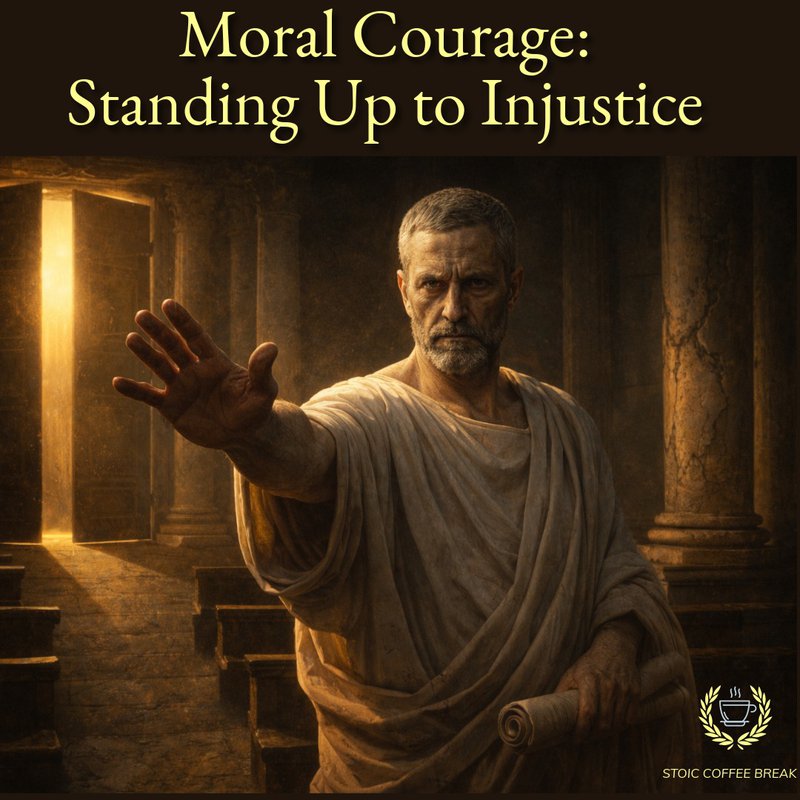
Why is it important to resist and stand up against injustice? What happens when we don’t stand up to injustice? Today we'll explore why virtue is necessary, what the Stoics taught about resistance, and how to actually practice moral courage in your daily life.
"The object of life is not to be on the side of the majority, but to escape finding oneself in the ranks of the insane." —Marcus Aurelius, Meditations 6.6
The Moment We're In…Right now we’re dealing with chaos— wars, uncertainty, leaders acting without virtue, neighbors being targeted and harmed.
When I see what’s happening in Minnesota, it’s challenging. I lived in Minnesota for five years, so it has special place in my heart. I’m proud of the people courageously standing up for their neighbors, and at the same time, I’m horrified by the abuse and killing of peaceful protesters by our government. I also live in Portland right now, and there have been incidents at protests and unarmed civilians being shot as well.
Like many people, I’ve struggled with what to do. I have a platform, and I speak about virtue and doing the right thing no matter what. So I can’t stay quiet anymore.
I generally don’t talk about politics on here, but this is not political. This is about virtue. This is about Justice.
I’m sure many of your feel paralyzed, unsure whether to speak up or stay quiet.
The question isn't academic anymore: "Do I stand up for my neighbor, or do I look away?"
This isn't about grand heroism. This is about virtue and standing up for what we know is right, even when it’s hard.
Part 1: The Challenge of Speaking Out
The Stoics teach us that we need to live with virtue.
The Four Cardinal Virtues:
- Wisdom (Prudence): Knowing what's right
- Courage (Fortitude): Acting on what's right despite fear
- Temperance (Restraint): Not being ruled by passions or power
- Justice: Giving each person their due, treating all with fairness
We uphold these virtues, not just when it’s easy, but when it’s hard. Principles are the anchors for when you face challenges. They guide your choices and actions. If your principles are only valid when it’s easy to uphold them, they aren’t principles.
This is what we are witnessing in Minnesota and other cities around the country. Everyday people stepping up against abuses of power. They’re standing up to injustice. They’re standing up for their neighbors.
People shouldn’t be shot for protesting. Children shouldn’t be torn away from their families. Schools and churches shouldn’t be raided by heavily armed squads. The government shouldn’t lie and slander those that it abuses, especially when when we can clearly see in videos what is really going on.
When I say these things it sounds like I’m describing a decaying third world country, not the U.S.
This is what the founding fathers of the U.S. were against. They saw how the king of England and his soldiers acted with impunity, and they found it intolerable.
They built this nation to be a nation of laws and that everyone should be treated fairly. If someone breaks those laws, they should prosecuted according to those laws.
Not unlawfully detained.
Not beaten.
Not shot.
When those in power fail to follow the laws and claim immunity from the consequences, then we slide into tyranny.
And regardless of where your politics lie, we can agree that everyone should be treated fairly, with justice. They should not be abused for exercising their 1st Amendment rights, because of the color of their skin, or having a different accent.
The Illusion of Safety in Silence
Many believe that staying quiet keeps them safe. But the Stoics knew better. They saw how silence and complicity lead to the downfall of society. They saw how compromising your principles for political expediency lead to the decay of character.
Cato the Younger—the Stoic exemplar of principled resistance—understood that living under tyranny without resistance isn't safety, it's slow death of the soul.
Staying silent and not acting when we see things that are against our values and morals allows these abuses to continue. Not raising your voice or supporting your neighbor is complicity, and that comes with a cost.
The Cost of Abandoning Our Neighbors
Marcus Aurelius reminds us:
"For we are made for cooperation, like feet, like hands, like eyelids, like the rows of the upper and lower teeth. To act against one another then is contrary to nature." — Marcus Aurelius, Meditations 2.1
When we abandon our neighbors, we act against our nature. We're social beings, not isolated individuals—we're interconnected parts of a larger whole. The Stoics called this sympatheia—the interconnection of all things.
"What is not good for the swarm is not good for the bee."— Marcus Aurelius, Meditations 6.54
When our neighbor suffers and we do nothing, we suffer too. Not just metaphorically—psychologically. This is what is known as “moral injury”. It means that we ourselves are harmed when we fail to step up and do the right thing. Recent research on "moral injury" shows that failing to act on our values creates profound psychological distress. Anthony Feinstein in his book Moral Courage describes it like this:
“A condition that arises from witnessing, perpetrating, or failing to prevent acts that transgress a person’s code of ethics or moral compass… Moral injury may occur in response to something a person does, an act of commission, or fails to do, an act of omission. It is typically associated with feelings of shame, guilt, anger and disgust.” — Anthony Feinstein, Moral Courage
Khadija Ismayilova, an Azerbaijani journalist who is featured in the book and risked her life exposing corruption said it simply:
“You get a gut feeling before publication that something bad might happen, but your first thought is to get it out there—because if you do not publish, you feel very bad about it. You feel like you gave up; you were scared. This is not a good feeling to live with.” — Khadija Ismayilova
The uncomfortable truth: Silence has a cost. Looking away has a cost. And often, that cost is higher than the cost of speaking up.
So if silence harms us and abandoning our neighbors goes against our nature, what did the Stoics actually teach about standing up? What wisdom can guide us when the stakes feel overwhelming?
Part 2: Stoic Wisdom – What the Ancients Taught About Resistance
Cosmopolitanism – We Are Citizens of the World First
The Stoics teach us that we're all part of the same human family, and that resistance starts with remembering what we're made for: cooperation, not isolation.
Epictetus:
"You are a citizen of the world, and a part of it, not one of the subservient parts, but a principal part. You are capable of comprehending the divine administration, and of considering the connection of things." — Epictetus, Discourses 2.10
Before you're a citizen of your nation, your state, your city—you're a citizen of the cosmos. A member of the human family. This isn't abstract philosophy; it's practical guidance.
When we see a neighbor targeted—whether because of their immigration status, their identity, their beliefs—the Stoic asks: "Do I belong only to my tribe, or to humanity itself?"
Marcus Aurelius on the Cosmopolis:
"If our intellectual part is common, the reason also, in respect of which we are rational beings, is common: if this is so, common also is the reason which commands us what to do, and what not to do; if this is so, there is a common law also; if this is so, we are fellow-citizens; if this is so, we are members of some political community; if this is so, the world is in a manner a state." — Marcus Aurelius, Meditations 4.4
We share reason. We share moral law. We share citizenship in the cosmopolis. Your neighbor isn't "other"—they're family.
Oikeiosis – The Natural Extension of Concern
The Stoics taught oikeiosis—the natural process by which we extend concern from ourselves to our immediate family, to our community, to all humanity. It's not forced; it's cultivation of what's already natural within us.
Modern psychology validates this: our sense of belonging directly influences our moral courage. When we feel connected to our community, we're more likely to stand up for moral principles and resist moral disengagement.
The practice: Notice where you draw your circles of concern. Can you extend them just a bit wider today?
The Example of Cato – Principled Resistance
Cato the Younger is the Stoic exemplar of resistance. As Julius Caesar consolidated power and dismantled the Republic, most senators either joined Caesar or stayed silent. Cato did neither.
He opposed Caesar at every turn—not out of personal ambition, but from principle. When Caesar's victory became inevitable and Cato was offered mercy, he chose death instead.
Why?
Because for a Stoic, living without virtue isn't living. Cooperating with tyranny, even to survive, betrays the self. He chose to take his own life rather than be used as tool by Julius Caesar. He knew that if he’d been prop for Caesar, greater damage would have been done in his name.
Important nuance: Cato's choice was his. The Stoics didn't demand martyrdom from everyone. But they did demand this: don't cooperate with injustice. Don't be complicit. Find your way to resist within what's in your control.
You don't need to be Cato. You just need to be you, showing up with integrity in the small moments.
The Dichotomy of Control Applied to Resistance
What's NOT in our control:
- Whether leaders act with virtue
- Whether injustice exists
- How others respond to our actions
- The outcomes of our resistance
What IS in our control:
- Whether we act with virtue ourselves
- Whether we speak up when we witness injustice
- How we treat our neighbors
- Whether we build networks of care
- Our own character in crisis
“Live out your life in truth and justice, tolerant of those who are neither true nor just.” ― Marcus Aurelius, Meditations
You didn't choose this moment. But you can choose how you show up in it.
The Obstacle Is the Way
Marcus Aurelius:
"The impediment to action advances action. What stands in the way becomes the way." — Marcus Aurelius, Meditations 5.20
The chaos, the fear, the risk of standing up—these aren't obstacles to virtue. They're the very conditions that make virtue possible. You can't practice courage without fear. You can't practice justice without injustice to oppose. You can't cultivate wisdom by looking away from truth.
The chaos around us? It's not an obstacle to your philosophical practice—it's the very soil in which your virtue grows.
The Stoic paradox: By standing up for others, you're actually taking care of yourself. You're protecting your character, preventing moral injury, becoming the person you're meant to be.
As Epictetus reminds us:
“Tentative efforts lead to tentative outcomes. Therefore, give yourself fully to your endeavors. Decide to construct your character through excellent actions and determine to pay the price of a worthy goal. The trials you encounter will introduce you to your strengths.” — Epictetus
The difficulty exists as a way to develop you character and strength.
So the philosophy is clear. But how do we actually do this? When your hands are shaking and your voice is uncertain, what does resistance actually look like?
Part 3: The Practice – How to Actually Stand Up
Moral Courage
Moral courage is the intersection of the Stoic virtues of Justice and Courage. It’s having the courage to stand up for what you believe is right, even when, especially when it’s hard. It’s doing the right thing in the face of fear.
First, reject the myth that moral courage is rare or only for heroes.
Research from the Journal of Personality (2024) found something remarkable: moral courage isn't a fixed personality trait. Even people who describe themselves as risk-averse demonstrate moral courage given the right circumstances. As the researchers concluded: "Everyday life is rich with opportunities for moral courage."
You already have it within you. The question is whether you'll cultivate it.
Start Where You Are – The Four Conditions
Research shows we're more likely to demonstrate moral courage when:
1. The norm violation is blatant You don't need perfect information. If you see clear injustice—someone being harassed, a policy causing obvious harm, a neighbor being targeted—trust that clarity.
2. You believe it's your responsibility This is key. The "bystander effect" paralyzes us when we think someone else will act. The Stoic reminds you: you're a citizen of the cosmopolis. It IS your responsibility.
3. You feel your intervention will be effective You don't need to fix everything. One voice added to others creates a chorus. One act of solidarity shows others they're not alone. Effectiveness isn't about solving the whole problem—it's about being part of the solution.
4. The perceived risk doesn't feel completely overwhelming Start small. Scale your actions to what you can sustain. There's a spectrum between silence and martyrdom—find your place on it today, knowing you can move further tomorrow.
Practical Actions – The Spectrum of Resistance
Level 1: Private Solidarity
- Check in on vulnerable neighbors
- Offer practical help (rides, meals, childcare)
- Donate to mutual aid funds
- Educate yourself on the issues
Level 2: Public Witness
- Show up at community meetings
- Sign petitions and statements
- Amplify affected voices
- Use your platforms to speak
Level 3: Direct Action
- Join or organize mutual aid networks
- Participate in peaceful protests
- Civil disobedience when conscience demands
- Use professional position to protect others
- Create alternative systems of care
Match your action to what's within your power today. Don't guilt yourself for not doing everything—but don't do nothing.
The Stoic Framework for Daily Practice
Morning Preparation (Premeditatio Malorum): "Today I will encounter opportunities to stand up for someone. I might feel fear. I might worry about consequences. That's natural. But I am part of the human family, and when I see injustice, I can choose to respond with virtue."
Evening Reflection:
- Where did I see injustice today?
- Did I speak up or stay silent?
- If I stayed silent, why? Was it wisdom or fear?
- If I spoke up, did I do so with both courage and compassion?
- What will I do differently tomorrow?
Handling Fear and Social Cost
Let’s be honest. Standing up is scary. You might face:
- Social rejection
- Professional consequences
- Loss of relationships
- Being called "too political" or "divisive"
The Stoics remind us that this is the cost of integrity. But consider the alternative cost—betraying your own values, living with moral injury, becoming complicit in harm.
Practical advice:
- Find your people—those who share your values
- Build support networks before you need them
- Practice small acts of courage to build the muscle
- Remember: You're not alone. Throughout history, ordinary people have stood up for justice and succeeded in changing the world.
Part 4: The Invitation
So here's the invitation: Look for your neighbor today.
- Who needs someone to stand with them?
- What small act of solidarity is within your power?
- Where can you extend your circle of concern?
- How can you embody cosmopolitanism in your daily life?
Remember:
"Waste no more time arguing what a good man should be. Be one." — Marcus Aurelius, Meditations 10.16
The world needs your virtue. Your neighbor needs your courage. You're part of the human family, and this is your moment to show up.
Not perfectly. Not fearlessly. But authentically, with integrity, as part of the web that connects us all.
Conclusion
"It is not because things are difficult that we do not dare; it is because we do not dare that things are difficult." — Seneca
The Challenge: This week, practice one act of solidarity with a neighbor. One conversation. One action. One moment of standing with rather than looking away.
Start small. But start.
Final Reminder: You're not alone in this. Across history, across the world right now, ordinary people are choosing courage over comfort, solidarity over silence, virtue over ease.
You're part of that tradition. You're part of that web.
Now is the time to step up and do the right thing.