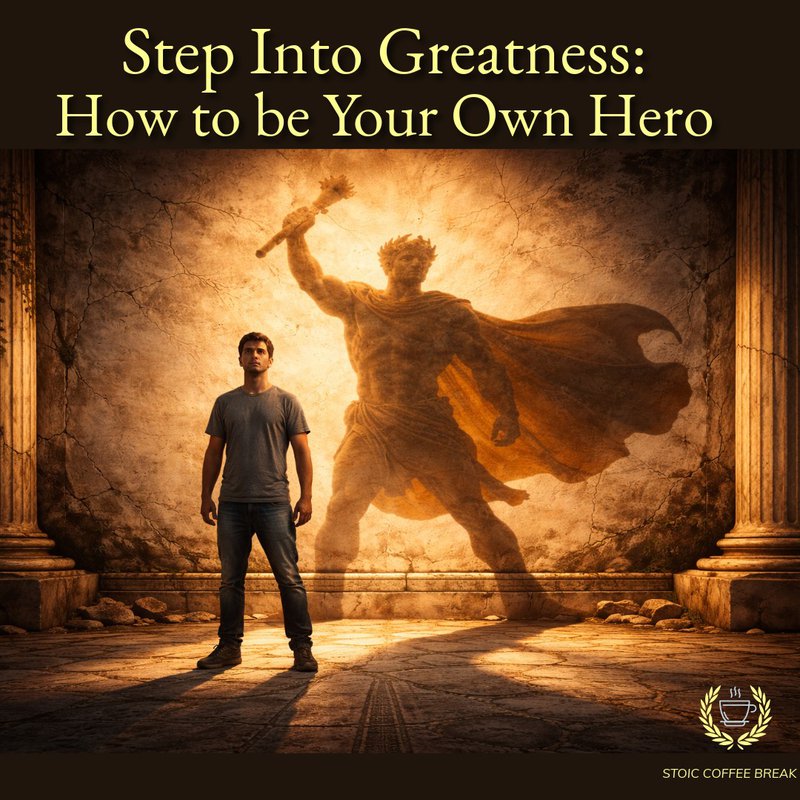
Are you living the life you want? Are you waiting for something to happen to push you into becoming the hero of your own story? In this episode I want to talk about why we fear stepping into greatness, and how you can be your own hero.
“Every difficulty in life presents us with an opportunity to turn inward and to invoke our own submerged inner resources. The trials we endure can and should introduce us to our strengths…Dig deeply. You possess strengths you might not realize you have. Find the right one. Use it.” — Epictetus
In countless hero's journey stories, the protagonist is dissatisfied but paralyzed. Luke Skywalker stares at twin sunsets, dreaming of adventure but staying on the farm. Frodo knows the Shire feels small but needs Gandalf to literally force the ring into his hands. They see the life they want but wait for their world to burn before stepping into it.
We do the same thing. We know we're capable of more, but we wait. We wait for the layoff, the divorce, the health scare, the crisis that makes the decision for us. The Stoics would ask: Why do we need permission from catastrophe to live courageously?
Part 1: Why We Hesitate to Step Into Greatness
1. Loss Aversion – The Devil You Know
Behavioral economist Daniel Kahneman demonstrated that we experience losses roughly twice as intensely as equivalent gains. Your mediocre job that pays the bills feels like safety; the entrepreneurial dream feels like risk. But here's the Stoic twist: you're already losing something every day you don't pursue what matters. You're losing time, potential, and what Marcus Aurelius called your "duty to the divine within."
Marcus Aurelius:
"People who labor all their lives but have no purpose to direct every thought and impulse toward are wasting their time—even when hard at work." — Marcus Aurelius, Meditations 2, 7
We think we're preserving something by staying put, but we're actually experiencing a slow-motion catastrophe – the catastrophe of an unlived life. Seneca is brutal about this:
"It is not that we have a short time to live, but that we waste a lot of it. Life is long enough, and a sufficiently generous amount has been given to us for the highest achievements if it were all well invested." —Seneca, On the Shortness of Life
The Illusion of Control
We convince ourselves we have control over our current circumstances. You think: "I know this job. I know how to navigate this relationship. I know what to expect." But Epictetus would remind us that external circumstances are never truly in our control anyway. You could be laid off tomorrow. The company could restructure. The relationship could end regardless of your maintenance efforts.
The only thing you truly control is your choice – your prohairesis. And by refusing to choose courageously, you've already made a choice.
Example: Think about someone staying in a job they've outgrown because it's "stable." They know they want to develop new skills, start something, take a risk. But they calculate: "I have the mortgage, the car payment, maybe one more promotion coming." Meanwhile, their industry is shifting, their skills are becoming obsolete, and they're less employable every year they stay. The "safe" choice is actually accumulating hidden risk, but it feels safer because it's familiar.
2. The Comfort of Victimhood (Waiting to Be Forced)
The Safety of Necessity
There's a psychological escape hatch in waiting for catastrophe. If you're forced into action—laid off, divorced, diagnosed—then you're responding to circumstances. You're not choosing boldly; you're adapting to necessity. The ego stays protected. You get to say, "I had no choice."
But as Epictetus teaches:
"No man is free who is not master of himself." — Epictetus
Waiting to be forced isn't freedom—it's a different kind of prison.
The Victimhood Bargain
Brené Brown's research on vulnerability shows that we often prefer the familiar discomfort of victimhood to the uncertain discomfort of agency. Being a victim of circumstances means:
- You don't have to face the fear of failure
- You don't have to risk discovering your limits
- You get sympathy instead of accountability
- You can blame external forces rather than confront internal resistance
But there’s a cost to staying a victim. According to Brené:
"Squandering our gifts brings distress to our lives. As it turns out, it's not merely benign or 'too bad' if we don't use the gifts that we've been given; we pay for it with our emotional and physical well-being. When we don't use our talents to cultivate meaningful work, we struggle. We feel disconnected and weighted down by feelings of emptiness, frustration, resentment, shame, disappointment, fear, and even grief." — Brené Brown
When we don’t step up and try to live to our potential then we trade the comfort of what we know for the greatness of what we could be. When we wait for life to shape us, and life will, we miss out on choosing the life we want.
Marcus Aurelius reminds us:
"You have power over your mind—not outside events. Realize this, and you will find strength." — Marcus Aurelius
The Stoics weren't dismissing that bad things happen. They were pointing out that your response is where your power lives. Waiting for catastrophe to decide for you is giving away the only power you actually have.
Example: Someone unhappy in their relationship who waits for it to become so unbearable that leaving feels justified. They're waiting for their partner to do something "bad enough" to make the decision for them. Meanwhile, both people are trapped in a dying connection, neither stepping up to have the courageous conversation or make the hard choice.
As Seneca wrote:
"Most powerful is he who has himself in his own power." — Seneca
The power to name the truth, to act with integrity, to choose consciously.
3. Identity Attachment – Who You'll Have to Stop Being
The Identity Crisis
Your current life, even the parts you don't like, forms your identity. "I'm the person who has this job." "I'm the one who handles everything." "I'm the stable one." To step into greatness often means killing that identity, and identity death feels like actual death to the ego.
Viktor Frankl observed in the concentration camps that those who survived had learned to detach their sense of self from their circumstances. He wrote:
"Everything can be taken from a man but one thing: the last of the human freedoms—to choose one's attitude in any given set of circumstances." — Viktor Frankl, Man’s Search for Meaning
The Sunk Cost of Self
You've invested years building this version of yourself. The friends who know you this way. The family who expects this from you. The self-image you've constructed. The Stoics would say you're confusing your circumstances with your essential self.
Epictetus: "If you wish to be a writer, write." Not "wait until you have permission" or "wait until you feel ready" or "wait until it's safe." Just be the thing.
The Role Trap
We mistake our roles for our identity. Parent, employee, provider, caretaker. These are things you do, not who you are. But we grip them tightly because they're how we and others define us. "Hero of your own story" isn’t an identity you have until you do it. It's undefined. That ambiguity is terrifying.
Example: A parent who has organized their entire identity around sacrifice for their children. When the kids grow up, rather than rediscover themselves, they find new things to sacrifice for, new ways to maintain the identity of "the one who gives everything for others." Stepping into their own heroic life would require admitting they have needs, desires, dreams separate from caregiving. It would require becoming someone new.
Marcus Aurelius, emperor of Rome, constantly reminded himself: "Nowhere can man find a quieter or more untroubled retreat than in his own soul." Your true self isn't your role. It's deeper than that.
Part 2: The Stoic Path to Becoming Your Own Hero
Practice 1: The "Present Hero" Principle
Don't wait for permission from catastrophe. Ask: "What would the hero of my story do right now?"
Not:
- After the crisis
- When I'm ready
- When it's safe
- When I have more money/time/courage
Today. In the next hour. Right now.
Stoic Foundation: Marcus Aurelius:
"Think of yourself as dead. You have lived your life. Now take what's left and live it properly." — Marcus Aurelius
The Stoics understood that "someday" is a fantasy. There is only this moment and what you choose to do with it.
Practical Application: Each morning, ask yourself: "If I were living heroically today, what would be different?" Then identify one small action aligned with that vision. Not the whole transformation. One choice. One conversation. One hour spent differently.
Example: You dream of writing a book but wait for "enough time." The hero version of you would write for 20 minutes before work today. That's it. Not quit your job and write full-time. Just 20 minutes. The catastrophe-waiting version plans to write "when I retire" or "when things settle down." The present hero writes today.
Practice 2: Premeditatio Malorum (Negative Visualization for Clarity)
The Exercise: Instead of vaguely fearing loss, examine it directly. The Stoics practiced premeditatio malorum (”premeditation of evils”)—visualizing worst-case scenarios—not to become pessimistic but to remove fear's power.
Three Questions:
- What specifically would I lose by pursuing greatness?
- Write it down. Be honest. Money? Status? Certain relationships? Comfort?
- What am I already losing by not pursuing it?
- Time. Energy. Self-respect. The feeling of being alive. Your "one wild and precious life" as Mary Oliver called it.
- If I died today, would this choice matter?
- Marcus Aurelius: "You could leave life right now. Let that determine what you do and say and think."
Stoic Wisdom: Seneca: "We suffer more in imagination than in reality." Most of what we fear about change never happens. And what does happen, we're usually capable of handling.
Epictetus: "Make the best use of what is in your power, and take the rest as it happens." You don't control outcomes. You control whether you act with courage and integrity.
Example: Someone afraid to leave corporate work for freelancing. What would they lose? Steady paycheck, health insurance, office friendships, clear identity. What are they already losing? Autonomy, creative fulfillment, time with family, mental health from stress, their most energetic years doing work they don't believe in. If they died next year, which loss would matter more?
Practice 3: The Dichotomy of Courage (Outcome Independence)
Heroism isn't about guaranteed success. It's about living according to your values regardless of external outcomes. This is pure Stoicism—the dichotomy of control applied to courage.
You Don't Control:
- Whether you succeed
- Whether others approve
- Whether the market cooperates
- Whether you "win"
You Do Control:
- Whether you act courageously
- Whether you live with integrity
- Whether you show up fully
- Whether you try
Marcus Aurelius admonished himself:
"Do external things distract you? Then make time for yourself to learn something worthwhile; stop letting yourself be pulled in all directions. But make sure you guard against the other kind of confusion. People who labor all their lives but have no purpose to direct every thought and impulse toward are wasting their time." — Marcus Aurelius, Meditations
The purpose isn't the outcome. The purpose is to live as a certain kind of person—courageous, intentional, free.
Example: An artist who creates not for gallery success but because creating is part of their essential nature. They're freed from the catastrophe-waiting pattern because they're not waiting for external validation to give them permission. They're already living heroically every time they sit down to work.
Practice 4: The Monthly "Failure Quota"
Most hero's journey stories skip over the part where the hero fails repeatedly. They montage it. But real heroism involves failing forward. Set a monthly quota: "I will fail at least three times this month at something that matters."
Why This Works:
- It reframes failure as evidence of courage rather than evidence of inadequacy
- It forces you to take risks rather than waiting for catastrophe
- It builds resilience through practice, not through trauma
Epictetus taught that obstacles are training:
"Difficulties are things that show what men are." — Epictetus
You don't become the hero by waiting for one big forced moment. You become the hero through accumulated small choices to act despite fear.
Example: Pitch three articles that might get rejected. Have three difficult conversations. Try three new approaches in your work. The goal isn't success—it's action. As Seneca wrote:
"It is not because things are difficult that we do not dare; it is because we do not dare that they are difficult." — Seneca
Closing: The Catastrophe Is Already Here
Here's what the Stoics understood: The catastrophe you're waiting for is already happening. Every day you don't step into your heroic life is a day lost. Every morning you wake up and choose safety over significance is a small death.
Marcus Aurelius:
"Remember how long you've been putting this off, how many extensions the gods gave you, and you didn't use them. At some point you have to recognize what world it is that you belong to; what power rules it and from what source you spring; that there is a limit to the time assigned to you, and if you don’t use it to free yourself it will be gone and will never return." — Marcus Aurelius, Meditations
You don't need your life to be destroyed to start living courageously. You need to recognize that waiting is the destruction.
The question isn't "What would I do if I had to?" The question is: "What will I do because I choose to?"
Be your own hero. Not someday. Today.
Train your mental toughness in the Build an Unbreakable Mind program!
My book Stoicism 101 is available! Order here!
Find out more at https://stoic.coffee
Watch episodes on YouTube!
Find me on linkedIn, instagram, or threads.
Thanks again for listening!