
What if the thing you've been quietly doing your whole life — the thing that feels almost too easy to count — is actually your greatest gift to the world?
And what would it cost you to keep holding it back?
I want to start today with a quote that I came across a few months ago. I was down in Grants Pass in southern Oregon, and I bought a candle at a shop. As part of that, the owner had me choose a quote from a basket. And it was a good. It's from the writer Brendan Francis, and it goes like this:
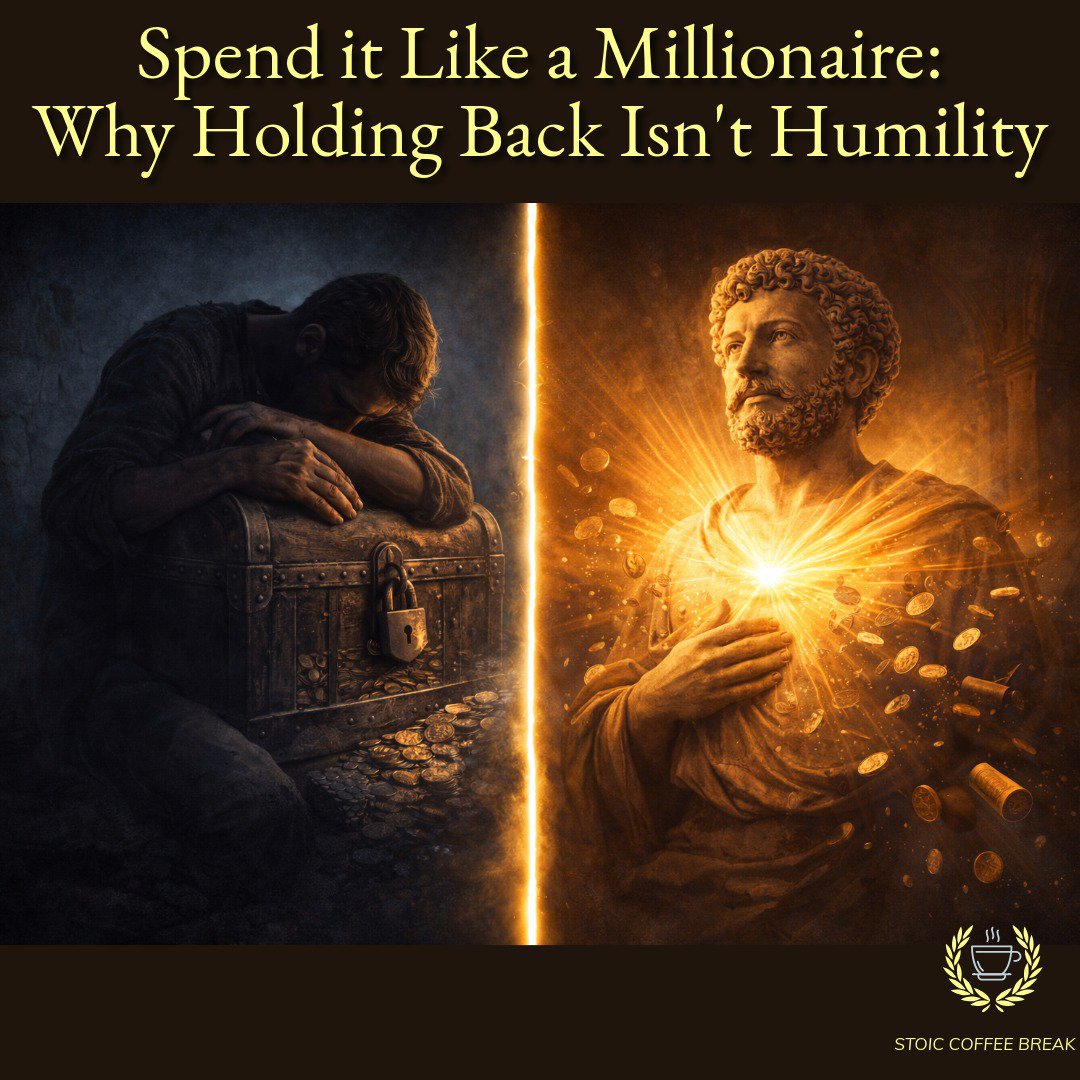
"If you have a talent, use it in every which way possible. Don't hoard it. Don't dole it out like a miser. Spend it lavishly like a millionaire intent on going broke." — Brendan Francis
A millionaire intent on going broke. That image has really hit me, and I think there's something profound in it — something that connects directly to what the Stoics were teaching two thousand years ago.
Today we're going to talk about talent. Not talent in the narrow, Olympic sense — not the kind that needs a credential or an audience to count. We're going to talk about what the Stoics called your fitted function — the particular way you're suited to engage with the world — and why holding it back isn't caution. It's a quiet betrayal of yourself.
Let's get into it.
Act One: The Problem
The Disqualification Trap
Most of us have already ruled ourselves out before the conversation even begins. We carry a definition of talent that's essentially Olympic. Rare. Credentialed. Publicly impressive. You're talented if you've published a book, or performed on a stage, or built something everyone can point to. Anything that doesn't clear that bar — anything that feels ordinary, or easy, or just… the way you've always been — doesn't count.
And so we say things like: "Oh, I'm not really talented at anything special." Or: "I'm still figuring out what my thing is." Or the one I hear most often — from coaching clients, from listeners, honestly from myself at different points — "I'll really start when I'm ready."
These aren't just throwaway phrases. They're a belief system. And that belief system has real consequences.
I think about how many people are sitting on something genuinely valuable — a way of thinking, a gift for connection, a capacity to see what others miss — and they've simply decided it doesn't qualify. They've disqualified themselves before they ever stepped onto the field.
And here's what I want you to hear: that disqualification is not humility. It's not wisdom. It's fear wearing the costume of modesty.
Because think about what the miser in Brendan Francis's quote is actually doing. He's not hoarding the gold because he doesn't value it. He hoards it precisely because he does. He's terrified of losing it. Of spending it and having nothing left.
We do the same thing with our gifts. We hold back not because they're not worth giving — but because full expression is terrifying in a very specific way. If I give everything and it still isn't enough, I have nothing left to blame. The holding back is protective.
And Seneca saw through this with almost brutal clarity. He wrote: “Dum differtur vita transcurrit.”
“While we are postponing, life speeds past." — Seneca
While we are deferring and waiting. While we are saving ourselves for the right moment that never quite arrives.
Unused talent doesn't wait patiently in a vault. Over time, it curdles. What starts as hesitation becomes a habit of holding back. And what starts as a habit becomes, eventually, regret.
The savings account isn't just locked. Most of us don't even believe we made a deposit.
ACT TWO — THE PHILOSOPHY
Expanding the Definition
So let's talk about what talent actually is. Because I think the Stoics had something much more interesting to say about this than our modern definition allows.
The Stoics didn't really use the word talent the way we do. They had a concept called kathêkon — your appropriate function, your fitted role. And it's richer than talent, because it's not just about what you're skilled at in a measurable way. It's about what you're suited for. Your particular nature — your way of seeing, thinking, engaging with the world — brought fully into contact with your life.
Marcus Aurelius put it simply in his Meditations:
"A man's true delight is to do the things he was made for." — Marcus Aurelius
And he extended this into the natural world, in a way that I find genuinely beautiful. He would observe that the vine lives to bear fruit. The sun lives to give light. A fig tree doesn't decide to grow half a fig to protect itself. Nature fulfills itself completely — or it isn't fully nature at all. For Marcus, we are no different. To live below your fitted function isn't caution. It's a violation of your own nature.
By this framework, talent isn't a peak performance. It's a pattern.
It's something you do more naturally than most — and often so naturally, you've stopped counting it as anything special. The things that come easiest to you are, paradoxically, the hardest to recognize as gifts. You don't experience them as extraordinary. You experience them as obvious.
Maybe Of course you'd think about it that way. Of course you noticed that. Of course knew what to say in that moment.
Except — other people don't. Other people are working hard at the thing that costs you almost nothing.
So here are the signs to look for. And I want you to actually sit with these:
What do people consistently thank you for, compliment you on, come to you for — that you always brush off? The ones where you say, "oh, it was nothing" — because to you, it genuinely felt like nothing.
What do you do effortlessly while you watch others visibly struggle with the same thing?
What do you keep returning to even when no one is watching, no one is paying you, and nothing is at stake?
What would you do if it didn't count?
There's a story about Marcus Aurelius that illuminates this perfectly. He was Emperor of Rome — the most powerful man in the known world. He had every conceivable reason to spend his early mornings on statecraft, military planning, the business of empire. Instead, historians record that he rose before dawn — often while on military campaigns in the cold northern territories — to write. Not policy. Not orders. Philosophy. Private reflections, never intended for publication, wrestling with how to be a better human being.
What we now call Meditations was his pre-dawn practice for years. Written for an audience of one.
That's the tell. He couldn't not do it. That is what your kathêkon looks like.
Exploration
Sometime we just need to try something that appeals to us. We often talk ourselves out of it because we don’t think we have the skills. But until you try it and work on it, you’ll never know if you would be good at it. You’ll never know how much you might like it.
In my own life, I never dreamed that I would host a podcast. I didn’t think I was going to be very good at it. I just started it because it sounded interesting. And in the beginning it wasn’t very good. But it was fun, and I did see that I was getting better, and that I was helping others by trying to teach the things that I was learning.
And even though I took a break from the podcast, well, two breaks, I kept returning to it. I would work through some problem or read something that really impacted my life, and I just had to share it. I couldn’t stay away from creating episodes for the podcast.
It was also through working on my podcast that I found that I had a skill for writing. Sitting down and creating these episodes sharpened my writing skills and eventually I was approached by a publisher. The process of writing my first book, Stoicism 101, also improved my ability to write.
Epictetus said it simply: “If you wish to be a writer, write.”
You don’t get better hoarding or hiding your talent. You get better by doing and sharing it.
Finding Proof
Once you see what you actually have — once you recognize the pattern — the question shifts entirely. Now it's no longer "do I have a gift worth giving?" Now the question is: what exactly is the excuse for holding it back?
This is where Seneca arrives, and he is not gentle about it.
In his essay On the Shortness of Life — which is one of the most urgent pieces of writing I've ever encountered — he says something that has stayed with me since the first time I read it:
"It is not that we have a short time to live, but that we waste a good deal of it." — Seneca
He wasn't being pessimistic. He was being precise. Life isn't short. The living is what we're rationing. There's no future moment when you'll finally be ready enough, safe enough, certain enough. That moment is a fiction we tell ourselves to make the holding back feel reasonable. This moment is the only real one.
But if Seneca is the intellectual argument for urgency — Epictetus is the living proof that it's possible.
I want to tell you about Epictetus, because his life is one of the most extraordinary demonstrations of this principle that history has given us.
Epictetus was born into slavery, in Hierapolis — what is now modern-day Turkey — around 50 AD. He was owned by a powerful freedman in Nero's court named Epaphroditus. There is a story that has come down through the centuries: his master once twisted his leg — either as punishment or simply to demonstrate his power. Epictetus, by the accounts we have, said calmly: "You will break it." And when it broke, he said: "Did I not tell you that you would break it?" He walked with a limp for the rest of his life.
He controlled almost nothing about his own existence. His body. His location. His daily circumstances. All of it was someone else's to determine.
And yet. He found the one channel available to him — thought, conversation, teaching — and he poured everything into it. Everything. Without reservation. Without waiting for circumstances that were worthy of his gifts. Without the protection of holding back.
He was eventually freed. He founded a school in Nicopolis and taught for decades. He never wrote a single word himself — everything we have comes from his student Arrian, who essentially took notes because he couldn't bear for the world to lose what Epictetus was giving away so freely.
Two thousand years later, his Discourses are still changing lives. Soldiers have carried them into battle. Viktor Frankl drew on this tradition while imprisoned in a Nazi concentration camp. The teachings are alive and working in the world right now — because one man, who had almost everything taken from him, refused to ration the one thing that couldn't be taken.
He didn't wait for perfect circumstances. He brought his full gifts to the circumstances he had.
Now here's what I want you to sit with. Because this is the thing that makes this more than just an inspiring story: Unlike money, talent doesn't deplete when you spend it. It compounds.
Every act of full expression — every time you bring your complete self to something, rather than the carefully managed, rationed version — reveals more capacity than you knew was there. Writers who write every day don't run out of ideas. They generate more. Teachers who give everything to their students don't empty out. They deepen. The millionaire intent on going broke discovers, every single morning, that the account has somehow refilled overnight.
This isn't just an inspiring metaphor. This is how creativity, skill, and human expression actually work. The act of giving your gift away is also the act of growing it.
Marcus understood this. He didn't write the Meditations in spite of his demanding life as Emperor and military commander. He wrote them because of it. The more he gave of his philosophical thinking — to himself, to his practice, to the page — the more he had to draw from when empire required wisdom rather than just power.
You cannot go broke with this currency.
ACT THREE — THE PRACTICE
So this week, I want to offer you two paths. Take the one that fits how you're wired — or take both.
For the Reflective: The Recognition Journal
Set aside ten quiet minutes — before the day starts if possible, which I think Marcus would appreciate. And answer these three questions as honestly as you can, without editing or minimizing what comes up.
First: What do people thank me for, compliment me on, or come to me for — that I always deflect or minimize?
Second: What do I do that others seem to find genuinely difficult, that I barely notice doing?
Third: If no one was watching, nothing was at stake, and it didn't "count" — what would I still do anyway?
Don't rush past what surfaces. The thing that feels too small or too obvious is almost certainly the thing worth looking at. Remember: Marcus didn't think his pre-dawn philosophical writing was remarkable. He thought it was just what he did. Your kathêkon will likely feel the same way.
For the Experiential: One Act of Lavish Spending
Think of one specific area in your life right now where you know — honestly know — you've been operating at half-capacity. Holding back. Rationing yourself.
Maybe it's a conversation you've been having at sixty percent because you don't want to overwhelm someone. Maybe it's a creative project you keep approaching carefully instead of fully. Maybe it's a skill you keep intending to bring more of to your work, but somehow never quite do.
This week — not perfectly, not dramatically — just more lavishly than yesterday. Bring more of your actual self to that one thing.
Think of Epictetus. He didn't wait for freedom to give everything. He gave everything as a slave, through the one channel available to him.
What's your one channel this week?
Conclusion
The Stoics didn't frame this primarily as generosity toward the world — though it is that. They framed it as being true to your own nature. Living any smaller than what you're fitted for isn't modesty. It's a quiet betrayal of yourself. Marcus called it a failure to live according to nature — and for him, that was among the most serious failures possible.
The miser doesn't hoard because he doesn't value the gold. He hoards because he's afraid of losing it. But you cannot lose this. You cannot go broke with this currency. Every act of full expression only adds to what's available.
Remember, a freed slave sitting in a modest school in northern Greece spoke without notes, without ego, without holding anything back — and his student Arrian wrote as fast as he could, trying to capture what was being given away so freely.
Two thousand years later, you're still receiving it.
That is the invitation this week. Not to be impressive. Not to be ready. Just to stop pretending you have nothing to give — and start spending like someone who finally understands they can't go broke.
The Build an Unbreakable Mind program for building mental discipline is now open for enrollment!
My book Stoicism 101 is available! Order here!
Find out more at https://stoic.coffee
Watch episodes on YouTube!
Find me on linkedIn, instagram, or threads.
Thanks again for listening!