How do you make a decision when all the choices in front of you feel like bad ones? Today I want talk about how Stoicism can help us take action when faced with impossible choices.
Act 1: The Problem
“What should we have ready at hand in a situation like this? The knowledge of what is mine and what is not mine, what I can and cannot do.”— Epictetus, Discourses I, 1.21
I had a coaching call this week that I haven’t been able to stop thinking about.
My client — a business owner who has built something real over the past several years — came to the call not panicking. That’s what struck me first. She was past panic. She was in that quieter, heavier place where someone has already done the math and doesn’t like any of the answers. The economy is shifting beneath her feet. AI is reshaping her industry. And every option in front of her feels like choosing which bone to break.
She said something that I think a lot of people are feeling right now but haven’t found the words for: “I’m not stuck because I don’t know what to do. I’m stuck because every path forward requires giving something up that I worked incredibly hard to build.”
That’s what real overwhelm sounds like. Not dramatic. Grinding. And it’s exactly the kind of moment the Stoics were built for.
The Sunk Cost Trap
There’s a specific psychological phenomenon that was making her situation worse, and it has a name: sunk cost fallacy. It’s the tendency to keep investing in something — time, money, identity, effort — because of what you’ve already put in, rather than what the future actually holds. She built something. She sacrificed for it. Walking away from any version of it feels like saying all of that didn’t matter.
But here’s the cruel irony: the more you’ve invested, the harder it is to see clearly. The past becomes a lens that distorts the present. And I could see that happening in real time on that call.
She’s not alone in this. Entire industries are facing this right now. AI isn’t coming — it’s here. Political and economic instability isn’t a blip — it’s a condition. Millions of people are sitting with exactly this kind of decision: not “how do I succeed?” but “which version of loss can I live with?” The Stoics would recognize this moment immediately. They lived inside collapse. And they left us a roadmap.
Act 2: The Philosophy
The Stoics Knew Disruption
Marcus Aurelius didn’t rule during Rome’s golden age. He ruled during plague, war, economic strain, and constant political betrayal. Epictetus was a slave — every single decision he made happened inside a life where the external circumstances were largely terrible. Seneca watched Nero’s reign destabilize everything he’d built. These weren’t philosophers writing from comfort. They were practitioners of clarity inside chaos.
What they developed wasn’t optimism. It was something more useful: a framework for making good decisions when the conditions are bad.
The Dichotomy of Control
Epictetus opens the Enchiridion with perhaps the most important sentence in Stoic philosophy:
“Some things are in our control and others not. Things in our control are opinion, pursuit, desire, aversion, and, in one word, whatever are our own actions. Things not in our control are body, reputation, command, and, in one word, whatever are not our own actions.”
As I listened to my client, I kept coming back to this. AI disruption: not in her control. The economy: not in her control. What her competitors do: not in her control. Her response, her character, her next deliberate action: entirely in her control. This isn’t dismissive of the difficulty — it’s clarifying about where her energy should actually go.
The Past Is Already Gone
Marcus Aurelius writes in the Meditations:
“Confine yourself to the present.”
And elsewhere:
“Never let the future disturb you. You will meet it, if you have to, with the same weapons of reason which today arm you against the present.”
The sunk cost fallacy is, at its root, a refusal to let the past be past. Every hour she spent calculating what she’d already lost was an hour she was living in something that no longer exists. The Stoics weren’t cold about this — they understood loss. But they were clear that the past has no vote in what happens next.
Grief Before Decision
This is where I think the standard reading of Stoicism falls short — and where I had to gently push back with my client. Traditional readings would say: acknowledge the dichotomy of control, release the sunk cost, move forward. And that’s not wrong — but it’s incomplete.
What she was experiencing wasn’t just a logic problem. It was grief. She was grieving the business she believed she was building. She was grieving a future she’d planned for. And I can see that until that grief is acknowledged — not suppressed, not bypassed — she isn’t going to be able to think clearly about any of it.
Brené Brown writes in Daring Greatly:
“When we deny our emotion, it owns us. When we own our emotion, we can rebuild and find our way through the pain.” — Brené Brown, Daring Greatly
Her research aligns directly here: unprocessed emotion doesn’t disappear, it goes underground and starts making decisions for you. The sunk cost fallacy is often grief in disguise — we can’t let go because we haven’t actually mourned what we’re losing.
Real Stoic strength isn’t powering through the feeling. It’s having the courage to actually feel it, name it, and then — only then — think from a clearer place.
Virtue Over Outcome
Here’s the Stoic reframe that I think changes everything about “least worst options.” Marcus Aurelius writes:
“You have power over your mind, not outside events. Realize this and you will find strength.”
The Stoics didn’t measure a good decision by whether it produced a good outcome — they measured it by whether it was made virtuously. With wisdom, with courage, with justice, with temperance. A decision made with clarity and integrity, even if the result is painful, is a good decision. A decision made from panic, attachment, or avoidance, even if it accidentally succeeds, is a poor one.
When I shared this with my client, something shifted. She didn’t need to find the good option. She needed to find the virtuous one — the one she could make with her eyes open, her values intact, and her focus on what she could actually control.
Act 3: The Practice
Step One: Name the Grief
The first thing to do in a situation like this — before any strategic thinking — was to honestly name what is being lost. Not catastrophizing. Just honest accounting. “I built this for years. I believed in this future. That future is no longer available, and that is genuinely painful.”
You cannot think clearly from inside unacknowledged grief. This step isn’t weakness — it’s the precondition for clear thinking. This is seeing things as they actually are, including the painful things, rather than turning away.
Step Two: Draw the Circle
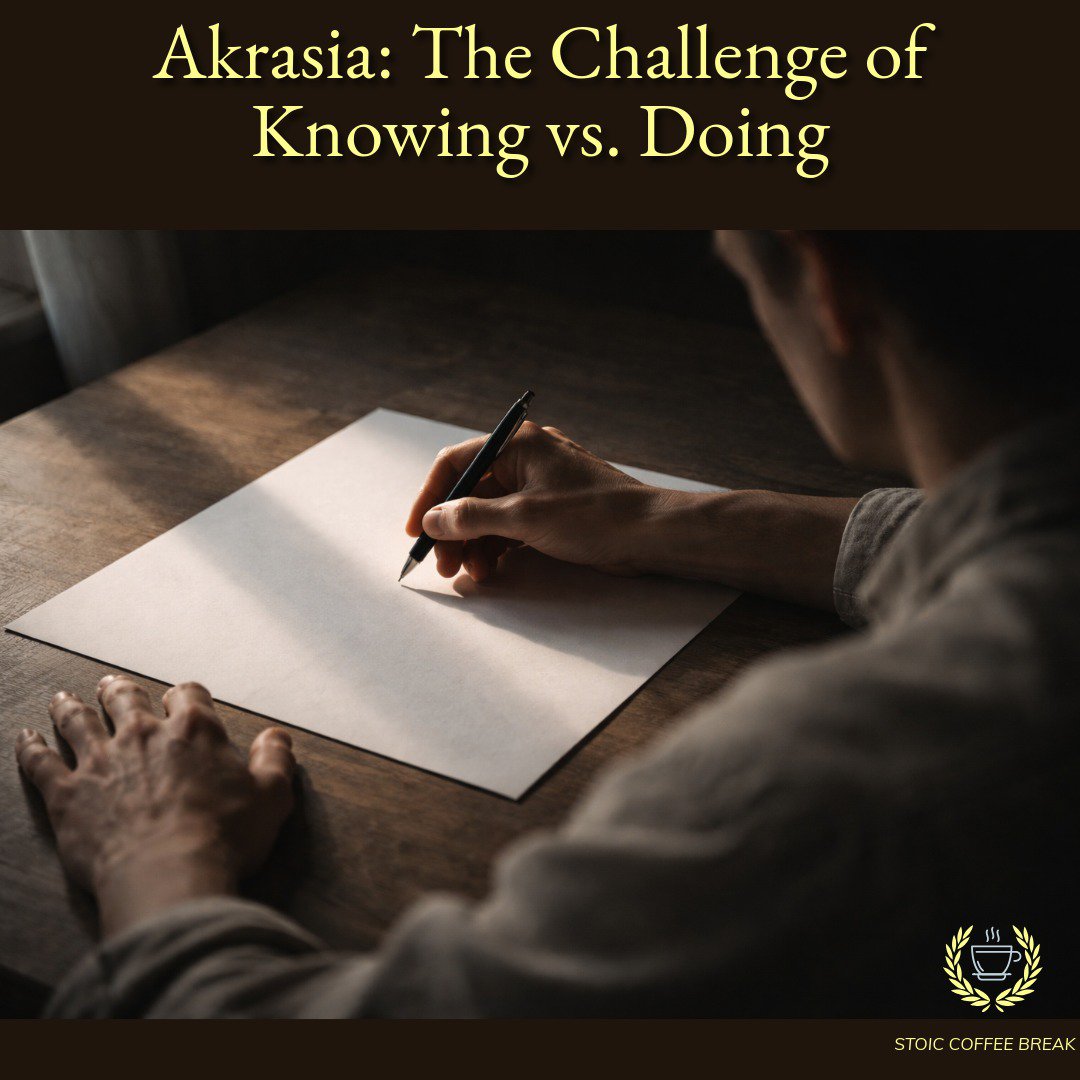
Take a piece of paper and draw two circles — one inside the other. In the outer circle, write everything about your situation that is outside your control: the economy, AI, competitors, policy changes, what has already happened. Get it all out.
In the inner circle, write only what you can actually influence: your response, your next action, how you show up, what you choose to prioritize, the values you bring to the decision.
Then — only work from the inner circle. Everything in the outer circle gets acknowledged and set down. This is what I walked my client through, and watching her physically write those things into the outer circle and then turn her attention away from them was one of those coaching moments that stays with you.
Step Three: The Present Moment Question
Marcus Aurelius, managing simultaneous empire-scale crises, didn’t solve everything at once. He returned again and again to one question: what is the right action available to me right now?
Not next year. Not the five-year plan. Right now. This week. What is the one decision — not all the decisions, just the next one — that can be made with clarity and integrity? The Stoics called this kathêkon: the appropriate action in this moment, given these circumstances. Not the perfect action. The appropriate one.
Step Four: Redefine What a Good Decision Looks Like
Stop measuring your decision against the outcome you wanted before things changed. That outcome is no longer the benchmark — it’s part of what you’re grieving. Instead, ask: can I make this decision with honesty about the situation as it actually is? Can I make it from my values rather than my fear? Can I look back in a year and say I chose with integrity, even though the circumstances were painful?
If yes — that’s a good decision. Regardless of how it turns out.
Step Five: Act Small, Act Now
Seneca writes:
“We suffer more in imagination than in reality.”
Overwhelm thrives in abstraction. The antidote is a specific, small, concrete next action. Not “figure out the business model.” Maybe it’s “have one honest conversation with my most important client this week.” Not “decide whether to pivot.” Maybe it’s “spend two hours researching what the pivot would actually require.” Momentum is built from motion, not from certainty, and what you need is that next action. Just one. That was enough.
Conclusion
My client isn’t weak. She’s not failing. She’s experiencing what the Stoics would recognize as a genuinely hard moment — the kind that has always existed, that has always asked something of us that feels like more than we have.
But here’s what I keep coming back to on that call: the difficulty of the decision is not evidence that she’s doing something wrong. It’s evidence that she’s someone who built something real, who cares deeply, and who is now being asked to demonstrate a different kind of strength than the one that got her here.
The strength that builds a business is vision, drive, and commitment. The strength that navigates a crisis is clarity, honesty, and the willingness to grieve what was while choosing well about what comes next.
Marcus Aurelius wrote:
“The impediment to action advances action. What stands in the way becomes the way.”
She doesn’t need the wreckage to clear before she can move. She needs to find the virtuous path through the wreckage. And I think that’s true for anyone sitting with an impossible decision right now. That path — as it always has been — runs directly through what you can control, what you value, and the single next right action available to you today.
That’s not a least worst option. That’s Stoic strength.
Want to talk your life to the next level? Let’s talk!
My book Stoicism 101 is available! Order here!
Find out more at https://stoic.coffee
Watch episodes on YouTube!
Find me on linkedIn, instagram, or threads.
Thanks again for listening!